The hum is the first thing you notice. If you stand near the perimeter fence of a hyperscale data center in the high desert of Oregon or the flatlands of Virginia, the sound isn’t a roar. It’s a relentless, low-frequency vibration that feels like it’s happening inside your teeth. This is the sound of the modern world thinking. Every time someone generates an AI-rendered sunset or asks a chatbot to summarize a legal brief, a thousand miles away, a rack of servers screams for more juice.
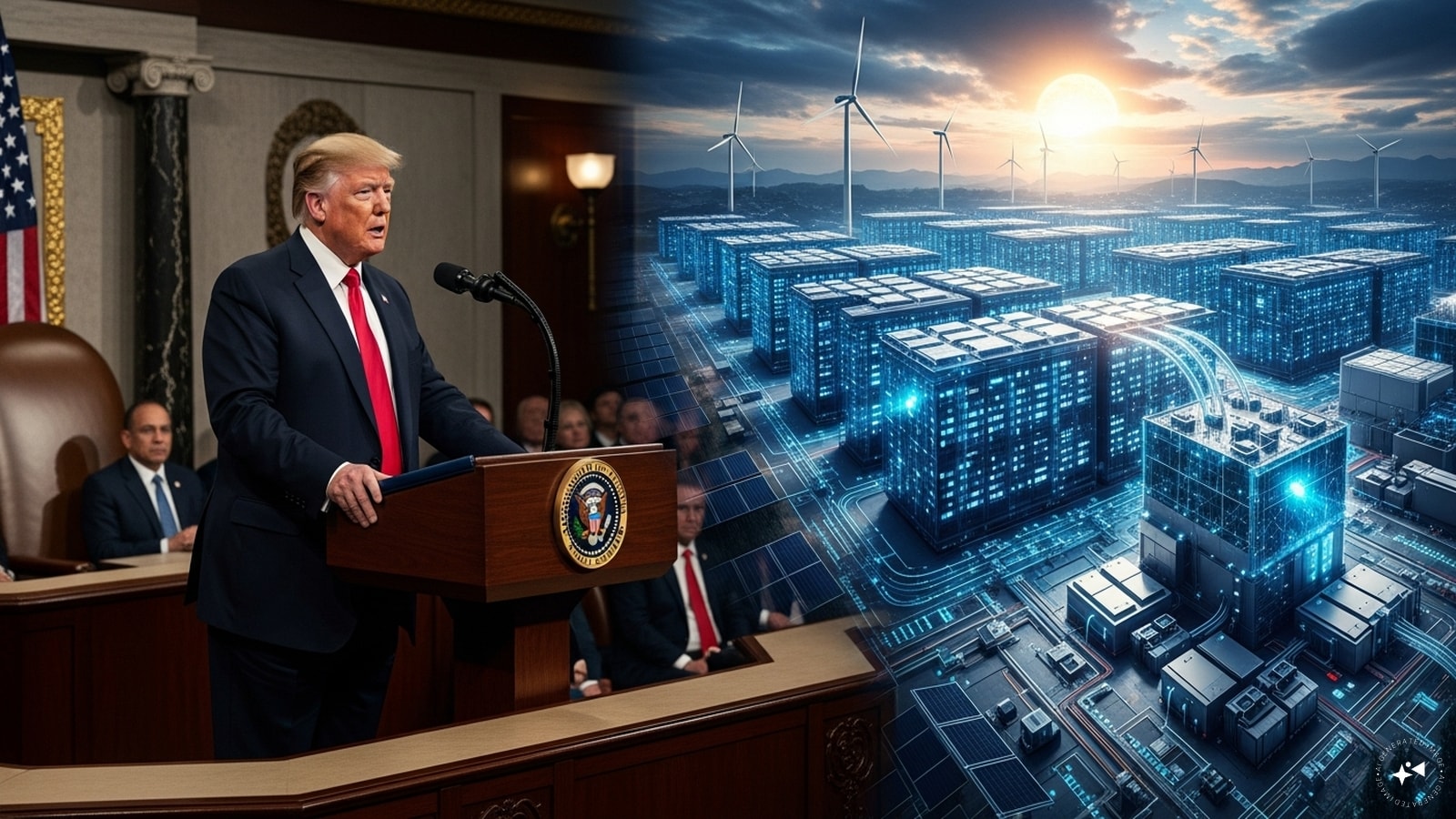
During the State of the Union address, Donald Trump threw a wrench into the gears of this digital expansion. He didn't just mention tech; he laid down a mandate that shifts the entire burden of the future onto the shoulders of the giants. The message was blunt: if Big Tech wants to build the cathedrals of the artificial intelligence age, they have to build the power plants to run them. No more leaning on the aging, flickering public grid. No more taking the neighbors' light to fuel the machine's mind.
It sounds like a dry policy shift. In reality, it is a battle for the physical soul of the country.
The Ghost in the Wires
Consider a woman named Sarah. She lives in a small town where the local utility company just announced a rate hike to fund "infrastructure upgrades." Sarah doesn't own a tech startup. She doesn't use AI to optimize her stock portfolio. She uses her computer to check her bank balance and her stove to cook dinner for her kids. But Sarah is indirectly competing for electrons with the most powerful computers ever built.
When a massive data center plugs into the local grid, it doesn't just pull a little extra weight. It gulps. A single large-scale AI facility can consume as much electricity as hundreds of thousands of homes. Under the previous status quo, the cost of upgrading the wires, the transformers, and the substations to handle that gulp often bled into the monthly bills of people like Sarah.
The President's stance effectively says the free ride is over. By demanding that tech firms "power their own," the administration is forcing a decoupling of the digital gold rush from the local citizen’s utility bill. It’s a move that recognizes a hard truth: we are running out of sparks.
The Physics of a Prompt
To understand why this is happening, we have to look at the sheer heat of the problem. Old-fashioned data centers—the ones that stored your emails and photos in 2015—were like library stacks. They were quiet, organized, and relatively cool. AI is different. Training a large language model is more like running a million jet engines at full throttle for months on end.
The silicon chips required for AI, specifically the high-end GPUs, operate at temperatures that would melt a standard laptop in minutes. They require sophisticated liquid cooling systems, essentially plumbing for the internet. But more than that, they require a constant, unwavering flow of high-voltage current.
In the past, tech companies could promise "carbon neutrality" by buying credits or funding a wind farm three states away. That was a shell game played with paper. The grid doesn't care about credits; it cares about load. When the sun goes down and the wind stops blowing, those servers still need to think. If the tech company hasn't built its own base-load power—think small modular nuclear reactors or massive battery arrays—they have to pull from the coal or gas plants that keep the rest of the city's lights on.
The New Industrialists
This mandate turns software companies into power companies. It forces a return to the era of the 19th-century industrial titans. When Henry Ford built the River Rouge complex, he didn’t just build an assembly line; he built a power plant, a steel mill, and a glass factory. He knew that to control the output, he had to own the input.
We are seeing a mirror of that history today. We are watching the birth of the Sovereign Data Center.
Microsoft, Google, and Amazon are already scouting for retired nuclear sites. They are looking at "behind-the-meter" solutions where the electricity never even touches the public wires. This isn't just about corporate responsibility. It’s about survival. If they cannot secure their own energy, their growth hits a hard ceiling made of copper and lead.
But there is a secondary effect to this "build your own" requirement that few are talking about. It creates a barrier to entry that is almost impossible to climb. If you are a brilliant startup with a new AI architecture, you can no longer just rent space in the cloud and hope for the best. You are now competing in a world where "innovation" means being able to permit and construct a multi-billion dollar energy facility.
The moat around the kings of tech just got a mile wider.
The Fragile Web
The urgency behind this policy isn't just about economics. It’s about national security. Our national grid is a patchwork quilt of 20th-century technology held together by hope and duct tape. It was never designed to handle the "compute" demands of an AI-driven economy.
Imagine a heatwave in the middle of July. The air conditioners are humming in every apartment. The hospitals are running at capacity. Suddenly, a massive AI model begins a "training run" that requires the energy equivalent of a mid-sized city. Something has to give. In the old world, that might mean a brownout for a residential neighborhood. In the new world envisioned by this address, the tech firm’s servers would simply shut down because they aren't allowed to cannibalize the public's share.
It’s a forced discipline. It’s telling the smartest people in the room that they can’t solve their problems by taking from everyone else.
The Nuclear Option
This leads us to the most controversial and fascinating ripple effect of the "power your own" mandate: the rehabilitation of nuclear energy.
For decades, nuclear power was a ghost, a relic of a previous age that we were too afraid to touch. But AI doesn't have the luxury of fear. It needs "firm" power—power that stays on 24 hours a day, 365 days a year. Solar and wind are beautiful, but they are intermittent. They don't satisfy the machine’s thirst at 3:00 AM on a still, cloudy night.
The tech giants are now the biggest lobbyists for the next generation of nuclear technology. They are funding Small Modular Reactors (SMRs) that can be built in a factory and shipped to a site. By forcing these companies to be self-sufficient, the government is inadvertently fast-tracking a nuclear renaissance that thirty years of climate activism couldn't quite achieve. The irony is thick: the quest for artificial minds is what might finally fix our physical energy crisis.
The Human Toll of the Digital Mirage
We often treat AI as if it exists in the "cloud," a word designed to make us think of something ethereal, weightless, and clean. But there is no cloud. There is only someone else's computer, sitting in a hot room, eating electricity and drinking water.
In places like Arizona, data centers have come under fire not just for the power they use, but for the millions of gallons of water required to keep them cool. When the President says these firms must "power their own," the subtext is that they must also "sustain" their own. They must find ways to exist that do not deplete the local aquifer or leave the surrounding town in the dark.
For the average person, this shift is invisible until it isn't. It’s the difference between a stable grocery bill and a skyrocketing one. It’s the difference between a reliable morning commute on an electric train and a grid collapse that leaves a region paralyzed.
A Hard Pivot to Reality
The era of the "move fast and break things" philosophy is hitting a wall made of physics. You can break software without much consequence. You can't break the power grid without people dying.
This policy is a realization that the digital world is finally too big for the physical world to ignore. We have spent twenty years pretending that what happens on our screens stays on our screens. But the cables lead back to the earth. The power comes from the ground. The heat is released into our air.
By demanding that tech companies build their own energy ecosystems, the administration is treating them like the utilities they have become. It is a transition from seeing Big Tech as a collection of clever apps to seeing them as the heavy industry of the 21st century. They are the new steel mills. They are the new oil refineries. And like those industries before them, they must now pay the full price of their footprint.
The machines will continue to learn. They will continue to grow, to calculate, and to simulate. But for the first time, the people running them will have to look at the meter and realize that the cost of an answer isn't just a few cents per kilowatt—it's the responsibility of keeping the lights on for everyone else.
The hum continues, but the bill is finally being delivered to the right address.