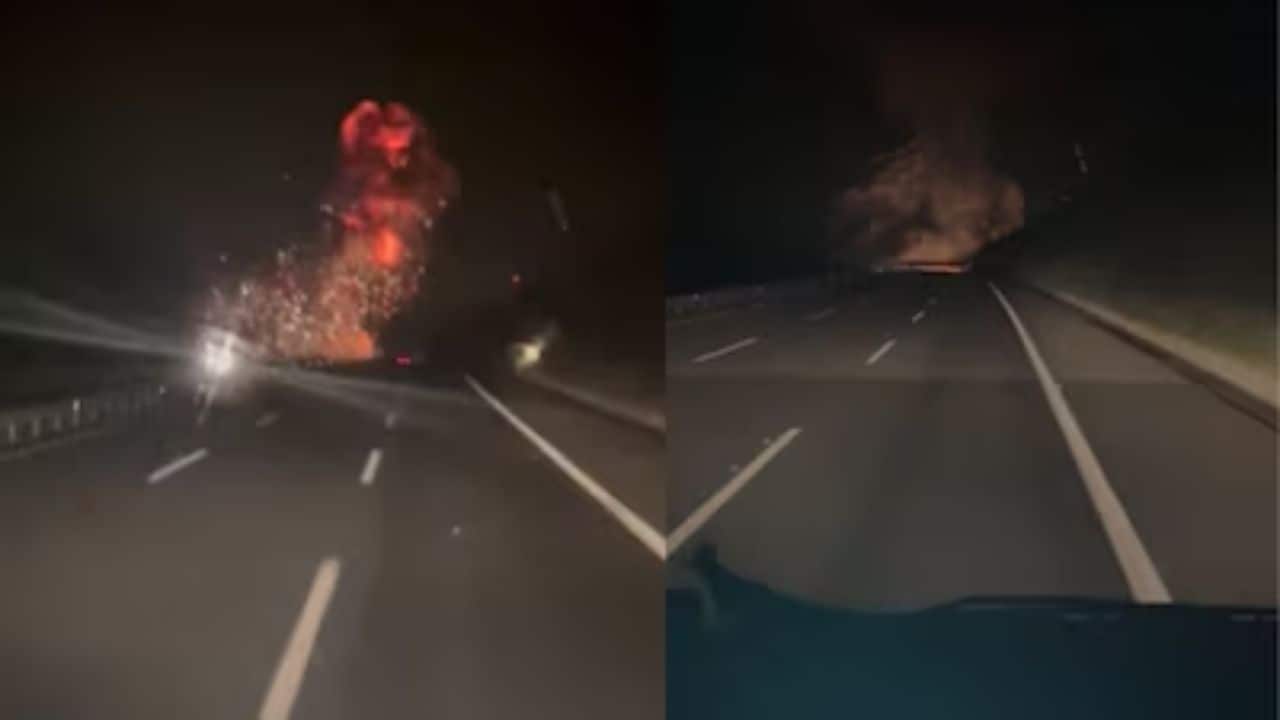
The loss of a Turkish Air Force (TuAF) F-16 Fighting Falcon near a major civilian arterial road represents a critical intersection of mechanical reliability, pilot decision-making under high-stress temporal constraints, and the inherent risks of urban-adjacent military corridors. While early reports focus on the tragic loss of life, a strategic audit of the incident reveals a failure chain that typically begins long before the airframe impacts the ground. To understand this event, one must look past the wreckage and analyze the three specific vectors of aerial failure: the aerodynamic envelope during low-altitude emergencies, the structural integrity of the General Electric F110-GE-129 engine under thermal or foreign object stress, and the human-machine interface during an Egress Decision Window.
The Mechanics of a Low-Altitude Engine Flameout
The F-16 is a single-engine, fly-by-wire platform. This configuration dictates a binary survival outcome during power loss: either the engine relights within the designated altitude block, or the pilot must convert remaining kinetic energy into potential energy (altitude) to buy time for an ejection or an unlikely dead-stick landing.
When a crash occurs near a highway, it suggests the aircraft was likely in a terminal phase of flight—either takeoff or approach—where the "energy maneuverability" is at its lowest. In this regime, an engine failure creates a catastrophic Drag-to-Thrust deficit.
- Compressor Stall Dynamics: If the engine ingested a foreign object or suffered a mechanical fatigue failure in the turbine blades, the resulting "stall" disrupts the high-pressure airflow required for combustion.
- The Glide Ratio Bottleneck: An F-16 has a glide ratio of approximately 1:1, meaning for every 1,000 feet of altitude, it can travel roughly one mile horizontally. At low altitudes, this ratio leaves zero margin for steering away from civilian infrastructure while simultaneously attempting a restart.
- Emergency Power Unit (EPU) Deployment: Upon engine failure, the EPU—powered by toxic hydrazine—must fire to maintain hydraulic pressure for the flight controls. If the EPU fails or the pilot is overwhelmed by task saturation, the aircraft becomes a ballistic object rather than a controllable glider.
The proximity to a highway indicates the pilot was likely attempting to maintain the aircraft's flight path away from populated areas, a choice that directly shrinks the window for a successful ejection.
The Human Factor and the Egress Decision Window
The decision to stay with a failing aircraft is governed by the Egress Decision Window (EDW). This is a psychological and temporal boundary where the pilot must choose between personal survival and the mitigation of collateral damage.
- Spatial Disorientation and Target Fixation: In the seconds following a catastrophic failure, a pilot may fixate on a "clear patch" of land—in this case, the area adjacent to the highway—to avoid hitting motorists. This fixation can delay the initiation of the ACES II ejection sequence.
- The Zero-Zero Capability Myth: While modern ejection seats are "zero-zero" (capable of functioning at zero altitude and zero airspeed), their effectiveness is severely compromised by the aircraft's sink rate and bank angle. If the F-16 was in a descending turn or a high-rate sink, the seat might fire the pilot into the ground or at an angle that prevents parachute inflation.
- Task Saturation: The pilot must manage the relight sequence, radio communication, and navigation simultaneously. In a single-engine jet, the loss of the primary power plant triggers a cascade of cockpit warnings that can lead to cognitive tunneling.
The fact that the pilot did not survive suggests the ejection was either initiated outside the safe envelope (too low, too fast a sink rate) or was delayed until the aircraft’s attitude made a safe exit impossible.
Geographic and Operational Risks in the Turkish Corridor
The proximity of a major air base to a highway is not merely a geographic inconvenience; it represents an Operational Risk Management (ORM) failure. In the Turkish context, these corridors are highly active for air superiority and strike training.
- Foreign Object Debris (FOD) Concentration: Highways and urban centers increase the risk of bird strikes or other environmental FOD, especially at low altitudes. If the aircraft was on a standard departure or approach path, its exposure to these risks was at its peak.
- Acoustic and Thermal Signal Interference: High-density traffic areas can complicate radar and sensor data during training, though in a mechanical failure, the environmental data becomes secondary to the aircraft's internal health.
- The Proximity to Civil Infrastructure: When a military jet operates near a highway, the "clear zones" mandated by military aviation are narrowed. If a failure occurs, the pilot has seconds to choose between a controlled ejection over a forest or an attempt to glide clear of a highway.
The Turkish Air Force operates one of the world's largest F-16 fleets. With high operational tempos come accelerated wear on the F110 engines. A fatigue crack in a compressor blade, invisible to the naked eye during pre-flight inspection, becomes a catastrophic failure under the high-G or high-heat loads of a standard mission profile.
The Strategic Path Forward
The crash near a Turkish highway is not an isolated tactical failure but a symptom of the interplay between aging airframes and high-intensity operation. To prevent recurrence, the TuAF must implement a more rigorous borescope inspection cycle on high-time engines and reassess its low-altitude training corridors near civilian highways.
- Engine Health Monitoring (EHM) Audit: Every F-16 in the fleet must undergo a vibration analysis of the engine's rotating components. This identifies anomalies in the F110-GE-129’s rotating assembly before they lead to a mid-air blade liberation.
- Redefining the Minimum Ejection Altitude (MEA): Pilot training must reinforce the MEA. If an engine relight fails by a predetermined altitude (e.g., 2,000 feet AGL), the pilot should be mandated to eject immediately, regardless of the perceived ability to steer the aircraft further.
- Urban-Adjacent Corridor Diversion: Whenever possible, takeoff and landing patterns must be re-routed to maximize "unpopulated terrain" exposure during the critical first and last 5 minutes of flight.
The pilot’s attempt to steer the aircraft away from the highway likely saved lives on the ground but cost him his own. This trade-off, while heroic, is a failure of the safety system itself. The goal of military aviation safety is to never force a pilot into a choice between their life and the lives of those on the ground.
Would you like me to analyze the specific engine maintenance logs or the historical safety record of the Turkish F-16 fleet compared to other NATO operators?