The Red River does not care about fiscal years. It does not read budget speeches, and it certainly does not wait for a provincial treasury to find its "optimal window" for investment. It just flows. It winds through Winnipeg like a slow, brown artery, carrying the city’s history, its debris, and—increasingly—its failures.
When the Manitoba provincial budget was recently unveiled, many looked for the shiny promises: tax cuts, healthcare boosters, or new schools. But in the North End, at the site of the city’s largest sewage treatment plant, the silence was deafening. There was no new money for the massive, multi-stage overhaul required to keep Winnipeg’s waste out of the water. For those who live near the river, or for anyone who understands how a city actually breathes, that silence felt like a leak that hasn’t been plugged.
Politics is often the art of the visible. You can cut a ribbon on a new bridge. You can photograph a new hospital wing. You cannot easily celebrate a nitrogen-removal system tucked away in a sprawling industrial complex. It is invisible work. It is also the most vital work we have.
The Ghost in the Pipes
Consider a hypothetical resident named Elias. He has lived three blocks from the North End Water Pollution Control Centre for forty years. To Elias, the plant isn't a line item in a government ledger. It is a neighbor. It’s the low hum he hears on quiet summer nights and the faint, metallic scent that hangs in the air when the wind shifts.
Elias remembers when the river felt like a playground. Now, he watches the warning signs go up after heavy rainfalls. He knows that when the system gets overwhelmed, the "combined sewer overflows" kick in. This is a polite way of saying that raw waste bypasses the treatment process and heads straight into the Red River.
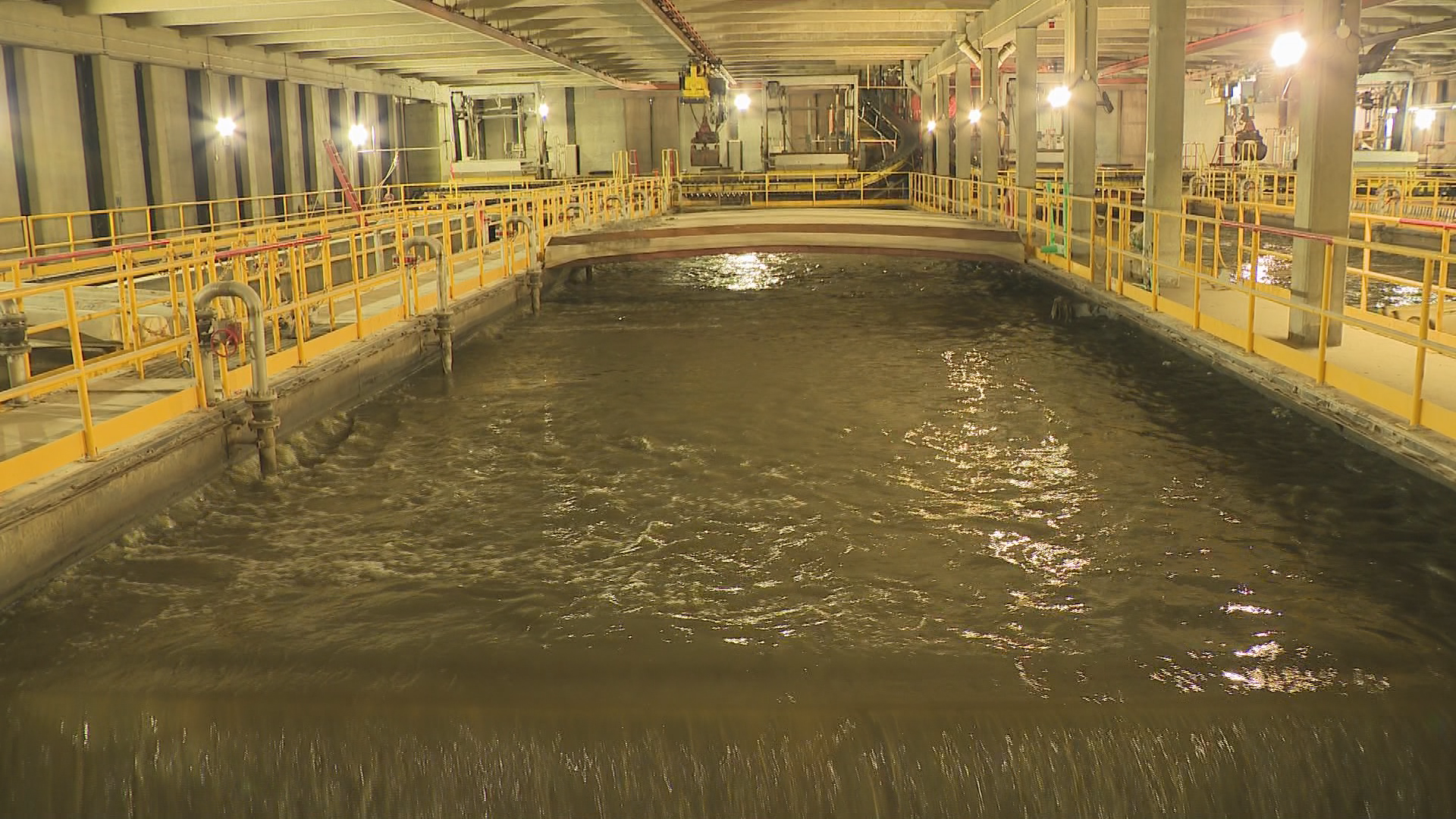
The North End plant is the oldest and largest in the city. It is currently the single greatest point-source of phosphorus and nitrogen entering Lake Winnipeg. These nutrients aren't just "science words." They are fuel. They feed the massive, toxic green algae blooms that are choking the life out of one of the world's largest freshwater lakes. When the province leaves this plant out of the budget, they aren't just saving money. They are choosing which debt to pay. They are choosing to pay the bankers instead of the biosphere.
The Math of Neglect
The numbers associated with the North End plant are staggering, often hovering in the billions. This is likely why politicians flinch. The Phase 2 and Phase 3 upgrades—focused on biosolids and nutrient removal—require a level of commitment that spans decades, not just election cycles.
Currently, the city and the province are locked in a slow-motion dance of "who blinks first." The federal government has some skin in the game, but the remaining gap is a chasm. When the provincial budget failed to bridge that gap, it signaled a delay.
Delay.
It sounds like a neutral word. In reality, delay is a multiplier. Construction costs in the 2020s do not stay stagnant; they climb with the relentless hunger of inflation. A project that costs $500 million today will cost $650 million in three years. By "saving" money now, the government is effectively ensuring that future taxpayers will pay a "procrastination tax" that could fund three new high schools.
But the real cost isn't on a spreadsheet. It’s in the phosphorus.
A Lake on Life Support
If you travel a few hours north of the city to the shores of Lake Winnipeg, the consequences of Winnipeg’s budget gaps become visceral. The water, which should be a shimmering blue-grey, often turns into a thick, pea-soup slurry.
This isn't just an aesthetic tragedy. These algae blooms can be toxic. They kill fish. They sicken pets. They ruin the livelihoods of commercial fishers who have worked these waters for generations. When we talk about "funding questions" for a treatment plant, we are actually talking about the slow poisoning of a massive ecosystem.
We have a habit of treating our infrastructure like a laptop. We use it until it breaks, then we complain about the cost of a replacement. But a city is not a consumer electronic. It is a living organism. If the kidneys of the city—which is exactly what the North End plant is—start to fail, the entire body suffers.
The province might argue that they are balancing the books. They might say they are prioritizing "front-line services." This is a false choice. Clean water is the ultimate front-line service. Without it, public health erodes, property values in the North End stagnate, and the natural heritage of the province is liquidated for short-term political breathing room.
The Invisible Stakes
Why is it so hard to care about sewage?
Psychologically, humans are wired to respond to immediate, dramatic threats. A fire. A storm. A sudden virus. We are poorly equipped to handle "creeping crises." The degradation of our water infrastructure is a creeping crisis. It happens one liter at a time, one budget cycle at a time, one missed upgrade at a time.
There is also a social element at play. The North End has historically been a community that is easy to overlook. If this plant were located in the affluent southern suburbs, where the lawns are manicured and the political donations are heavy, would the funding still be "facing questions"?
Infrastructure is an expression of values. Where we spend our collective wealth tells the story of who we think matters. By leaving the North End plant in the shadows, the message to the residents—and to the river itself—is that they can wait.
But the river is tired of waiting.
The Cost of Doing Nothing
Imagine the city ten years from now. If the upgrades remain unfunded, the plant will continue to operate beyond its intended capacity. The equipment, already strained, will face more frequent breakdowns. The "accidental" spills will become less accidental and more inevitable.
The federal government, which has strict environmental regulations, could eventually step in with fines. These fines don't clean the water; they just move money from one government pocket to another while the problem persists. Meanwhile, the algae blooms in Lake Winnipeg will grow larger, eventually reaching a tipping point where the lake’s ecology may never fully recover.
We often talk about "investment" in the context of the stock market. We want a return. The return on investment for the North End treatment plant is simple: a city that doesn't poison its own backyard. It’s the ability for a kid in 2040 to jump into the Red River without a parent worrying about a skin rash or worse.
Beyond the Ledger
The debate over the Manitoba budget isn't just about partisan bickering or municipal-provincial squabbles. It is a test of our maturity as a society. Are we capable of building things that outlast our own careers? Can we find the courage to spend money on things that are buried underground, hidden behind concrete walls, and decidedly unglamorous?
The "questions" facing the funding are not technical. We know how to fix the plant. We have the engineering. We have the plans. The questions are moral.
Elias still walks by the river. He sees the debris caught in the reeds. He sees the way the water churns near the outflow pipes. He doesn't need to read the budget to know that the people in the tall buildings downtown have looked away again.
We have treated the Red River as a convenient rug to sweep our messes under for over a century. We have assumed its capacity to absorb our waste was infinite. We were wrong. The debt has come due, and the longer we wait to pay it, the more the river will take from us in return.
The water keeps moving, indifferent to our excuses, carrying the weight of everything we refuse to fix.