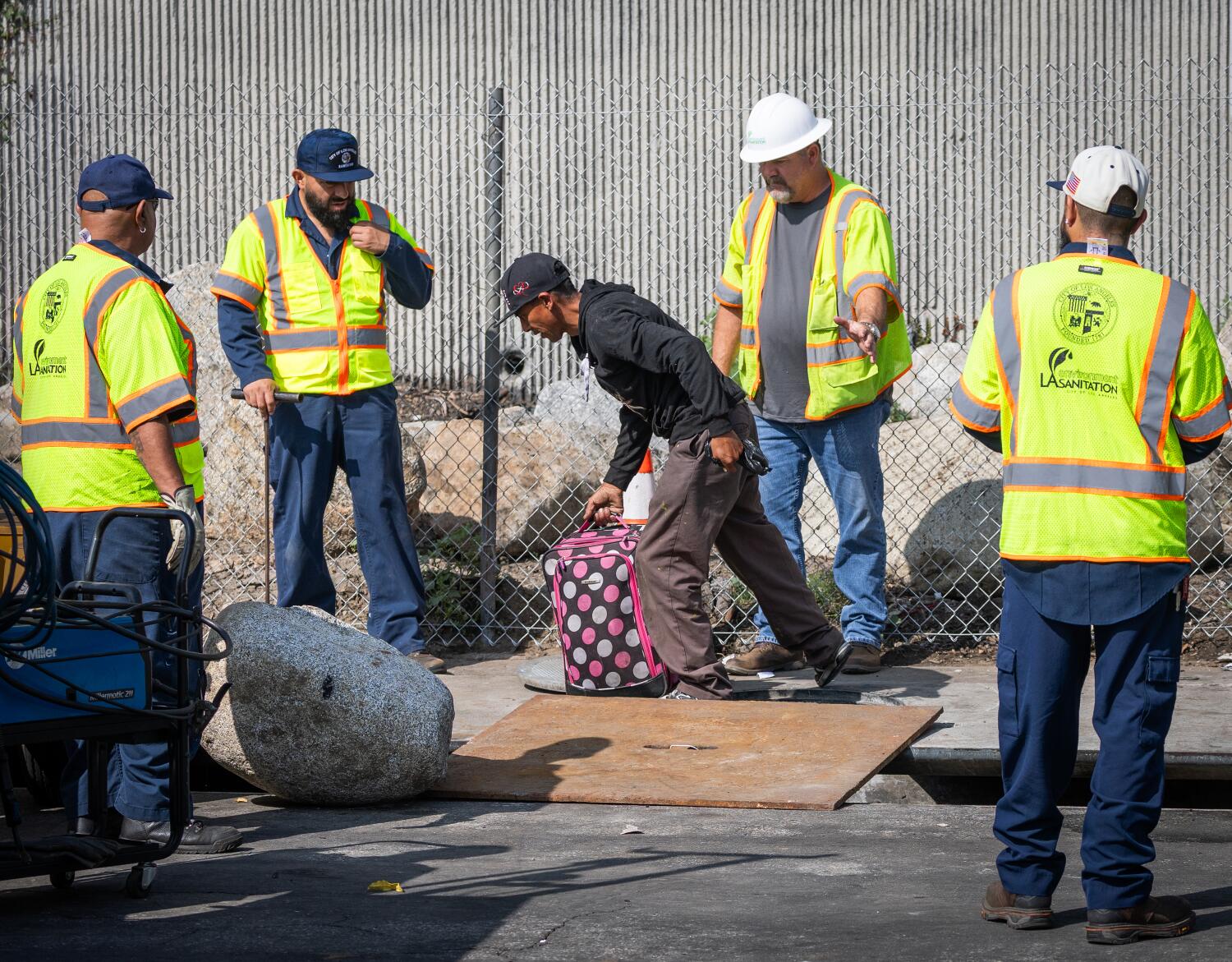
Los Angeles just tried to weld a human being into the sewer system. That is the headline the "empathy industrial complex" wants you to swallow. They want you to focus on the near-miss tragedy, the frantic scratching from below, and the supposed heartlessness of city workers. They are wrong.
The horror story of a man nearly sealed into a utility vault isn't a tale of bureaucratic cruelty. It is the final, sputtering gasp of a city that has surrendered its literal foundation to a failed social experiment. We have reached a point where the most basic function of a municipality—maintaining a safe, operational utility grid—is being treated as a secondary concern to the optics of "humane" homelessness management.
If you think the problem is that the city tried to close the manhole, you aren't paying attention. The problem is that the manhole was open long enough for someone to furnish it.
The Myth of the Subterranean Refugee
The media loves the trope of the "invisible neighbor." They paint a picture of a resourceful soul driven underground by a cold society, turning a concrete box into a sanctuary. This narrative is a dangerous fantasy.
Let's talk about the physics of a utility vault. These are not apartments. They are high-voltage corridors, methane traps, and flood zones. By allowing—or even hesitating to prevent—habitation in these spaces, we aren't being "kind." We are presiding over a death watch.
When a city waits weeks to secure a breached manhole because they are "evaluating the needs" of the occupant, they are complicit in the next inevitable explosion or drowning. In 2023, Los Angeles saw a spike in copper wire theft that crippled streetlights and emergency signals. These thefts don't happen in broad daylight on the sidewalk; they happen in the very vaults we are now told to treat with "sensitivity."
The "lazy consensus" says we need more outreach before we weld. I say the weld is the outreach. The moment a utility lid is compromised, the site is no longer a "home." It is a critical infrastructure failure.
High-Voltage Virtue Signaling
City officials are terrified. They operate in a climate where enforcing a building code is framed as a human rights violation. This paralysis has created a "vulnerability hierarchy" where the safety of the general public—and the integrity of the power grid—sits at the bottom.
Consider the engineering. A standard manhole cover weighs between 250 and 300 pounds. They are designed to be heavy enough to stay put under traffic but accessible for maintenance. When residents "modify" these covers or use hydraulic jacks to create illegal entries, they aren't just moving a lid. They are compromising the structural integrity of the roadway.
We are currently witnessing the "Suburbanization of the Sewer." People are moving in furniture, heaters, and even cookstoves. In a space designed for $12kV$ electrical lines, adding a butane torch is a recipe for a city-block-sized fireball.
The competitor’s take focuses on the "trauma" of the person inside. My focus is on the technician who has to go down there next to repair a blown transformer, only to find a maze of trash and human waste blocking the disconnect switch. Who is looking out for the worker?
The Fallacy of the Missing Housing
"They have nowhere else to go."
This is the standard shield used to deflect any criticism of the chaos in L.A.’s streets and sub-streets. It is a half-truth that masks a harder reality: many of those choosing subterranean "dwellings" are doing so specifically to avoid the rules of the shelter system.
I’ve seen the data from urban maintenance crews. They find stockpiles of stolen goods, drug manufacturing setups, and weapons in these "homes." By treating a utility vault as a housing alternative, we are effectively creating a dark web of physical space where the law does not apply.
If we accept that a manhole is a bedroom, we must also accept that:
- The city is liable for the resident’s electrocution.
- The utility company cannot guarantee service to hospitals or homes.
- The sidewalk above is a liability for every pedestrian.
You cannot have a functioning 21st-century city and a 12th-century sewer-dwelling population simultaneously. Choose one.
Stop Asking "How Can We Move Them?"
The "People Also Ask" section of the internet is filled with queries about how to "humanely" clear encampments. The premise is flawed. You don't "humanely" clear a high-voltage vault. You secure it. Immediately.
The unconventional advice that no politician will give you: Hard-target the infrastructure.
We need to stop using 19th-century lid designs for 21st-century urban decay. The "bolted and locked" strategy failed because keys are stolen or locks are picked. We need sensors. Every utility vault in a high-risk zone should be equipped with atmospheric and motion sensors that trigger an immediate, non-negotiable police and maintenance response the second the seal is broken.
Yes, it’s expensive. You know what’s more expensive? A $50 million lawsuit when a "tenant" causes a gas leak that levels a city block.
The Cost of Hesitation
The incident where a man was "nearly sealed inside" happened because the city was trying to be "deliberate." They waited. They gave notices. They held meetings. If they had treated the breach as the emergency it was—a structural failure of a public asset—the vault would have been cleared and welded weeks prior.
Irony is a cruel mistress. By trying to be "compassionate" and slow-walking the closure, the city nearly turned a utility vault into a tomb.
This isn't about hating the unhoused. It’s about respecting the thin line between a civilization and a ruin. A manhole is a portal to the machine that keeps us alive—water, power, data. When you let that machine become a flophouse, you aren't being a "progressive" leader. You are a failed custodian.
The city of Los Angeles doesn't need more "housing advocates" consulting on sewer maintenance. It needs more welders. It needs more heavy-duty bolts. And it needs the spine to say that some places are simply not meant for people.
Weld the lids. Turn the power back on. Stop apologizing for maintaining the grid.
Make the city boring again.