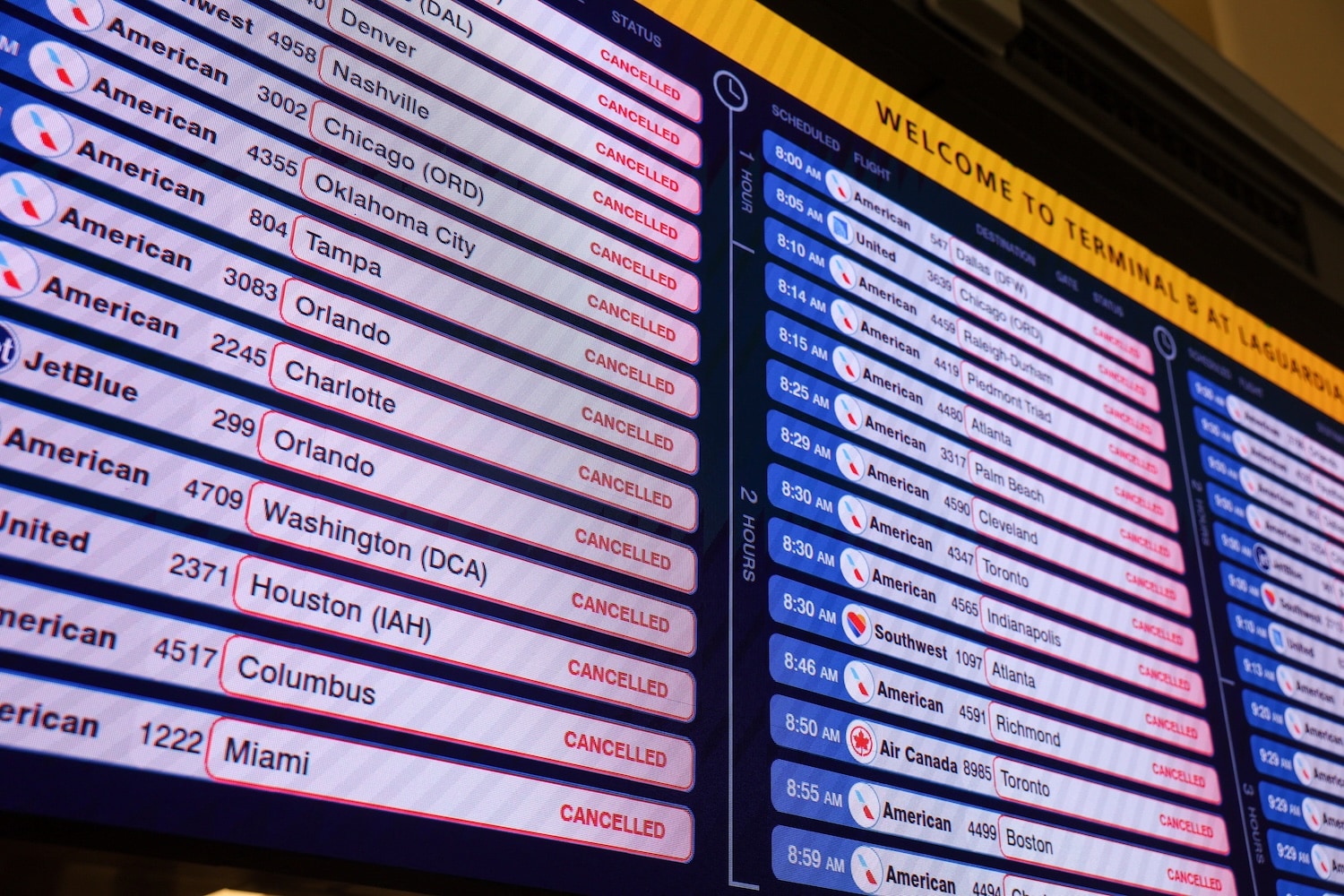
If you’ve ever been stuck at JFK during a winter blast, you know the specific kind of hell that 1,300 cancelled flights feels like. It’s not just a statistic on a flickering departure board. It’s the smell of overpriced terminal coffee, the sound of frustrated travelers arguing with gate agents who have no answers, and the realization that your "quick trip" just turned into a three-day ordeal. When a massive storm hits the Tri-State area, the entire global aviation network feels the tremor.
New York’s three major hubs—JFK, LaGuardia, and Newark—operate on such tight margins that even a minor delay can snowball. Throw in a full-blown winter storm, and the system doesn't just bend; it breaks.
Why New York Airports Fail Harder Than Others
Most people think a few inches of snow shouldn't ground a modern jet. They're technically right. The planes can handle the cold. The problem is the infrastructure and the sheer volume of traffic. JFK and Newark are among the busiest airspace corridors in the world. When visibility drops or runways need constant de-icing, the "flow rate"—the number of planes allowed to land per hour—plummets.
If LaGuardia can usually handle 40 landings an hour and that number drops to 10 because of wind shear or snow removal, 30 planes have nowhere to go. They get diverted or, more likely, they never leave their origin city. This is why a storm in Queens can ruin someone's afternoon in Los Angeles or London.
The physical layout of these airports doesn't help. LaGuardia is essentially a postage stamp surrounded by water. There's no room for error. Newark and JFK are massive but aging, struggling to keep up with the demands of 21st-century weather patterns. When 1,300 flights get wiped off the schedule in a single day, it’s a logistical nightmare that takes nearly a week to fully untangle.
The Secret Math of Airline Cancellations
Airlines don't cancel flights because they want to. They do it to save money and protect their crews. Each tail number—the physical airplane—is scheduled for multiple legs a day. If a plane gets stuck in the snow at Newark, it can’t make its next six flights.
Airlines use sophisticated software to decide which flights to axe first. Usually, it's the high-frequency "shuttle" routes. If there are 15 flights a day between NYC and Chicago, they’ll cancel ten of them and try to cram everyone onto the remaining five. It’s cold-blooded efficiency. If you're on a once-a-day international long-haul, you have a better chance of flying, but if that gets cancelled, you’re in much deeper trouble.
Crew timing is another "hidden" reason for the chaos. Pilots and flight attendants have strict legal limits on how long they can work. If a plane is sitting on the tarmac for three hours waiting for a de-icing truck, the crew might "timeout." Even if the weather clears, the flight gets cancelled because there's nobody legal to fly the plane.
What the Airlines Won't Tell You About Rebooking
When the "Act of God" clause (force majeure) gets invoked due to weather, the airlines basically wash their hands of your hotel and meal costs. You’re on your own. But there’s a loophole most people miss.
If you can prove that your flight was delayed or cancelled due to a mechanical issue before the weather hit, they owe you. Always ask for the specific reason for the delay. Don't just take "weather" for an answer if the sun is shining at your departure gate and the plane at the next gate is taking off for the same destination.
Check the "interline agreements" too. Most major carriers have deals with their competitors. If United cancels your flight, they can technically book you on a Delta or American flight if there’s a seat. They hate doing this because they have to pay the competitor for that seat, so they won't offer it unless you ask—or demand—it.
Tactical Steps When the 1,300 Cancellations Include You
You need a plan the second the notification hits your phone. Don't join the 200-person line at the "Customer Service" desk. That’s a trap. While you’re standing there, the last three seats on the next available flight are being snapped up by people who know better.
- Call the international help desk. If you're flying American Airlines, don't call the US number. Call their UK or Canadian support line. You’ll get through to a human in minutes while the domestic line has a four-hour wait. They have the same power to rebook you.
- Use the app, but don't trust it. Sometimes the app only shows you "approved" options. A gate agent or a phone rep can often see "ghost seats" or routes that the algorithm ignores.
- Head to the lounge. Even if you aren't a member, many lounges allow day passes. The agents inside those lounges are generally more experienced and have more time to help you than the stressed-out staff at the main gates.
- Check secondary airports. If JFK is a mess, see if you can get out of Islip (ISP) or even Philadelphia (PHL). A $100 Uber ride might save you two days of waiting.
Your Credit Card Is Your Secret Weapon
This is where your choice of plastic matters. High-end travel cards like the Chase Sapphire Reserve or the Amex Platinum include trip delay insurance. If your flight is delayed by more than 6 or 12 hours due to weather, they’ll reimburse you for a hotel, meals, and even toiletries up to a certain amount (usually $500).
Keep every single receipt. Even that $4 airport Snickers bar. You’ll need them to file the claim later. Most people forget this and end up eating the cost of a $300 Marriott room near Newark because the airline told them "it's not our fault."
The Reality of "Travel Halts" in 2026
We're seeing these mass cancellations more often. The climate is shifting, and "unprecedented" storms are becoming the winter norm for the Northeast. The aviation industry hasn't quite figured out how to buffer against this. They run "lean," which is corporate-speak for not having enough spare planes or staff when things go sideways.
When a storm halts travel at JFK, LaGuardia, and Newark simultaneously, the ripple effect hits the entire US economy. Business meetings get missed, cargo gets delayed, and families are stranded. It's a reminder of how fragile our "seamless" world actually is.
If you see a storm in the forecast, move your flight early. Most airlines offer "weather waivers" 24 to 48 hours before the first snowflake falls. This allows you to rebook for free before the 1,300 cancellations happen. If you wait until the storm hits, you're just another person sleeping on a yoga mat in Terminal 5.
Get ahead of the curve by monitoring the FAA’s National Airspace System (NAS) Status page directly. It shows real-time ground stops and delay programs before they even hit the airline's own apps. If you see a "Ground Delay Program" for Newark with an average delay of 180 minutes, start looking for your Plan B immediately. Don't wait for the text message that says your flight is gone. By then, it’s already too late.