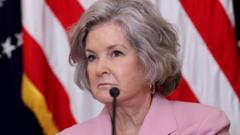
The West Wing is a place of relentless noise. It is the sound of leather soles hitting marble, the frantic rhythmic tapping of glass-screened phones, and the low, urgent murmur of people who believe they are directing the course of history. In the center of this storm stands Susie Wiles. Known for her preternatural calm and a penchant for staying in the shadows while others crave the spotlight, she is the engine of an administration. But recently, a different kind of silence began to compete with the political roar. It was the silence of a clinical room, the sharp scent of antiseptic, and a diagnosis that does not care about election cycles or transition schedules.
Susie Wiles is facing breast cancer.
To understand the weight of this, you have to understand the role she occupies. She is not just a staffer; she is the Chief of Staff, often described as the "Ice Maiden" for her composure. In the high-stakes theater of Washington, D.C., showing vulnerability is often seen as a tactical error. Yet, cancer is a universal equalizer. It strips away the titles and the security clearances. It replaces the frantic scheduling of cabinet meetings with the rigid, terrifying architecture of oncology appointments.
The Body as a Battlefield
We often talk about political "battles" or "campaign wars." We use the language of combat to describe passing a bill or winning a swing state. But when the battle moves inside the skin, the metaphor changes. It becomes visceral. For a woman like Wiles, who has spent decades managing the egos and agendas of the most powerful people on earth, the sudden realization that she cannot simply "manage" her own cells is a profound shift in reality.
Breast cancer remains the most common cancer among women globally, excluding skin cancers. In the United States, about one in eight women will develop invasive breast cancer over the course of her lifetime. These are not just statistics found in a medical journal. They are the quiet conversations happening in breakrooms, the sudden absences at school functions, and now, the shadow hanging over the highest office in the land.
The biology is cold and indifferent. It begins with a mutation, a cellular glitch where the instructions for growth and decay go haywire. The body, usually a marvel of self-regulation, fails to recognize the insurgent. In the early stages, there is often no pain. There is only the discovery—a lump felt during a routine check, or more often today, a tiny shadow on a mammogram that looks like a grain of salt against a dark sea.
The Invisible Stakes of Timing
Timing is everything in politics, but in oncology, it is the difference between a footnote and a tragedy. Wiles has reportedly been diagnosed with an early-stage form of the disease. In the world of medicine, "early" is a word weighted with immense hope.
Consider the difference in the path ahead. When breast cancer is detected early and remains localized, the five-year survival rate sits near 99 percent. It is a testament to decades of research, billions in funding, and the tireless work of scientists who mapped the human genome. However, if the cells find a way into the lymphatic system—the body's secret highway—the complexity of the fight scales up exponentially.
Wiles is navigating a world where "Stage" is the only metric that matters.
- Stage 0: Non-invasive, staying within the milk ducts.
- Stage I: Small tumors, often localized.
- Stage II-III: Larger tumors or involvement of nearby lymph nodes.
- Stage IV: Metastatic disease, where the cancer has traveled to distant organs.
For a Chief of Staff, her life is usually measured in fifteen-minute increments. Now, it is measured in cycles of treatment. The irony is sharp. She is tasked with protecting the President and the country, yet she must now dedicate a significant portion of her formidable will to protecting herself from her own biology.
The Human Element in the Hallways of Power
Washington has a habit of turning people into caricatures. We see the "political operative" or the "strategist." We forget the mother, the friend, and the individual who has to sit in a cold chair and wait for test results just like anyone else.
There is a specific kind of loneliness that comes with a diagnosis when you are in a position of high visibility. You become a symbol. To some, Wiles’ diagnosis is a moment for bipartisan empathy—a rare occasion where the political masks slip, and everyone remembers that we are all made of the same fragile carbon. To others, it is a point of speculation about her ability to perform under the most grueling job on the planet.
But the human-centric reality is much simpler and more grueling. It is the exhaustion that sets in after a session of radiation. It is the "chemo fog" that can cloud even the sharpest mind. It is the strange experience of discussing national security in the morning and discussing white blood cell counts in the afternoon.
Wiles has opted to remain in her role while undergoing treatment. This is a choice made by thousands of women every year who refuse to let a diagnosis define their identity or dictate their contribution to the world. It is an act of defiance. It is a statement that while the body may be under siege, the spirit remains the commanding officer.
The Cost of the Shadow
We rarely talk about the emotional labor of being the "strong one." In her professional life, Wiles is the one who solves the problems. She is the one who calms the waters. When the person who is supposed to have all the answers suddenly faces a question that medicine can only answer with "we hope," the internal pressure is immense.
Early-stage breast cancer treatment often involves a combination of surgery—either a lumpectomy or a mastectomy—followed potentially by radiation, chemotherapy, or hormone therapy. Each of these paths carries its own tax. Surgery requires physical recovery time that the White House schedule doesn't naturally afford. Hormone therapy can last for years, subtly altering one's mood and energy levels.
Yet, there is a secondary effect to her public disclosure. When a person of her stature speaks about her diagnosis, it ripples outward. It prompts the staffer in the next office to finally book that overdue screening. It reminds the high-powered executive that no one is too busy for a check-up. This is the "celebrity effect" of health crises, turning a personal struggle into a public service.
Beyond the Diagnosis
The narrative of cancer is often framed as a "war," but for those living through it, it feels more like a long, arduous trek through a landscape they never asked to visit. There are good days where the world feels normal, and there are days where the weight of the future feels like a physical burden on the chest.
Susie Wiles is not a dry fact in a news ticker. She is a woman standing at a crossroads. Behind her is a career defined by intensity and victory. In front of her is a clinical challenge that requires a different kind of strength—not the strength of political maneuvering, but the quiet, dogged endurance of a patient.
The West Wing will continue its frantic pace. The phones will keep ringing, the briefings will be printed, and the geopolitical chess board will keep shifting. But in one office, the stakes have become deeply personal. The "Ice Maiden" is proving that she can weather a storm that has nothing to do with polling data or policy papers.
She is fighting a silent war. And she is doing it in the loudest room in the world.
The monitors in the hospital don't care about the West Wing. They only track the steady, persistent beat of a heart that refuses to slow down, even when the world is watching, and even when the cells are conspiring. It is a reminder that beneath the suits and the titles, there is a human core that is terrifyingly fragile and remarkably unbreakable all at once.
The light stays on in her office late into the night. It isn't just the work of the nation keeping it burning. It is the stubborn refusal to let the darkness of a diagnosis dim the brilliance of a life still very much in progress.
Would you like me to look into the latest advancements in targeted therapies for early-stage breast cancer that might be relevant to this case?