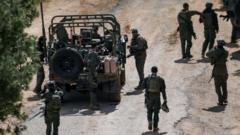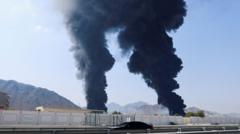
The recent kinetic strikes against the Jebel Ali port in the United Arab Emirates and Dubai International Airport (DXB) represent a fundamental shift from symbolic regional friction to a systematic breakdown of the "Safe Haven" economic model. This escalation is not a localized skirmish; it is a calculated stress test of the global energy supply chain and the logistical viability of the Persian Gulf. By targeting the UAE’s two most critical nodes—the world’s largest man-made harbor and the busiest international airport for passenger traffic—the aggressor has moved to devalue the UAE’s primary currency: its reputation for absolute stability.
The Triad of UAE Vulnerability
The UAE’s economic architecture rests on three pillars that, while providing immense wealth, create concentrated points of failure for asymmetric warfare.
- Logistical Centrality: Jebel Ali functions as the premier "Gateway" for the Middle East. It is the only port in the region capable of handling the largest container ships (Ultra Large Container Vessels). A sustained threat to this port does not just affect the UAE; it bottlenecks the entire Arabian Peninsula's import-export capacity.
- Aviation Interconnectivity: Dubai International Airport is the nervous system of the global East-West transit route. Unlike domestic-heavy markets like the US or China, DXB relies almost 100% on international transit. Physical damage or even the credible threat of drone incursions triggers immediate insurance premium hikes and rerouting, threatening the 12% of GDP contributed by the aviation sector.
- The Re-export Model: Much of Dubai’s economy functions on the value-added processing and re-exporting of goods. This requires a frictionless environment. Kinetic strikes introduce friction, which acts as a hidden tax on every transaction.
Mechanics of Asymmetric Surface-to-Surface Engagement
The strikes utilized a combination of low-cost Unmanned Aerial Vehicles (UAVs) and land-attack cruise missiles (LACMs). The strategic advantage of this "high-low" mix is the exhaustion of expensive air defense systems.
The UAE utilizes the Terminal High Altitude Area Defense (THAAD) and Patriot PAC-3 systems. While these are effective against ballistic threats, they face a negative cost-exchange ratio when engaging swarms of $20,000 drones. The math of this engagement is unsustainable. If an interceptor missile costs $2 million and the incoming threat costs $20,000, the defender loses the economic war even if they intercept every target.
Saturation attacks are designed to find the "blind spots" in radar coverage, particularly the low-altitude profiles of drones that can hug the coastline to avoid detection until they are within terminal range of high-value targets like oil storage tanks or desalination plants.
The Energy Risk Function
The strike on an oil port isn't just about destroying barrels; it’s about the "War Risk Premium" in maritime insurance.
$$Risk Premium = (Probability of Strike \times Potential Loss) + Reinsurance Margin$$
When a port like Jebel Ali is targeted, the probability variable shifts from a theoretical outlier to a baseline expectation. This causes:
- Freight Rate Spikes: Tanker owners demand higher fees to enter the Gulf.
- Increased Bunkering Costs: The UAE is a global hub for ship refueling. If the infrastructure is compromised, ships must carry more fuel, reducing their cargo capacity and further increasing global shipping costs.
- Just-in-Time Disruption: Modern supply chains operate with zero margin for error. A 48-hour closure of Jebel Ali creates a 14-day ripple effect across global schedules.
Geopolitical Calibration and Strategic Signaling
These attacks are precise instruments of "grey zone" warfare. By hitting the UAE instead of Saudi Arabia, the aggressor signals that no partner in the Abraham Accords or the regional security architecture is untouchable.
The choice of targets—an airport and a port—is a direct attack on the UAE’s diversification strategy. For decades, the UAE has attempted to decouple its economy from direct oil dependency by becoming a tourism and logistics powerhouse. By demonstrating that these "non-oil" sectors are just as vulnerable to kinetic strikes as oil refineries, the aggressor is attempting to force a diplomatic pivot.
The UAE finds itself in a "security paradox." Increased military spending and more aggressive defense postures may deter some attacks, but the very presence of heightened military readiness can scare away the high-net-worth individuals and international corporations that Dubai’s economy requires.
Hardening the Infrastructure: Tactical Limitations
Standard hardening of infrastructure (concrete barriers, reinforced hangars) is insufficient for a hub that relies on the "openness" of its facilities. A port cannot be "closed" and remain a port.
- Cyber-Kinetic Convergence: The threat isn't just physical. Future iterations of these strikes will likely involve electronic warfare (EW) to jam GPS signals, causing drones to drift or forcing the airport to ground all flights due to safety concerns, even without a physical explosion.
- Directed Energy Weapons (DEW): The UAE is looking toward laser-based defense systems to solve the cost-exchange ratio problem. However, these systems are still in the early deployment stages and are hampered by atmospheric conditions like the high humidity and dust common in the Gulf.
The move toward "distributed logistics"—moving critical assets to the UAE’s East Coast (Fujairah) to bypass the Strait of Hormuz—is the primary strategic counter. However, Fujairah lacks the massive processing infrastructure of Jebel Ali, and transferring that capacity would take a decade of capital investment.
Global Macroeconomic Implications
The immediate consequence of the strike is the decoupling of the "Peace Dividend" from Gulf investments. Global markets have long treated the UAE as a safe harbor in a volatile region. This "de-risking" of the Gulf meant lower interest rates for UAE corporate debt and higher foreign direct investment (FDI).
If the UAE is re-categorized as a high-risk zone, we will see a capital flight toward alternative logistics hubs like Singapore or even the emerging Red Sea projects in Saudi Arabia, provided they can demonstrate superior defense capabilities.
The stability of the global energy market is now tied to the effectiveness of the UAE’s point-defense systems. A single successful hit on a major VLCC (Very Large Crude Carrier) at berth could trigger an oil price shock of $10-$15 per barrel overnight, not due to supply shortage, but due to the total stoppage of traffic through the Strait of Hormuz.
The UAE must now decide between two paths: rapid de-escalation via diplomatic concessions to the aggressor, or a total integration into a regional "missile shield" that includes unprecedented intelligence sharing with Israel and the US. This second path effectively ends the UAE’s long-standing policy of "strategic hedging" between global powers. The era of the UAE being "everyone’s friend" is being forcibly ended by the reality of long-range precision munitions.
The most effective immediate move for regional stakeholders is the establishment of a Joint Maritime and Air Defense (JMAD) network that treats the entire GCC airspace as a single theater. This eliminates the "seams" between national air defenses that drones exploit. Without this integration, the individual nodes of the UAE’s economy remain isolated targets in a high-speed, low-cost war of attrition. Operators must prepare for a sustained period where "Operational Continuity" is no longer a given, but a daily struggle against asymmetric gravity.