Most headlines about the massive November 2026 military drill in southeastern Poland make it sound like Western Europe is marching straight into active combat in Ukraine. That's simply not true.
Between November 9 and November 22, 2026, roughly 2,800 troops from 11 nations converged on the Nowa Deba training ground in Poland for an exercise called Koalicja (Polish for "Coalition"). Co-led by France and the United Kingdom, this operation marks the first full-scale field test of the Multinational Force Ukraine (MNF-U), the military arm of the 37-nation "Coalition of the Willing". Don't miss our earlier coverage on this related article.
If you look past the sensationalist chatter, the real story here isn't about starting a war. It's about how Europe is trying to guarantee a ceasefire without relying on NATO's Article 5 or waiting around for Washington.
Why the Coalition of the Willing Exists Outside NATO
To understand what happened at Nowa Deba, you have to look at why this coalition was built in the first place. After nearly two years of diplomatic summits in London and Paris, European leaders faced a harsh reality. Ukraine wanted full NATO membership and the ironclad protection of Article 5, which treats an attack on one ally as an attack on all. Political divisions within the alliance made that impossible in the short term. To read more about the context here, TIME provides an informative breakdown.
So France and the UK stepped into the vacuum. Starting in early 2025, they assembled a 37-country diplomatic grouping designed to offer Kyiv an alternative security guarantee. Twenty-four of the 27 European Union member states joined—with Hungary, Slovakia, and Malta sitting out—alongside non-European partners like Canada, Australia, New Zealand, and Japan.
Koalicja is the moment that diplomatic paperwork turned into boots on the ground. Operating completely outside the formal NATO command structure, the exercise tested whether European nations can actually mobilize, supply, and command a multi-domain force on their own.
Inside Operation Koalicja in Southeastern Poland
Let's clear up the numbers, because reporting on troop counts has been messy. The core multinational contingent deploying into the exercise numbered around 2,800 personnel across 11 participating countries:
- France carried the heaviest load, committing 1,100 soldiers alongside autonomous aerial and ground drone units.
- The United Kingdom deployed 300 troops, Typhoon fighter jets, and Voyager air-to-air refueling tankers.
- Supporting allies included Belgium, Estonia, Germany, Lithuania, the Netherlands, Spain, Sweden, and Turkey.
When you factor in the nearly 2,000 Polish host-nation troops managing logistics and infrastructure, total participation pushed close to 5,000 personnel.
Moving that many soldiers isn't easy. Coalition units arrived in Poland by sea, air, and land before transferring onto rail and road networks to reach Nowa Deba. Meanwhile, Turkey ran the maritime side of the drill remotely from Istanbul, simulating Black Sea naval coordination without physically sending ships into Polish waters.
What These Troops Are Actually Training For
Here is where the biggest misconception kicks in. Critics and commentators frequently refer to the MNF-U as a "peacekeeping" force. Inside military headquarters, that word is practically banned.
As British Lieutenant General Tom Bateman, the commander of the MNF-U, made clear during the drills, these soldiers will not monitor ceasefires, patrol buffer zones, or stand on the front lines fighting Russian troops. Western planners remember the bitter failure of unarmed OSCE observers trying to enforce the Minsk agreements after 2014. A traditional peacekeeping mission in Ukraine would be a sitting duck.
Instead, the MNF-U is a reassurance and regeneration force designed to deploy only after a formal ceasefire or peace deal is signed and Kyiv officially invites them in. During Koalicja, troops practiced four specific missions:
- Rebuilding Ukraine's military: Training instructors to rapidly regenerate Ukrainian brigades behind the lines so Kyiv can deter a second invasion on its own.
- Reopening Ukrainian skies: Establishing air-policing and defense protocols so civilian commercial flights can safely return to Ukrainian airspace.
- Clearing the Black Sea: Running naval demining operations to keep commercial grain and cargo shipping lanes open.
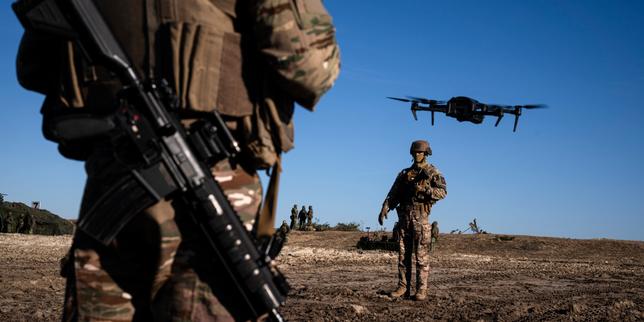
- Surviving modern drone warfare: Practicing trench defense and counter-drone tactics. Even in a post-ceasefire environment, commanders know stray drones or localized provocations remain the single biggest threat to foreign troops.
Ed Arnold, a senior associate fellow at the Royal United Services Institute (RUSI) in London, summed up the paradox well. Even though the MNF-U has a purely defensive mandate, it still has to deploy as a credible combat force just to protect itself.
The Cracks Beneath European Unity
While French and British officials hailed Koalicja as proof of European resolve, looking closely at who is willing to do what reveals serious political friction.
If the MNF-U ever deploys for real, planners estimate it would require up to 20,000 soldiers—roughly a full military division—stationed well back from the Russian border. Getting European capitals to agree on sending troops into Ukrainian territory is another story entirely.
Take Poland. Warsaw hosted the exercise, managed the supply chains, and committed thousands of troops to the training ground. Yet the Polish defense ministry explicitly reiterated that Poland will not send its own soldiers into Ukraine under any postwar settlement. Warsaw sees its job as serving as the indispensable logistics hub on NATO's eastern flank, not putting Polish troops across the border.
Germany has taken a similar stance, leading a bloc of countries that argue MNF-U forces should remain stationed in neighboring states like Poland rather than inside Ukraine itself. That reluctance explains why France supplied more than a third of the multinational troops at Nowa Deba. Paris and London are willing to put skin in the game; several of their neighbors still prefer to stay on the safe side of the border.
The exercise also unfolded under real-world pressure. A Russian missile crash near the Polish border coincided with the drills, prompting Polish Prime Minister Donald Tusk and Defense Minister Władysław Kosiniak-Kamysz to call out Moscow for attempting to intimidate the coalition. Rather than scaring the allies off, the incident hardened their messaging around European self-reliance.
How to Follow What Happens Next With the MNF-U
If you're tracking European defense policy or watching for signs of a genuine peace framework in Ukraine, don't get distracted by daily political speeches. Watch these concrete indicators over the coming months instead:
- Monitor troop commitment pledges from Paris and London: Watch whether the UK Ministry of Defence and the French Armed Forces Ministry transition from 300-to-1,100-person exercise deployments toward the full 20,000-troop division benchmark planners say is required.
- Track bilateral legal frameworks with Kyiv: The MNF-U cannot legally enter Ukraine without a formal status-of-forces agreement ratified by the Ukrainian government. Any announcement of finalized legal treaties between Kyiv, Paris, and London is a major signal that a ceasefire framework is getting serious.
- Watch German and Polish basing decisions: Pay attention to whether Berlin and Warsaw commit to permanent forward-staging bases in southeastern Poland, which will determine how fast the coalition can actually move if a truce is called.
- Check primary defense ministry briefings: Skip secondary social media rumors and follow direct operational updates from the French Ministry for Europe and Foreign Affairs or analyses from the French Institute of International Relations (Ifri) for verified force-structure changes.