The moon is not a monument. It is a target.
For billions of years, our silent silver companion has worn its history upon its face like a battered boxer. Every crater, every pale streak of ejecta, every dark basin of basaltic plain tells a story of violence. We look up at the night sky from our city balconies, clutching our ceramic mugs of coffee, and we see serenity. We see poetry. We see a pale, unblinking eye keeping watch over the tides.
That comfort is an illusion written in stone.
Consider what happens when a piece of the ancient debris field that birthed our solar system finally intercepts our orbit. It does not knock politely. It arrives unannounced, traveling at velocities that human minds struggle to quantify—speeds where air ceases to behave like a gas and begins to act like a wall of solid steel. On Earth, our atmospheric shield acts as an incinerator, turning most incoming rocks into fleeting shooting stars, brilliant streaks of self-immolating glory that vanish before they ever touch the grass.
The moon has no such luxury. It breathes vacuum.
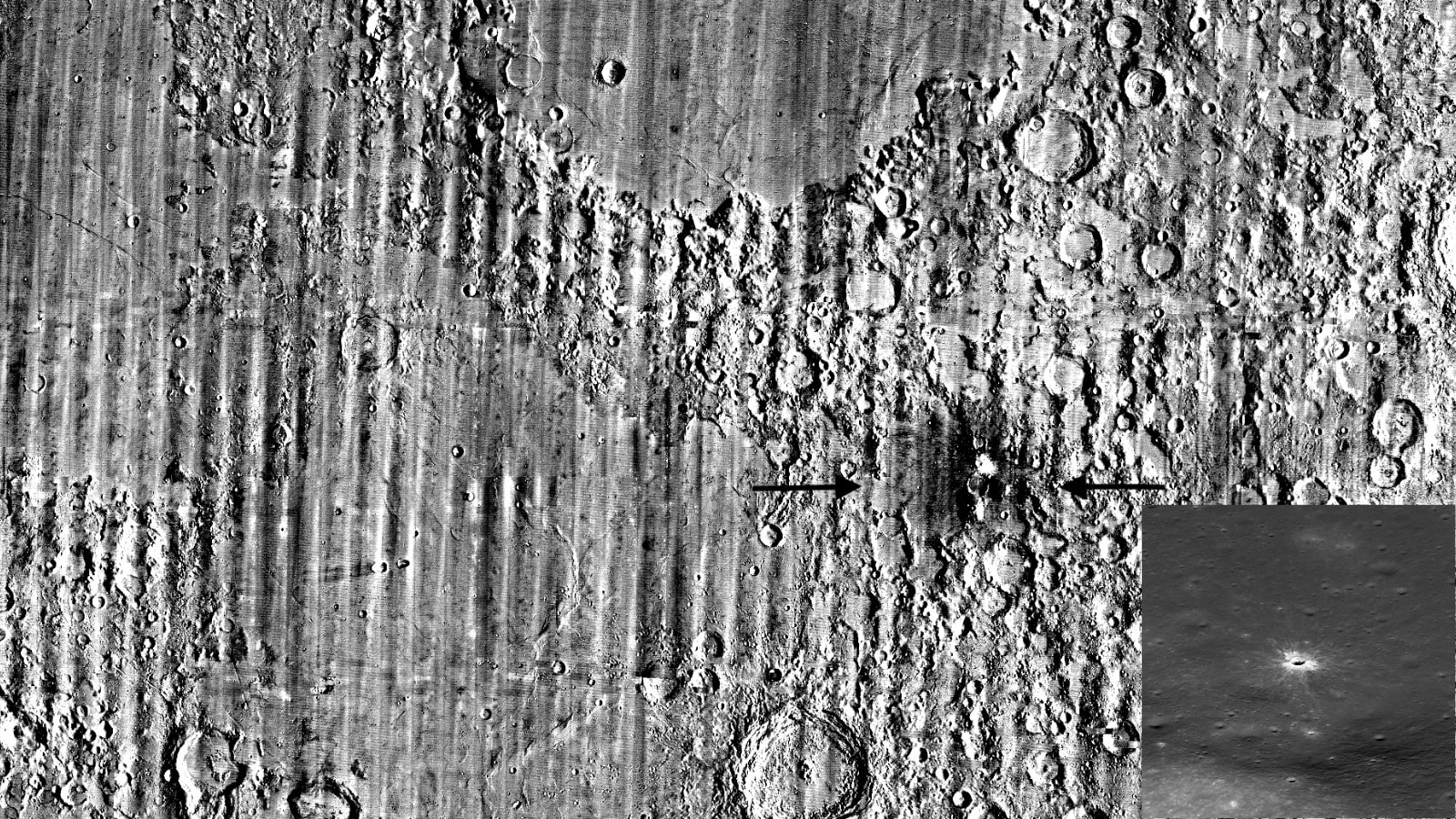
When a rogue asteroid or cometary fragment collides with the lunar surface, there is no air to cushion the blow, no atmospheric friction to burn the intruder away. There is only a collision of pure momentum. And recently, NASA instruments caught sight of a scar born from an event so rare, so statistically improbable, that astronomers have classified it as a once-in-130-year phenomenon.
Imagine standing on the edge of the Sea of Tranquility on a moonless night.
To your left, the black velvet of space is choked with stars that never twinkle, sharp and brilliant because there is no air to blur their light. To your right, the curvature of the horizon drops away into absolute shadow. You are breathing recycled air inside a pressurized suit, listening to the steady, metronomic sound of your own inhalation.
Then, without sound—because sound cannot travel through the empty void—the world splits open.
A quarter of a second. That is all it takes for kinetic energy to violently transform into thermal and mechanical catastrophe. A chunk of rock, perhaps no larger than a boulder you might find resting quietly in a New England forest, strikes the regolith at thirty miles per second.
Energy does not simply vanish. It converts. In the blinding flash of impact, temperatures skyrocket to levels matching the surface of the sun. Molten rock sprays outward in a magnificent, fan-shaped plume of incandescent glass and pulverized dust. A shockwave races through the crust, fracturing ancient bedrock that had remained undisturbed since the heavy bombardment epoch of the early solar system.
When NASA researchers later analyzed the before-and-after imagery captured by lunar orbiters, the scale of the disruption became painfully clear. A fresh, raw crater had blossomed in the gray dust, its interior glowing with the faint thermal signature of cooling rock, surrounded by a spiderweb of bright rays stretching out across the ancient highlands like a shattered windshield.
Why does this matter? Why should anyone sitting in a traffic-choked commute or worrying over a mortgage payment care about a hole punched into a dead world a quarter-million miles away?
Because the moon is our proxy.
It is the bodyguard standing in the alley, taking the hits so we don't have to. Every crater carved into the lunar surface is a reminder of a bullet that missed us. The Earth and the moon share an orbital neighborhood, floating through a cosmic shooting gallery strewn with gravitational landmines. When we map a new impact scar on the moon, we are reading a history book written in blood and stone—a history that belongs to us, too.
For decades, amateur astronomers and professional observatories have monitored the unlit side of the moon during lunar eclipses, searching for the sudden, micro-second flickers of light that betray an impact. Most of these events are tiny—flashes generated by pebble-sized meteoroids releasing energy equivalent to a few sticks of dynamite. They are scientific curiosities, minor blips on a seismograph.
This was different.
The sheer volume of displaced material, the blinding magnitude of the flash, and the subsequent structural collapse of the crater rim pointed to a massive interloper. This was an object carrying the punch of a tactical weapon, a chunk of primordial architecture that had somehow slipped through the cosmic surveillance net, evaded the gravitational tugs of the gas giants, and found its way straight into the lunar target zone.
Think about the precision required. The moon takes up a vanishingly small fraction of the sky from our perspective. To hit it from the deep, trackless dark of interplanetary space is like firing a rifle bullet from New York and striking a specific coin resting on the sidewalk in Los Angeles. Yet, on a cosmic timeline, it happens with terrifying regularity.
And when it happens to the moon, we watch. We measure. We learn.
We learn because the same mechanics that sculpted that lunar crater are at work across the entire solar system. Asteroids do not play favorites. They do not check planetary addresses. They obey only the cold, unfeeling laws of orbital mechanics, intersecting orbits with the ruthless indifference of clockwork.
When we look at that fresh lunar wound, we are looking at a mirror. It forces us to confront our own fragility. We live on a fragile blue marble wrapped in a skin of air so thin that if the Earth were the size of a basketball, our atmosphere would be no thicker than a single coat of varnish.
Yet, we often act as though our perch is permanent. We build civilizations designed for eternity upon a crust that floats over a churning sea of magma, beneath a sky filled with wandering mountains of iron and rock.
The astronomers who study these impacts are not alarmists. They are historians of the future. By cataloging the frequency of these massive strikes, by understanding the size distribution of the impactors, they are drawing a statistical map of our neighborhood risk. They are the watchmen on the wall, peering into the fog, trying to determine if the next shadow on the horizon is a passing cloud or a falling axe.
The once-in-130-year marker is not just a statistic. It is a pacing mechanism. It tells us something fundamental about the breathing rate of our solar system. Catastrophe is not a constant drumbeat; it is a metronome that ticks very slowly, lulling us into a false sense of security between beats.
One hundred and thirty years.
In human terms, that is generations. It spans the distance between horse-drawn carriages and artificial intelligence, between the first flickering incandescent bulbs and the digital age. In geological terms, it is less than the blink of an eye.
When the flash faded on that distant lunar night, the moon did not stop spinning. It continued its slow, steady orbit, presenting its scarred face to the stars once more. It absorbed the blow, took the shrapnel, and kept the Earth safe for another rotation.
We owe our existence to that silent, battered shield. Every sunrise we get to witness, every cup of coffee we drink on our quiet mornings, exists in the shadow of a world that took a bullet meant for us.
Look up tonight if the sky is clear. Find that pale disk hanging in the dark. It looks so peaceful, so untouchable, washing the night in silver light. But remember what lies beneath the dust. Remember the violence of its history, and the quiet vigilance of its service.
The dark is full of moving parts. And somewhere out there, the clock is ticking toward the next intersection.