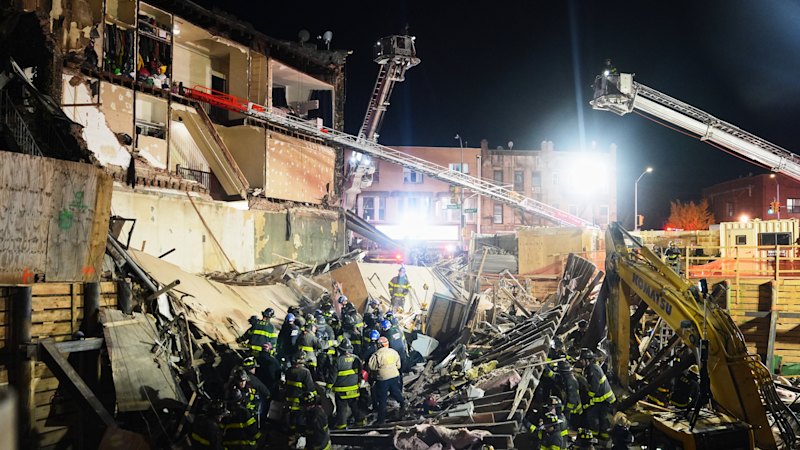
When a New York apartment block collapses and kills at least two people, the city reacts with predictable shock. News helicopters circle the dust cloud. Politicians hold press conferences in hard hats. Everyone asks how a residential building in one of the wealthiest cities on earth can simply give way.
Here's the uncomfortable truth. It shouldn't surprise anyone who pays attention to New York's aging housing stock and how building enforcement actually works on the ground.
Most people assume a catastrophic structural failure comes out of nowhere. A freak accident. An act of God. In reality, buildings rarely fail without leaving a trail of red flags that stretch back years—sometimes decades. Cracked load-bearing walls, illegal basement conversions, unpermitted structural work, and ignored Department of Buildings (DOB) violations are almost always sitting right there in the public record before the bricks hit the sidewalk.
What Happens Behind the Scenes of a Building Collapse
To understand why an apartment block comes down, you have to look at how New York was built. A massive portion of the city's residential buildings—especially pre-war walk-ups in the Bronx, Brooklyn, Manhattan, and Queens—rely on unreinforced masonry. That means brick walls carry the entire weight of the floors and roof above them.
Unlike modern steel-frame skyscrapers, masonry buildings have zero redundancy. Take out one critical section of a load-bearing wall, or let water rot the wooden floor joists tied into that brick, and the whole structure loses its equilibrium.
I've looked through hundreds of DOB violation histories over the years, and the pattern is painfully consistent. Landlords defer maintenance to protect margins. Contractors cut corners during renovations to save time. Tenants complain about doors suddenly sticking, floors sloping, or diagonal cracks spreading across plaster walls, and those complaints get buried in an administrative backlog.
Then one day, a crew removes a wall they thought was just a partition, or heavy rain saturates already compromised mortar, or vibrations from nearby construction push a weakened facade past its breaking point. Gravity does the rest in seconds.
The Enforcement Gap Nobody Wants to Fix
New York actually has some of the strictest building codes in the United States. Local Law 11—officially the Facade Inspection & Safety Program—requires owners of buildings taller than six stories to have their exterior walls inspected every five years. On paper, it sounds thorough.
In practice, there are massive blind spots.
First, smaller apartment blocks—four, five, and six-story walk-ups where millions of working-class New Yorkers live—fall outside Local Law 11's mandatory facade inspection rules. Nobody is legally required to put up scaffolding and check the brickwork on a five-story tenement every five years unless someone files a complaint.
Second, issuing a violation isn't the same thing as fixing a hazard. A landlord can rack up dozens of open DOB and Department of Housing Preservation and Development (HPD) violations, pay a fraction of the fines years later, or tie up enforcement in housing court while people continue sleeping under a compromised roof.
When a collapse kills residents, investigators almost always find a paper trail showing the city knew something was wrong long before emergency crews arrived with search dogs. The system is reactive by design. Inspectors respond to 311 calls, slap a paper notice on the front door, and move on to the next address on an impossibly long list.
Misconceptions About Structural Safety in NYC
If you live in a New York apartment, you've probably heard a few comforting myths about building safety. Let's clear them up right now.
Myth 1: "If the building is still standing after 100 years, it's built like a tank."
Old brick buildings aren't invincible. Mortar degrades over a century of freeze-thaw cycles. Water intrusion rusts steel lintels above windows, causing the metal to expand and crack the surrounding brick—a process engineers call "oxide jacking." Age isn't proof of durability; it's proof of wear.
Myth 2: "The city shuts down dangerous buildings immediately."
Full vacate orders are rare and usually happen only when a collapse is literally imminent or already underway. A building can have severe structural complaints and stay fully occupied for months while paperwork crawls through municipal agencies.
Myth 3: "Construction next door is harmless as long as they have permits."
Excavation and underpinning on an adjacent lot are among the leading triggers of residential collapses in New York. Digging below the foundation of an older neighboring building without proper shoring can cause the soil to shift and pull the older structure down. Even permitted sites routinely violate safety protocols when inspectors aren't watching.
How to Check If Your Own Building Is at Risk
You don't need an engineering degree to figure out whether your apartment building has serious structural baggage. New York makes its property records public, even if the interfaces feel like they were designed in 2004.
Start with the NYC Department of Buildings BIS (Buildings Information System) or DOB NOW portals. Type in your building's address and look at three specific things:
- Open ECB/OATH Violations: Check for anything labeled "Immediately Hazardous" (Class 1) or mentioning structural stability, bulging facades, or work without a permit.
- Stop Work Orders: A history of Stop Work Orders tells you the owner or their contractors have a habit of doing illegal construction.
- Neighboring Construction Permits: Look up the addresses immediately to your left, right, and rear. If someone is excavating a deep foundation next door, pay close attention to your own walls.
Next, check HPD Online for housing maintenance complaints. Look for recurring reports of water leaks from the roof or exterior walls. Water is the silent killer of masonry buildings; where water gets in, structural rot follows.
Physical Warning Signs You Should Never Ignore
Paper records tell you the history, but your own eyes tell you what's happening today. Walk around your apartment and the common hallways with a critical eye.
- Diagonal cracks running from the corners of windows or doorways. Hairline vertical cracks in old plaster are usually just settling, but stair-step cracks through brick or widening diagonal tears signal active structural movement.
- Doors and windows that suddenly jam when they opened fine a month ago. That means the frame is warping under shifting weight.
- Bulging or bowing exterior walls. Look up at the facade from across the street. A brick wall should look flat, not pregnant.
- Loud popping, creaking, or grinding noises coming from the walls or ceiling, especially when there's wind, heavy rain, or construction nearby.
- Unexplained dust or crumbling mortar appearing along baseboards or inside basement storage areas.
What to Do the Moment You Spot Trouble
If you see active structural shifting—like a widening crack, a bulging wall, or debris falling from the facade—don't email your landlord and wait three business days for a response.
Call 911 if the danger looks immediate, or call 311 and explicitly use the words "structural stability" and "bulging facade" or "illegal structural work" so the complaint gets routed to the DOB's emergency response unit rather than general housing maintenance.
Take timestamped photos and videos of everything. Send a written notice to your management company creating a paper trail, and talk to your neighbors. Buildings get inspected much faster when five different apartments call 311 on the same afternoon than when one tenant files a lonely complaint.
Every time a New York apartment block collapses and takes innocent lives, officials promise sweeping reforms and tighter oversight. Sometimes a few new rules get passed. Mostly, the news cycle moves on within a week, leaving tenants to rely on their own vigilance in a city full of aging brick and rushed construction. Check your building's DOB profile tonight, know the warning signs in your walls, and never assume someone else is watching out for the roof over your head.