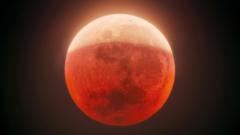
Observational astronomy often suffers from sensationalized media framing, particularly when rare celestial alignments occur. Coverage of the upcoming August 2026 partial lunar eclipse over the United Kingdom reduces a precise orbital alignment to vague descriptions of a blood moon. Deconstructing this event requires shifting away from superficial descriptions and evaluating the actual mechanical variables: shadow geometry, atmospheric refraction indices, and regional horizon constraints.
The Orbital Mechanics of the Earth Shadow Cone
A lunar eclipse is fundamentally an exercise in celestial geometry. The event occurs exclusively during the full moon phase, when the orbital plane of the Moon intersects closely enough with the ecliptic plane for the Earth to interpose directly between the Sun and the Moon.
The Earth casts two distinct shadow zones into space:
- The penumbra: The outer, lighter region where the Earth blocks only a fraction of the Sun's disk.
- The umbra: The central, conical core of the shadow where direct solar radiation is entirely occluded by the planetary disk.
For the August 28, 2026 event observed across the British Isles, approximately 93 percent of the lunar surface will penetrate the umbral boundary at maximum eclipse. This qualifies the event as a deep partial lunar eclipse rather than a total occlusion. Because the Earth's diameter is significantly larger than the Moon's, the umbral shadow cone at the distance of the lunar orbit spans roughly 9,000 kilometers across, creating a gradual ingress and egress timeline spanning several hours.
The Physics of Chromatic Filtering
The colloquial descriptor "blood moon" implies an active lighting change on the lunar surface, but the phenomenon is passive, driven entirely by the optical properties of the terrestrial atmosphere.
When the Moon is submerged within the umbra, it does not go black. Instead, the only sunlight reaching the lunar surface is filtered through the ring of Earth's troposphere. This light undergoes two distinct physical processes:
- Mie scattering: Interaction with atmospheric aerosols, water vapor, and dust particles, which scatters shorter wavelengths uniformly.
- Rayleigh scattering and refraction: The bending of longer electromagnetic wavelengths (reds and oranges) through the nitrogen-oxygen matrix of the air while shorter wavelengths (blues and violets) are stripped away.
The resulting hue and luminosity of the eclipsed lunar disk depend heavily on particulate loading in the stratosphere at the terminator line (the global circle separating day from night). Volcanic activity or severe wildfire smoke introduces aerosols that deepen the shadow to a dark brown or charcoal profile, whereas a clear stratosphere yields a bright copper-orange spectrum. Observers quantifying this utilize the Danjon scale, which categorizes lunar eclipse brightness from L=0 (nearly invisible) to L=4 (bright copper-red).
Regional Visibility Constraints in the United Kingdom
While solar eclipses require narrow visibility paths because the Moon's small shadow covers a restricted area of Earth, lunar eclipses are visible from an entire planetary hemisphere. Any location experiencing night during the event can view the progression.
However, geographic coordinates dictate the altitude of the target relative to the local horizon. For the British Isles, the temporal window creates strict observational bottlenecks:
- Penumbral phase initiation: 02:23 BST
- Umbral partial phase entry: 03:33 BST
- Maximum eclipse magnitude (0.93): 05:12 BST
- Moonset horizon intersection: Approximately 06:15 BST (varying by regional coordinates)
Because the maximum eclipse occurs shortly before dawn, the Moon will sit exceptionally low in the western-southwesterly sky. Observers face an obstructed sightline risk. Buildings, elevated terrain, and dense low-altitude atmospheric moisture will degrade the contrast ratio long before the partial phase concludes at 06:51 BST.
Observational Logistics and Equipment Requirements
Unlike solar events, which mandate certified polymer filters or indirect projection methods to prevent retinal damage, lunar observation requires no specialized safety equipment. The luminous flux density of filtered sunlight reflecting off the regolith is well below safety thresholds for human vision.
To maximize data collection or visual clarity during the event, optical setups should prioritize aperture size over magnification. Binoculars or small refractors enhance contrast against the brightening morning sky, allowing observers to track the crisp edge of the Earth's curved umbral shadow as it sweeps across lunar maria and highlands. Success relies strictly on minimizing light pollution and securing an unobstructed western horizon prior to 05:12 BST. Position observation posts at high elevations facing southwest to bypass low-altitude tropospheric haze.