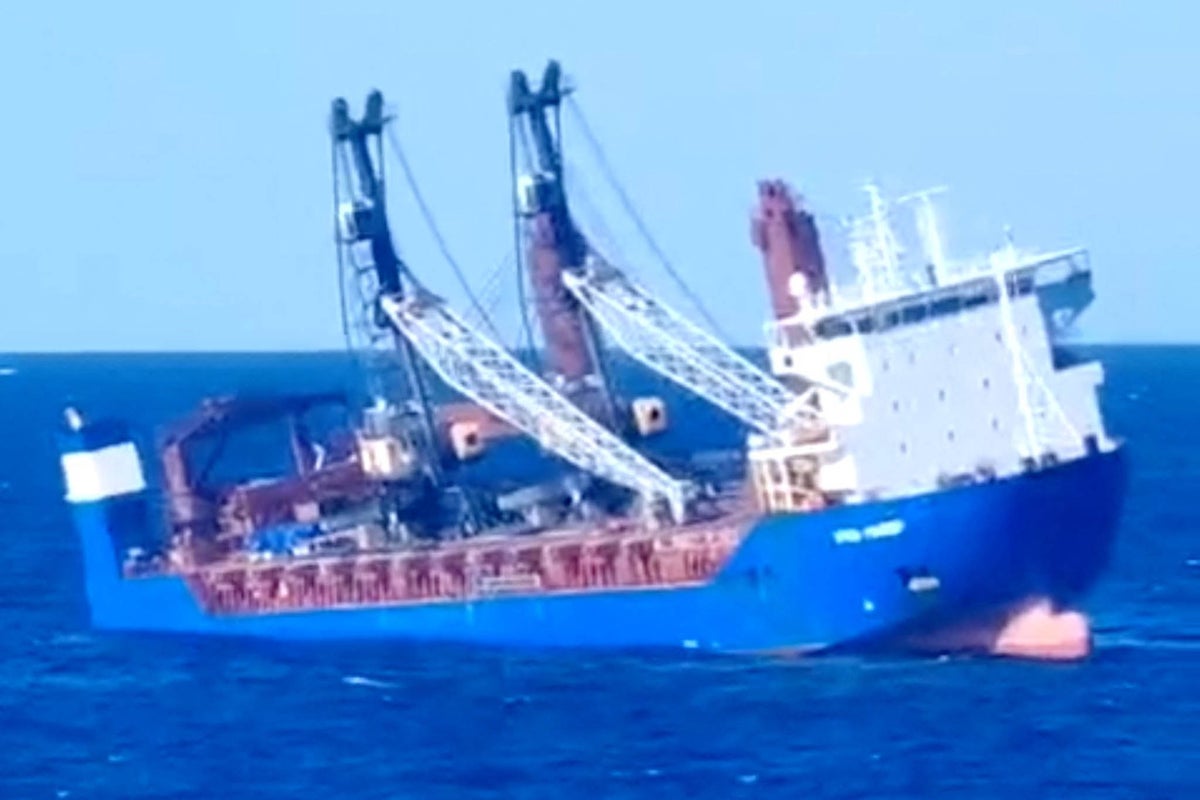
The sinking of the Sparta IV—a Russian-flagged cargo vessel sanctioned by the U.S. Treasury—near the Spanish coast represents more than a maritime casualty; it is a data point in the shifting logistics of sanctioned technology transfers. While initial reports focus on the spectacle of the sinking, the strategic significance lies in the cargo's likely destination and the specific technical nature of the suspected payload: specialized components for light-water or experimental nuclear reactors. Analyzing this event requires a breakdown of three critical vectors: the vessel’s operational history, the technical constraints of North Korean nuclear development, and the geopolitical incentive structures that bypass traditional shipping lanes.
The Logistics of Sanctioned Maritime Transit
The Sparta IV is not a standard commercial freighter. Owned by SC South LLC, a subsidiary of the Russian Ministry of Defense-linked Oboronlogistika, the vessel has a documented history of transporting military equipment between Novorossiysk and Tartus, Syria. Its movements are dictated by "dark" operational protocols, characterized by frequent AIS (Automatic Identification System) gaps and the use of ports that offer low transparency.
The vessel's presence in the Mediterranean, ostensibly heading toward the Atlantic, suggests a long-haul circumnavigation rather than a regional delivery. When a sanctioned vessel of this class sinks, the immediate concern is the "cargo manifest gap." Russia’s domestic nuclear industry, managed by Rosatom, maintains a surplus of hardware—ranging from coolant pumps to control rod assemblies—that are technically compatible with the aging infrastructure of the Yongbyon Nuclear Scientific Research Center or the newer Light Water Reactor (LWR) projects in North Korea.
Structural Incentives for the Russia-DPRK Nuclear Axis
The relationship between Moscow and Pyongyang has evolved from a diplomatic convenience to a hard-asset exchange. North Korea requires specific high-precision components that its domestic industry cannot yet reliably manufacture at scale. Conversely, Russia requires conventional munitions to sustain high-intensity operations in Ukraine. This creates a "Technology for Shells" trade framework.
The nuclear components suspected to be aboard the Sparta IV fall into three high-value categories:
- Primary Coolant System Hardware: High-pressure pumps and heat exchangers capable of handling the thermal output of a reactor core. These are massive, identifiable, and difficult to smuggle via air freight.
- Radiation-Hardened Electronics: Specialized sensors and monitoring equipment required to operate within a reactor’s containment structure.
- Fuel Assembly Handling Tools: Precision-engineered cranes and loading mechanisms that allow for the safe insertion and removal of fissile material.
Shipping these items via the Atlantic and around the Cape of Good Hope—rather than through the more monitored Suez Canal—minimizes the risk of boarding and inspection by NATO-aligned naval forces. The sinking near Spain occurs at a geographic bottleneck where the vessel would have been transitioning from the Mediterranean’s relatively high-density surveillance into the open Atlantic.
The Physics of Sinking and Cargo Recovery Risks
The depth of the water where the Sparta IV foundered determines the feasibility of a clandestine recovery operation. In maritime intelligence, a "strategic sinking" is a rare but non-zero possibility used to prevent the seizure of sensitive technology. However, the more likely scenario is a combination of mechanical failure and the inherent risks of "overloading" a vessel to maximize the value of a single high-risk voyage.
Displacement and Ballast Variables
Cargo vessels carrying heavy industrial nuclear components face unique stability challenges. If a shipment of reactor pressure vessel segments—which can weigh hundreds of tons—is not secured with extreme precision, a minor list can rapidly escalate into a catastrophic capsizing event. The center of gravity for such a vessel is highly sensitive to shifting loads.
If the Sparta IV was carrying dense, high-mass components for a reactor core, any hull breach or engine failure would leave the crew with a significantly reduced window for damage control. The rapid sinking reported suggests a massive loss of buoyancy or a structural failure consistent with the transport of heavy industrial steel.
Mapping the Proliferation Corridor
The route from the Black Sea to the Korean Peninsula via the Atlantic and Indian Oceans is a ten-thousand-mile logistical bypass. This corridor serves as a pressure valve for the "Sanctions Gap."
- The Mediterranean Phase: High risk of aerial surveillance. Vessels often "go dark" by disabling AIS to obscure their exact heading.
- The Atlantic Transition: The point of highest vulnerability to weather and mechanical stress. The sinking near Spain happened at the apex of this transition.
- The Indian Ocean Leg: Utilization of "shadow fleets" and ship-to-ship (STS) transfers to further obfuscate the origin of the cargo before reaching the Yellow Sea.
The failure of the Sparta IV to complete the first phase of this journey forces a recalibration of the risk-reward ratio for Russian maritime logistics. If the vessel was indeed carrying nuclear-related hardware, the loss represents a multi-year setback for the recipient's energy or weapons programs, as these components are not off-the-shelf items; they are often custom-machined for specific reactor architectures.
Technical Implications for North Korea’s LWR Program
North Korea’s push for a functional Light Water Reactor (LWR) is a dual-use strategy. While ostensibly for civilian power, an LWR provides a pretext for the enrichment of uranium and the production of plutonium. The specific hardware Russia is incentivized to provide would bridge the gap between North Korea's current experimental stages and a stable, grid-connected power source.
The "Cold Chain" of nuclear procurement requires that components remain uncontaminated and structurally sound. A sinking in saltwater renders most nuclear-grade electronics and precision-machined valves useless due to corrosion and pressure-induced deformation. Even if the wreckage is located, the "salvage value" of the technology is effectively zero for the original intended use. This makes the Sparta IV a total loss for the proliferation network.
The Intelligence Bottleneck
The primary limitation in analyzing this event is the lack of a verified manifest. However, maritime analysts look for "surrogate indicators" of sensitive cargo:
- Vessel Modification: Were the cranes on the Sparta IV upgraded recently to handle heavier loads?
- Port Security: Did the vessel load at a civilian dock or a restricted military terminal in Novorossiysk?
- Insurance Anomalies: Sanctioned vessels often operate without traditional Western P&I (Protection and Indemnity) insurance, meaning the financial loss is borne entirely by the state or the specific state-owned enterprise.
The absence of a distress call or the specific timing of the crew’s evacuation can also signal whether the sinking was a controlled event or a genuine accident. In this instance, the location—international waters near Spain—is suboptimal for a "controlled" sinking if the goal was to keep the cargo out of the hands of Western intelligence, as the Spanish Navy and NATO allies have advanced deep-sea monitoring and submersible capabilities in the region.
Strategic Realignment of Sanctioned Shipping
The loss of the Sparta IV necessitates an immediate shift in how sanctioned states move heavy-duty industrial assets. We can project three tactical responses:
- Increased Reliance on Rail: If maritime routes through the Mediterranean are deemed too high-risk or prone to failure, the Trans-Siberian corridor becomes the primary artery. However, rail is limited by gauge changes and weight capacities that ships easily exceed.
- Modularization of Cargo: To avoid the stability risks that likely contributed to the Sparta IV sinking, shippers may attempt to break down nuclear components into smaller, less conspicuous packages spread across multiple smaller vessels.
- Escorted Transits: Future high-value transfers may involve Russian naval escorts, though this would signal the nature of the cargo to every intelligence agency in the world, defeating the purpose of a "gray zone" operation.
The sinking serves as a stress test for the Russia-DPRK logistics chain. It highlights the physical reality that even the most sophisticated geopolitical maneuvering is subject to the unforgiving physics of the ocean. For Spain and the broader EU, the presence of a sunken vessel potentially containing sensitive industrial or nuclear hardware within proximity to their territorial waters creates a long-term environmental and security monitoring requirement.
The most effective counter-proliferation strategy following this event is the deployment of deep-sea ROVs (Remotely Operated Vehicles) to conduct a "thermal and isotopic survey" of the wreck site. Identifying the presence of specific alloys or trace radiation would confirm the nature of the cargo, providing the necessary evidence to tighten maritime secondary sanctions on the remaining vessels in the Sparta class. This is not merely a shipwreck; it is a forensic site for the future of global security.