The milk in Clara’s refrigerator turned three days ago. By yesterday afternoon, the thick, sour smell had escaped the seal and settled into the corners of the kitchen like an uninvited guest. Today, she doesn't open the door at all. There is no point. Inside, the shelves hold only warm condiments and a carton of eggs that she eyes with a quiet, growing suspicion.
Outside her kitchen window, the air hangs heavy and indifferent.
In an Indiana city that has spent the last seventy-two hours swallowed by an unyielding blackout, time has lost its sharp edges. The clocks on the microwave are blank, dead faces. The digital thermostats are dark. Even the streetlights, usually a comforting amber anchor against the midnight sky, are hollow glass bulbs casting no reflection on the wet asphalt below.
Silence is the loudest thing in the house.
We talk about power outages in the language of spreadsheets and municipal reports. We hear about megawatts, downed transmission lines, and regional grid operators scrambling to reroute voltage. We read the dry bulletins issued by utility companies: crews dispatched, assessments underway, restoration estimated by Tuesday evening.
Numbers. Percentages. Technical jargon meant to soothe an anxious public.
But a power outage is not a statistic. It is a slow unraveling of modern gravity.
Consider what happens when the electricity vanishes without warning. In the first hour, it’s an inconvenience. A flickering of lights, a collective groan from the neighborhood porch, and the immediate reach for smartphones to check the weather radar. By hour twelve, the novelty is gone. The phone batteries begin to dip into the red zone, glowing like dying embers in darkened living rooms. By hour thirty-six, the refrigerator has stopped fighting the ambient heat, and the quiet hum of domestic life is replaced by the erratic, mechanical roar of neighborhood generators rattling on back patios, smelling of gasoline and exhaustion.
Clara, seventy-four years old and living alone in a neighborhood choked by fallen maples, knows this rhythm by heart. She didn't lose power in the winter storms of her youth—back then, woodstoves kept the chill at bay. But this is different. This is a modern paralysis.
Without power, her life is suspended. Her blood pressure medication, stored in a pharmacy forty minutes away, relies on a computerized refill system she cannot access. The cordless landline is useless. The television, her primary companion through the long afternoon hours, is a black glass mirror reflecting her own lined face.
She sits in her rocking chair near the front window, listening to the distant, rhythmic thrum of utility trucks idling down the county road two blocks over.
Relief, they say, may be near.
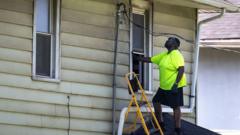
The phrase hangs in the local news broadcasts, pulled off car radios running on dying car batteries. Utility crews from three neighboring states have converged on the county, working in eighteen-hour shifts beneath halogen floodlights that cut through the Indiana humidity like surgical knives. Linemen—men and women with grease-stained knuckles and heavy tool belts—are currently dangling fifty feet in the air above tangled nests of aluminum wire and splintered oak branches.
To the average commuter driving past a blocked-off intersection, those workers are just orange vests and flashing amber hazards. But to Clara, they are the architects of normal life.
There is an invisible architecture holding our days together. We build our entire existence on the assumption that flicking a switch will summon illumination, that turning a tap will deliver clean water, that pressing a button will ignite a flame. We forget that this modern miracle is a fragile web spun by human hands.
When a severe summer storm rips through the Midwest, snapping century-old trunks like dry twigs and tearing heavy-duty high-voltage lines from their moorings, that web tears. And when it tears, we are instantly thrown back into a raw, unfiltered vulnerability.
Down the street from Clara, a young family of four is camping in their own living room. A tent pitched on the hardwood floor serves as a novelty for the six-year-old, but for the parents, the mood is tense. The cooler in the bathtub is melting, its ice replaced by lukewarm water floating the remnants of last week's groceries. The father has made three trips to the local gas station just to charge his work laptop in the cigarette lighter of his sedan, desperately typing out client emails while parked under the harsh glare of a canopy light, eating warm crackers from a box.
They are waiting. Everyone is waiting.
The psychological weight of a blackout is not born from hardship alone, but from the complete absence of a timeline. If you know a storm will last two hours, you endure it. If you know it will last a week, you pack your bags and leave. But forty-eight hours stretching into seventy-two, with every evening news broadcast offering a hesitant "maybe tonight" or "barring any unforeseen complications," creates a unique kind of psychological static. You cannot unpack your bags, and you cannot settle into the dark. You are suspended in amber.
Yet, in the very heart of that suspension, something else happens.
The neighborhood porch lights may be dead, but the front porches themselves are crowded. Yesterday evening, three doors down, a family hauled a charcoal grill out to the driveway because the gas stove wouldn't ignite. They didn't cook in isolation. Within twenty minutes, neighbors wandered over with defrosted hot dogs that would otherwise spoil, a warm bag of potato chips, and a plastic pitcher of tap water filled from the one house on the block lucky enough to have a deep-well hand pump.
They sat on lawn chairs in the gathering dusk, talking in low, unhurried tones about nothing in particular. In the absence of television screens and glowing rectangles, they looked at each other’s faces. They remembered names they hadn't spoken aloud in months.
It is a strange paradox of infrastructure: we build vast, complex networks to isolate ourselves in the comfort of our own private homes, yet it is only when those networks break down that we remember we are part of a village.
At the main substation two miles away, a lead technician named Marcus wipes sweat from his forehead with the back of a grime-caked forearm. He hasn't slept in twenty-four hours. Before him lies a massive control panel glowing with diagnostic readouts, a maze of circuit breakers and relay switches that look like the exposed nervous system of a metallic beast.
He points a finger at a blinking red indicator light on sector four.
"That's the transformer feeding the residential west side," he tells a younger apprentice, his voice hoarse from shouting over the diesel roar of temporary generators. "We clear that line, and three thousand homes come back online simultaneously."
The apprentice nods, his eyes bloodshot, gripping a heavy insulated wrench like a talisman.
They are the unseen boundary between civilization and chaos. We rarely think of them when the air conditioning hums quietly in the background on a Tuesday afternoon. We only see them when the world stops.
Back on her front porch, Clara watches the sun dip below the jagged silhouette of the treeline, painting the western sky in bruised shades of violet and orange. The air is cooling down just enough to offer a breath of relief.
A sudden, sharp sound cuts through the neighborhood stillness.
It isn't the rumble of a generator. It is the deep, electric sigh of a transformer box resetting down the alley.
Across the street, a single porch light stutters, blinks twice, and then holds steady in the gathering dark. A second later, the streetlamp at the corner pops to life, casting a warm, familiar pool of yellow light over the wet pavement.
In Clara’s kitchen, the silent refrigerator shivers, clears its throat, and begins its steady, beautiful hum.