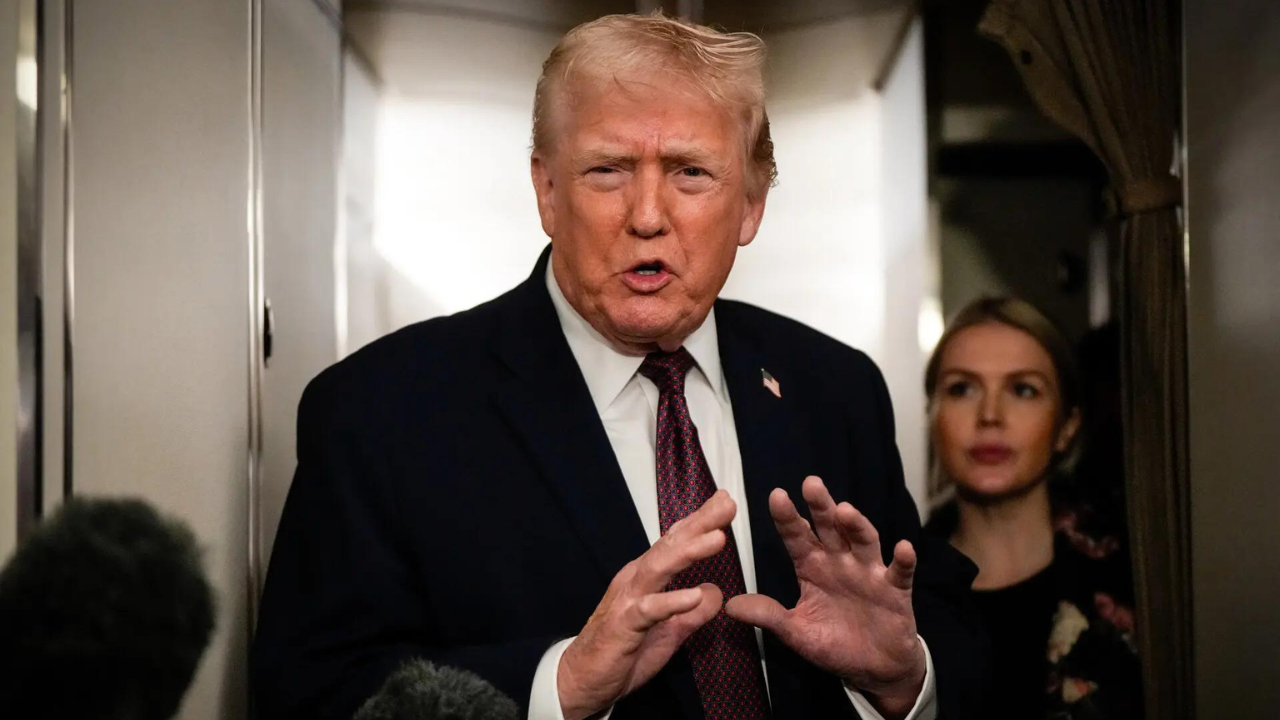
The air in the Oval Office is heavy, not with the scent of old wood or floor wax, but with the invisible weight of a clock that refuses to stop ticking. Donald Trump sits behind the Resolute Desk, a slab of oak that has seen the birth of doctrines and the death of empires. He is restless. He is, by all accounts filtering through the thick walls of the West Wing, not exactly happy.
It is a specific kind of frustration. It is the irritation of a closer who has been told the game is moving into extra innings, and the lights in the stadium are flickering. For a man whose entire brand is built on the art of the definitive "yes" or the crushing "no," the gray space of nuclear diplomacy with Iran is a suffocating fog.
The Ghost of the Grand Bargain
To understand the current tension, you have to look past the cable news chyrons and into the mechanics of the deal itself. Diplomacy, at this level, isn't about handshakes. It is about leverage—that cold, hard currency of international relations. Trump inherited a board where the pieces were already moved, a JCPOA agreement he viewed not as a bridge, but as a trap door.
He tore it up. He applied "maximum pressure." He expected the walls to cave in.
Instead, he found a regime that has mastered the art of the long game. Imagine a high-stakes poker match where one player is betting his house, his car, and his reputation, while the other player is betting with chips he’s been hiding in his sleeves for forty years. Iran doesn't play by the quarterly earnings cycle of Western politics. They play by the century.
This mismatch of timelines is what creates the friction. Trump wants the "Big Deal." He wants the photo op that rivals Singapore, the signature that echoes through history, the finality of a problem solved. But Tehran offers only incrementalism, a slow-motion dance of "maybe" and "not yet."
The Invisible Stakes in the Strait
While the talk remains centered on centrifuges and enrichment levels, the real story lives in the narrow, turquoise waters of the Strait of Hormuz.
Consider a hypothetical merchant sailor named Elias. He’s three weeks into a haul, carrying millions of barrels of crude. For Elias, "nuclear talks" aren't an abstract policy debate. They are the reason he scans the horizon for fast-attack craft every morning. They are the reason his insurance premiums have spiked so high his company is considering cutting his hazard pay just to stay afloat.
When the President expresses dissatisfaction with the pace of talks, Elias feels it in the tightening of his chest. If the diplomacy fails, the friction doesn't stay in a briefing room in Vienna or Geneva. It spills into the water. It raises the price of a gallon of gas in a suburb in Ohio. It dictates whether a factory in Germany can afford its power bill next winter.
The nuclear issue is the sun around which every other regional conflict orbits. If the sun goes dark, everything else freezes.
The Language of the Unspoken
There is a psychological component to this standoff that often gets lost in the technical jargon of breakout times and heavy water reactors. Trump operates on a frequency of dominance. He perceives the world as a series of winners and losers. In his view, the very act of Iran hesitating is an affront—a sign that the "maximum pressure" hasn't yet reached the bone.
But for the leadership in Tehran, survival is the only metric that matters. They watched what happened to regimes that gave up their unconventional weapons programs without ironclad guarantees. They saw the footage from Libya. They remember the history. To them, the nuclear program is more than a weapon; it is a life insurance policy.
This is the fundamental disconnect. One side wants a transaction. The other side wants a transformation.
The President’s unhappiness stems from the realization that you cannot bully a ghost. You cannot bankrupt a country that has been under some form of sanctions since the disco era and has built an entire "resistance economy" around that reality. The tools that work on a New York real estate developer or a rival CEO are blunt instruments when applied to a revolutionary theocracy.
The Cost of the Stalemate
Politics is often described as the art of the possible, but right now, it feels more like the art of the agonizing.
Every day that passes without a breakthrough, the technical reality on the ground changes. Iran’s centrifuges spin faster. Their stockpiles grow. The "breakout time"—the theoretical window they need to produce enough material for a weapon—shrinks from months to weeks, and then to days.
It is a terrifying arithmetic.
$$T = \frac{M}{R}$$
In this simplified model, $T$ is the time to breakout, $M$ is the mass of enriched material required, and $R$ is the rate of production. As $R$ increases due to more advanced machinery, $T$ plummets.
Trump knows this math. His advisors whisper it to him during the morning briefs. He knows that "not exactly happy" is the polite way of saying that the window for a non-military solution is closing. He is staring at a legacy that could either be defined by the man who stopped the bomb, or the man who presided over its arrival.
The Human Toll of the Ledger
We talk about "sanctions" as if they are a dial on a machine. In reality, they are a weight on a human back. In the bazaars of Isfahan, the price of medicine for a child with a chronic heart condition isn't a policy point. It’s a tragedy.
When the talks stall, the currency devalues. When the currency devalues, the middle class vanishes. When the middle class vanishes, the only people left with power are the ones with the guns.
The irony of the current stalemate is that the very pressure intended to force Iran to the table often empowers the hardliners who want to stay away from it. It creates a siege mentality. It turns the "Great Satan" into a tangible, everyday enemy responsible for the empty shelves in the grocery store.
The President is frustrated because he sees the leverage he has built, but he cannot seem to find the fulcrum. He has the sanctions. He has the military might. He has the global stage. Yet, the signature remains elusive.
The Silence of the Room
There is a specific kind of silence that happens in the middle of a high-stakes negotiation. It’s the moment after an offer is made, when the only sound is the hum of the air conditioning and the heartbeat in your ears.
Trump is a man who hates silence. He wants movement. He wants noise. He wants the "clink" of the pen hitting the desk after a successful signing ceremony.
Instead, he is getting reports of slow-walked meetings and vague demands. He is watching his European allies hedge their bets, trying to build financial workarounds that bypass the American dollar. He is seeing his "maximum pressure" campaign yield maximum complexity.
The tragedy of the situation is that both sides are likely right about their own fears. Trump is right that the original deal was flawed and temporary. Iran is right that the United States is a fickle partner whose policy can do a 180-degree turn every four years.
How do you build a bridge on shifting sand?
You don't. You just stand on your side of the river and shout, hoping the wind carries your voice.
The President isn't just unhappy with Iran; he is unhappy with the limitations of power. He is discovering that being the leader of the free world doesn't mean you get to dictate the ending of every story. Sometimes, the characters refuse to follow the script. Sometimes, the plot twists are out of your control.
The shadow over the Resolute Desk is growing longer as the afternoon sun dips below the Washington Monument. The clock is still ticking. The centrifuges are still spinning. And the man who promised to make the best deals in the world is finding that some debts can never be settled, and some fires can never be fully extinguished.
He stares at the phone, waiting for a call that may never come, while the rest of the world holds its breath, wondering if the next sound they hear will be a pen on paper or the low rumble of a storm that has been brewing for forty years.