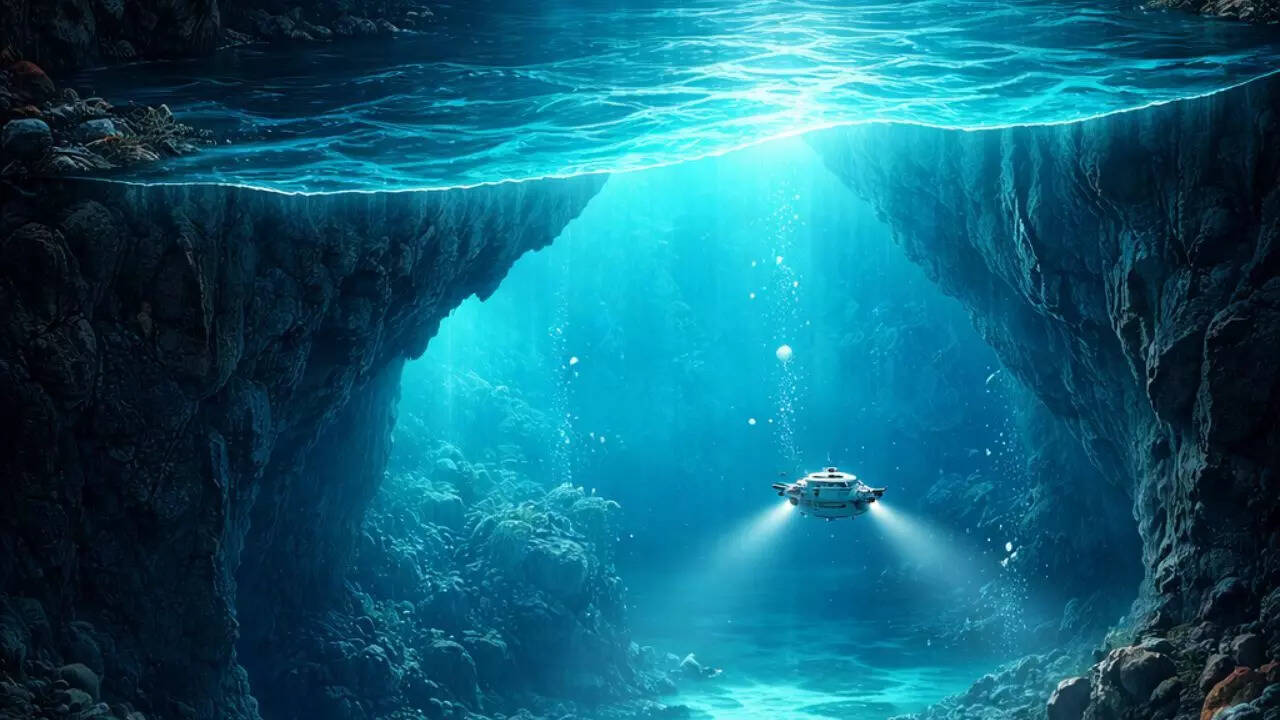
Imagine a reservoir so vast it could fill 1.1 billion Olympic-sized swimming pools. Now imagine it's tucked away where you’d least expect it—trapped beneath the salty, crushing weight of the Atlantic Ocean. For decades, mariners and oil drillers whispered about hitting "low-salinity" water while working off the U.S. East Coast. They weren't crazy.
A team of researchers from Columbia University and the Woods Hole Oceanographic Institution finally mapped this massive expanse. It stretches from at least the shores of New Jersey down to Florida. This isn't just a geological curiosity. It’s a 20,000-year-old time capsule of freshwater that might just be the most important insurance policy for a planet running dry. Meanwhile, you can explore other developments here: The Cold Truth About Russias Crumbling Power Grid.
Most people think of the ocean floor as a wasteland of salt and silt. They're wrong. This hidden treasure, known as a "sub-seafloor freshwater aquifer," exists because of how the Earth behaved during the last Ice Age.
How Freshwater Ends Up Under the Sea
You're probably wondering how fresh water stays fresh when it’s surrounded by the Atlantic. It feels like a physics mistake. But it's actually about timing and pressure. Roughly 20,000 years ago, much of the world’s water was locked up in massive glaciers. Sea levels were significantly lower than they are today. To explore the complete picture, check out the excellent analysis by NPR.
Back then, the continental shelf—the part of the ocean floor that’s now underwater—was dry land. When those glaciers started melting, the runoff didn't just sit on the surface. It soaked into the ground. It filled the porous sediments, creating giant underground lakes. As the Ice Age ended and sea levels rose, the ocean swallowed the land, but it couldn't easily displace the water already trapped in the deep, heavy clays and sands.
The weight of the ocean actually helps keep this water in place. Think of it like a giant sponge. The salty seawater is denser than the freshwater, but the fine-grained sediments act as a barrier. The water discovered by the Columbia University team, led by Chloe Gustafson, isn't just a few pockets here and there. We're talking about a continuous band of "freshened" water. It sits about 600 feet below the ocean floor and extends nearly 50 miles out to sea.
The Scale of the Discovery
Let’s talk numbers because they're staggering. This aquifer contains at least 2,800 cubic kilometers of low-salinity water. If you look at the U.S. Northeast, this is enough water to cover the entire region in a lake two feet deep.
Researchers used electromagnetic imaging to find it. Saltwater conducts electricity much better than freshwater. By dropping sensors to the seafloor and measuring how electromagnetic waves traveled through the crust, the team could "see" where the fresh stuff was hiding.
What they found was a massive, blurry gradient. Near the shore, the water is nearly as fresh as what comes out of your tap. As you move further out toward the edge of the continental shelf, it gets "brackish," meaning it’s a mix of salt and fresh. This is actually a good thing. Brackish water is significantly cheaper and easier to desalinate than raw seawater.
Why We Cant Just Start Pumping Tomorrow
Before you think we’ve solved the global water crisis, we need to be realistic. This isn't as simple as sticking a giant straw into the ocean floor. Pumping water from under the sea is expensive. It's technically challenging.
There's also the risk of land subsidence. If you pull too much water out of those underground sediments, the ground above can collapse. When that happens on the ocean floor, it can lead to underwater landslides.
However, we’re already seeing cities like Perth and San Diego spend billions on coastal desalination plants. Those plants take incredibly salty seawater and force it through membranes at high pressure. It’s a massive energy suck. If those same plants could pull "freshened" water from the seafloor instead, the energy costs would plummet. You're starting with a product that's already 90% of the way to being drinkable.
The Global Implications
The Atlantic discovery is the biggest one we've found so far, but it isn't the only one. Scientists are starting to realize these hidden aquifers might be a global phenomenon. Similar deposits have been hinted at off the coasts of Australia, China, and South Africa.
We’ve spent centuries looking at the surface of the ocean for resources—fish, shipping lanes, oil. We’ve barely looked inside the crust. This discovery suggests that the continental shelves of the world might be hiding enough water to sustain mega-cities for centuries.
It changes the math for coastal urban planning. If you're a city manager in a drought-prone area, you aren't just looking at the sky for rain anymore. You're looking at the seabed.
The Environmental Catch
I’m not going to pretend this is a consequence-free gold mine. These aquifers are "fossil water." That means once you use it, it’s gone. It doesn't refill—at least not on a human timescale. We’d be mining a prehistoric resource.
There's also the ecosystem to consider. We don't fully understand how these deep freshwater pockets interact with the seafloor biology. Does that freshwater slowly seep out and support specific types of marine life? If we suck the aquifer dry, do we destroy a habitat we haven't even mapped yet? These are the questions that keep geologists up at night.
Taking Action on Water Security
This discovery should be a wake-up call for how we manage our most precious resource. Even with a massive "backup tank" under the Atlantic, the cost of extraction remains high. The best move right now isn't to build a fleet of underwater pumps, but to invest in the tech that makes extraction viable when the time comes.
You can actually track these developments through the International Ocean Discovery Program (IODP). They provide public data on sub-seafloor research. If you live in a coastal state, look into your local groundwater management plans. Most of them don't even have "offshore aquifers" on their radar yet. They should.
Start by supporting local water conservation and advocating for diversified water portfolios in your city. The water is there. It’s been there since the mammoths roamed. We just need to be smart enough not to waste it before we even get the chance to use it.
Check the USGS (United States Geological Survey) coastal groundwater maps to see if your region sits above one of these "freshened" zones. Knowledge of your local geology is the first step toward demanding better long-term resource management from your local government.