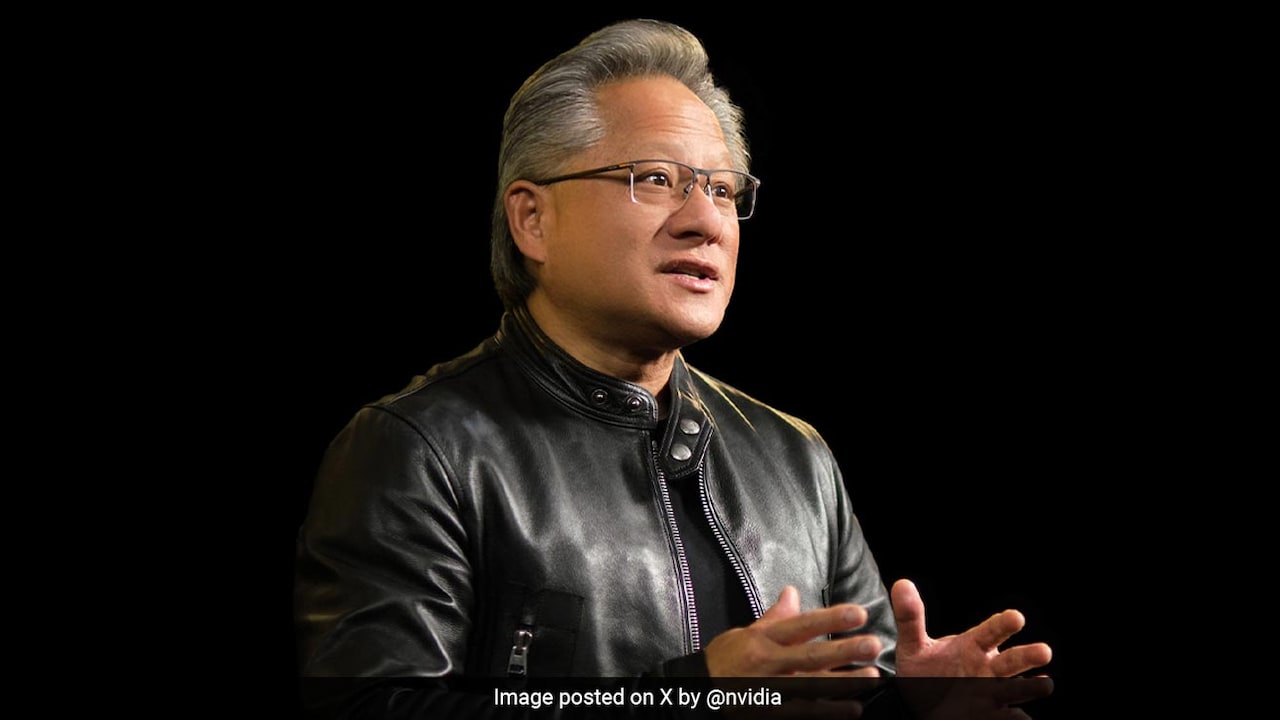
The room goes cold first. Not from the air conditioning, though server farms and corporate boardrooms share a fondness for keeping things refrigerated, but from the sudden vacuum left when the loudest heartbeat in modern computing stops echoing off the walls.
Imagine—as a purely hypothetical exercise to ground what is actually a very real corporate earthquake—a mid-level hardware architect named Elena sitting in a glass-walled conference room in Santa Clara. Her badge has hung around her neck since the days when graphics cards were mostly bought by teenagers trying to render water reflections in first-person shooters. For decades, Elena has operated under a single, unspoken gravitational law: Jensen Huang is at the center of the universe. When an engineering bottleneck threatened to stall an entire generation of silicon, Jensen didn't send a memo through three layers of middle management. He walked down the hall, asked uncomfortable questions at a whiteboard until midnight, and made a terrifyingly expensive bet on an architecture nobody else believed in yet. Meanwhile, you can find other events here: Stop Asking If Fighting Climate Change Is Good for Business.
Now picture Elena staring at a press release. The words are scrubbed clean by corporate lawyers, polished until they reflect nothing at all. Phrases like "initiating search for permanent CEO" sit on the screen like sterile surgical instruments.
Stop. Read those six words again. To understand the full picture, check out the detailed article by The Wall Street Journal.
For anyone who has spent the last ten years watching artificial intelligence mutate from a dusty academic curiosity into the primary engine of the global economy, the idea of Nvidia without Jensen Huang feels less like a normal executive transition and more like removing the spine from a living organism to see if it can still stand up straight.
The Architecture of an Obsession
To understand why a single departure statement sends shockwaves through pension funds, sovereign wealth accounts, and late-night engineering labs from Taipei to Austin, you have to strip away the stock charts. Everyone knows the numbers. Everyone has seen the parabolic curve that turned a humble graphics chip designer founded at a Denny's booth in 1993 into a multi-trillion-dollar colossus.
Numbers lie by omission. They make triumph look inevitable.
I remember sitting in the back of a dimly lit auditorium years ago, long before artificial intelligence became a dinner-table phrase, watching Jensen pitch a technology called CUDA to a room full of skeptical analysts. Wall Street hated it. They saw a CEO burning billions of dollars of shareholder cash to build software tools for a market of scientists and researchers that barely existed. In the hallway afterward, an institutional investor muttered to me that Huang was "indulgently chasing science projects while his core gaming margins got squeezed."
That investor missed the invisible truth. Jensen wasn't building a chip company; he was building a nervous system. While competitors obsessed over quarterly unit shipments and incremental clock speeds, he spent twenty years laying down tracks for a train nobody else could hear coming. By the time the rest of Silicon Valley realized that parallel processing was the secret key to unlocking neural networks, Nvidia didn't just hold the lead. They owned the entire railroad.
When a leader operates with that kind of monolithic conviction, the company stops being a standard corporation and becomes an extension of one human brain. There are no traditional layers of bureaucracy insulating the top floor from the loading dock. Nvidia famously operates with a flat organizational chart—dozens of vice presidents reporting directly to the man in the black leather jacket, skipping the standard corporate game of telephone where bad news gets softened at every rung of the ladder.
That structure is a superpower when the founder is in the chair. It becomes an existential terror the second he stands up.
The Myth of the Plug-and-Play Executive
Wall Street loves to pretend that great companies are machines with interchangeable parts. Boards of directors hire executive search firms, draw up glossy matrices of "core competencies," and reassure nervous shareholders that the bench is deep. They point to Apple after Steve Jobs, or Microsoft after Bill Gates, as proof that an institution can outlive its creator without missing a beat.
Here is the uncomfortable reality that corporate governance experts rarely admit out loud: those transitions are miracles, not templates.
Think of a founder-led empire as a custom-built Formula One car tuned specifically to the reflexes of one driver. Every aerodynamic curve, every brake bias setting, every hair-trigger throttle response is calibrated to how that specific person feels the road through their fingertips. You can put another world-class driver in the cockpit, someone with a trophy case full of championships and an impeccable resume, and they will spin out on the first wet corner because the machine wasn't built for normal human instincts.
When an official statement announces a search for a permanent chief executive, the financial press immediately starts playing parlor games. They line up internal lieutenants alongside external heavyweights from rival semiconductor giants. They debate operational discipline versus visionary product roadmaps. They treat the vacancy like an open seat on a city council.
Look closer at what actually happens inside the building during those months of limbo.
In our hypothetical scenario back in Santa Clara, Elena isn't worried about her stock options vesting. She is worried about the terrifying projects. Under Jensen, Nvidia thrived on bets that looked suicidal on a spreadsheet—initiatives with a five-year time horizon and a fifty percent chance of flaming out in public. When an interim leader steps in, or when a board begins vetting outside candidates whose primary qualification is "not rocking the boat," risk tolerance evaporates overnight.
Middle managers start hoarding budgets. Engineers stop proposing wild architectural leaps because nobody wants to be the person pitching a three-billion-dollar gamble to an acting executive whose main goal is keeping the stock price flat until the permanent replacement arrives. The immune system of a hyper-aggressive innovator begins to attack its own antibodies.
Why Competitors Are Secretly Holding Their Breath
You might assume that every rival executive in Silicon Valley opens a bottle of champagne the moment an Nvidia succession headline hits the wire. For years, competitors have thrown billions of dollars at trying to break the stranglehold Nvidia holds over data centers. Custom silicon projects, open-source software coalitions, desperate price cuts—nothing has dented the fortress.
Yet if you talk privately to the engineers and strategists working at rival chipmakers, you find a strange, conflicted anxiety.
Competitors know how to fight Jensen Huang. They know his patterns. They know he will release new architectures on an annual cadence so brutal it forces everyone else to burn through their R&D budgets just to stay in the rearview mirror. They know he will bundle hardware, networking, and proprietary software so tightly that ripping Nvidia out of a data center feels like performing open-heart surgery on a marathon runner mid-race.
An unknown successor introduces chaos into a chessboard where every piece had predictable rules.
Will a new CEO—especially one recruited from the outside—decide to appease regulators and hyperscale cloud customers by opening up Nvidia's closed software ecosystem? Or will they retreat into safe, margin-protecting defensive plays, accidentally leaving a crack in the armor wide enough for hungry startups and custom-chip teams to slip through?
Even more unsettling is the geopolitical tightrope. Semiconductors are no longer just commercial products; they are the primary currency of national security. Navigating export controls, supply chain bottlenecks across the Taiwan Strait, and tense diplomatic standoffs requires more than technical brilliance. It requires personal credibility built over thirty years of handshakes in foundry cleanrooms and government ministries. You cannot transfer three decades of trust via a handover memo.
The Gravity of a Single Voice
Consider what happens when a customer—say, the chief technology officer of a massive cloud provider spending ten billion dollars a year on compute—picks up the phone during a supply crunch.
Historically, that call ended with Jensen. He could allocate scarce wafers, redirect engineering teams, and make binding multi-billion-dollar commitments on the spot without checking with a committee. That speed is why Nvidia dominated the generative AI boom; while other companies were scheduling alignment meetings to discuss capacity expansion, Nvidia had already bought up the supply chain.
Search committees rarely hire icons. Search committees hire consensus candidates.
By design, the process of vetting a permanent CEO filters out the eccentric, abrasive, obsessive traits that made the founder unstoppable in the first place. A board looking to protect trillions of dollars in market value naturally gravitates toward steady hands, polished communicators, and seasoned operators who speak the soothing language of quarterly predictability.
I have watched this exact movie play out across three decades of covering technology. A legendary founder steps back. The board installs a brilliant, disciplined operator. For the first two years, profits actually go up because the new leader trims the "wasteful" moonshot projects and squeezes efficiency out of the supply chain. Wall Street applauds the newfound maturity. Analysts write glowing notes about operational rigor.
Then, four years later, the wave breaks—and the company realizes it never built the surfboard for the next swell because the person who used to obsess over distant horizons was replaced by someone paid to optimize the present.
What Remains When the Jacket Leaves the Room
Walk through the lobby of Nvidia's headquarters in Santa Clara and you are standing inside a giant triangle—a nod to the basic geometric polygon that forms the foundation of computer graphics. Every angle, every beam of natural light, every open staircase was designed to enforce collision, transparency, and relentless forward motion.
Buildings outlive their architects, and great engineering cultures possess a stubborn momentum of their own. Tens of thousands of brilliant engineers do not suddenly forget how to design parallel processors or write compiler code because the name on the corner office door changes. The sheer gravitational mass of Nvidia's installed hardware base, combined with millions of developers trained exclusively on its software stack, creates a moat wide enough to survive years of turbulence.
Yet anyone who tells you that leadership transitions at this altitude are routine is selling comfort over truth.
The real story hidden beneath the sterile corporate phrasing of a CEO search isn't about who gets the title next, how the stock reacts on Monday morning, or what severance package gets filed with the regulators. It is about whether an organism engineered to run at a permanent, terrifying sprint can teach itself how to breathe without the man who set the pace.
Somewhere in a lab, a young engineer is sketching an architecture that won't ship for six years, wondering if the next person wearing the badge at the top of the org chart will have the nerve to sign the check.