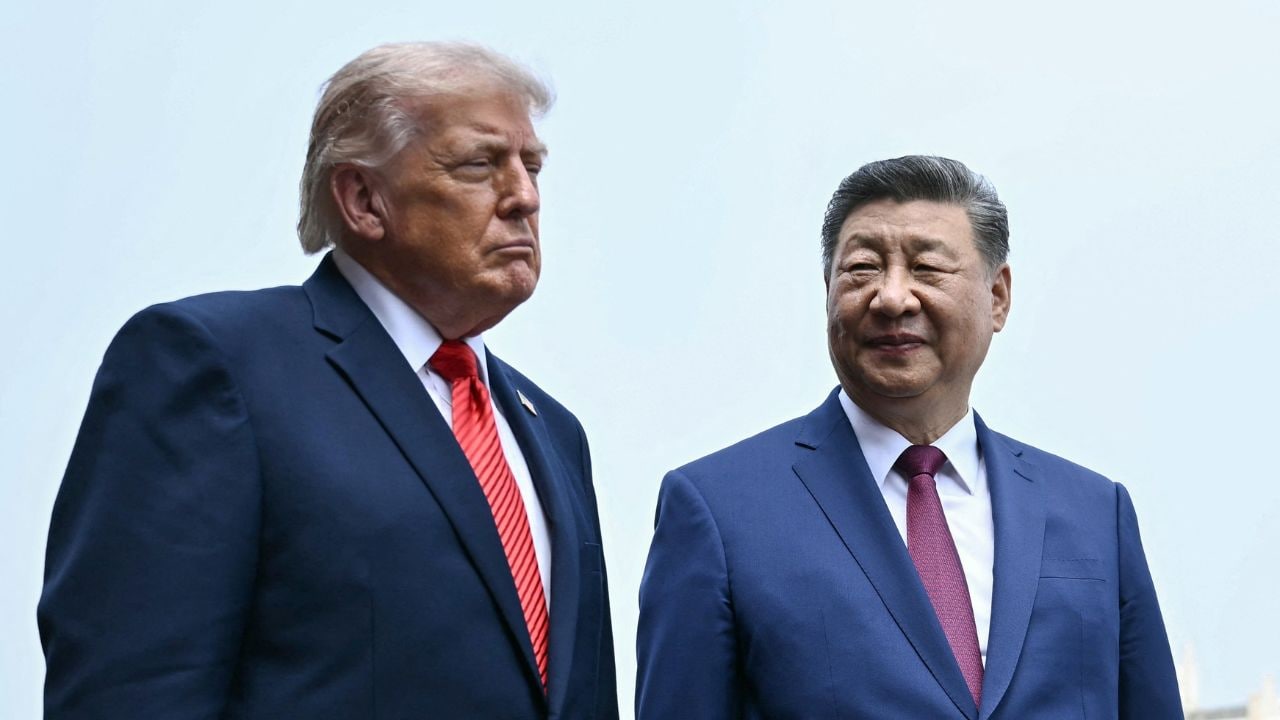
The financial press is currently obsessed with a narrative that belongs in a 1990s textbook. They see a "deal-maker" president heading to Beijing and a "hawkish" central banker taking the reins at the Federal Reserve, and they conclude we are entering an era of stability and pragmatic growth. They are wrong. This isn't a return to normalcy. It is the beginning of a systemic fracture that most analysts are too terrified to acknowledge.
The consensus view suggests that diplomacy fixes trade deficits and that interest rate policy can be fine-tuned like a thermostat. I have spent two decades watching boardrooms and trading floors ignore the structural rot in favor of these tidy stories. If you are betting your portfolio on the "Trump-Warsh" era of prosperity, you are walking into a meat grinder.
The China Deal Delusion
Everyone loves a handshake photo op. The media treats these bilateral trade agreements as if they are binding contracts that change the trajectory of global commerce. They aren't. They are political theater designed to soothe equity markets for a fiscal quarter before the underlying math asserts itself again.
The idea that any single administration can "fix" the trade imbalance with China through intermittent deal-making ignores the fundamental reality of industrial policy. China isn't playing a four-year election cycle game. They are executing a fifty-year transition into a high-tech, self-sustaining hegemon.
When you hear about a "massive purchase agreement" for American soybeans or aircraft, understand what is actually happening. It is a temporary release valve. It does nothing to address the intellectual property theft or the structural subsidies that make fair competition impossible. We aren't winning; we are just selling the furniture to pay the rent.
Investors think these deals provide "certainty." In reality, they create a fragile dependency. Every time a deal is signed, US companies lean further into a market that is actively building the infrastructure to exclude them. I’ve seen Fortune 500 CEOs celebrate these "wins" while their long-term moat evaporates in real-time. If your growth strategy relies on the goodwill of a geopolitical rival, you don't have a strategy. You have a prayer.
Kevin Warsh is Not the Savior You Think He Is
The Senate confirmation of Kevin Warsh as Fed leader is being hailed as a return to "sound money" and "market-based" signaling. The logic is that Warsh, with his private sector background and skepticism of massive balance sheet expansion, will finally bring discipline to the Eccles Building.
This is a fantasy.
The Federal Reserve is no longer an independent body capable of steering the economy through pure monetary theory. It is a hostage to the federal debt. We are currently operating in a regime of fiscal dominance. It doesn't matter how hawkish Warsh wants to be in theory; the math of the US deficit dictates his actions.
If Warsh attempts to aggressively normalize the balance sheet or push rates significantly higher to combat structural inflation, he risks a sovereign debt crisis. The interest payments on our national debt are already eclipsing the defense budget. A truly "hawkish" Fed would bankrupt the Treasury within twenty-four months.
The market expects Warsh to be a "maverick." I expect him to be a realist who eventually bows to the same pressures as his predecessors. The only difference is that he will use more sophisticated language to justify the inevitable pivot back to liquidity injections.
The Taylor Rule is a Ghost
Technocrats love to cite the Taylor Rule—a formula that suggests where interest rates should be based on inflation and economic output.
$$r = p + 0.5y + 0.5(p - 2) + 2$$
In this equation, $r$ represents the target federal funds rate, $p$ is the rate of inflation, and $y$ is the percent deviation of real GDP from a target. It looks clean. It looks scientific. It is useless in the current environment.
The "output gap" ($y$) is a guess. Inflation ($p$) is manipulated by hedonics and changing baskets. When Warsh sits at that table, he isn't looking at a stable formula. He is looking at a crumbling global financial architecture. Citing the Taylor Rule in 2026 is like using a compass during a pole shift. It might make you feel better, but you’re still going to hit the iceberg.
The Dangerous Lure of "Market Signaling"
Warsh is famous for his focus on "market signals" rather than lagging economic data. This sounds brilliant to anyone who has never actually managed risk.
The problem with listening to the market is that the market is currently a feedback loop of its own making. High-frequency trading and passive index flows have stripped the "signal" out of price action. When the Fed listens to the market, and the market listens to the Fed, you get a hall of mirrors.
I’ve watched entire sectors get wiped out because they mistook a liquidity-driven rally for a fundamental shift in economic health. Warsh’s "market-first" approach risks turning the Federal Reserve into a giant momentum trader. That isn't leadership. It's a recipe for extreme volatility.
Why the "Common Wisdom" is Financial Poison
People often ask: "Isn't a businessman-led trade policy better than a lawyer-led one?" Or: "Isn't a market-savvy Fed Chair better than an academic?"
These are the wrong questions. You are asking who is better at rearranging the deck chairs.
The real question is: How do you survive the inevitable decoupling of the world's two largest economies while the central bank is trapped by its own balance sheet?
- Abandon the "Reversion to Mean" Fallacy: The last thirty years of globalization were an anomaly, not the standard. We are returning to a world of fragmented trade blocs and persistent, cost-push inflation.
- Stop Trusting the "Pivot": Everyone is waiting for the moment the Fed "saves" the market. That trade is crowded and dangerous. When the pivot comes this time, it won't be a sign of health; it will be a confession of failure.
- Volatility is the New Alpha: In a world of "deals" and "market signals," the only thing you can count on is chaos. The winners won't be the ones holding the most "stable" assets. They will be the ones positioned to profit when the consensus narrative shatters.
The downside to this contrarian view? It’s lonely. It’s much easier to follow the herd and hope the "deal-maker" and the "maverick" actually know what they’re doing. But the herd usually ends up at the slaughterhouse.
The "deals" in China are nothing more than a managed retreat. The "new leadership" at the Fed is a fresh coat of paint on a condemned building. If you want to protect your capital, stop reading the headlines and start looking at the math. The math doesn't care about handshakes or Senate confirmations. The math says the system is reaching its limit.
Stop looking for a savior in Washington. There isn't one.