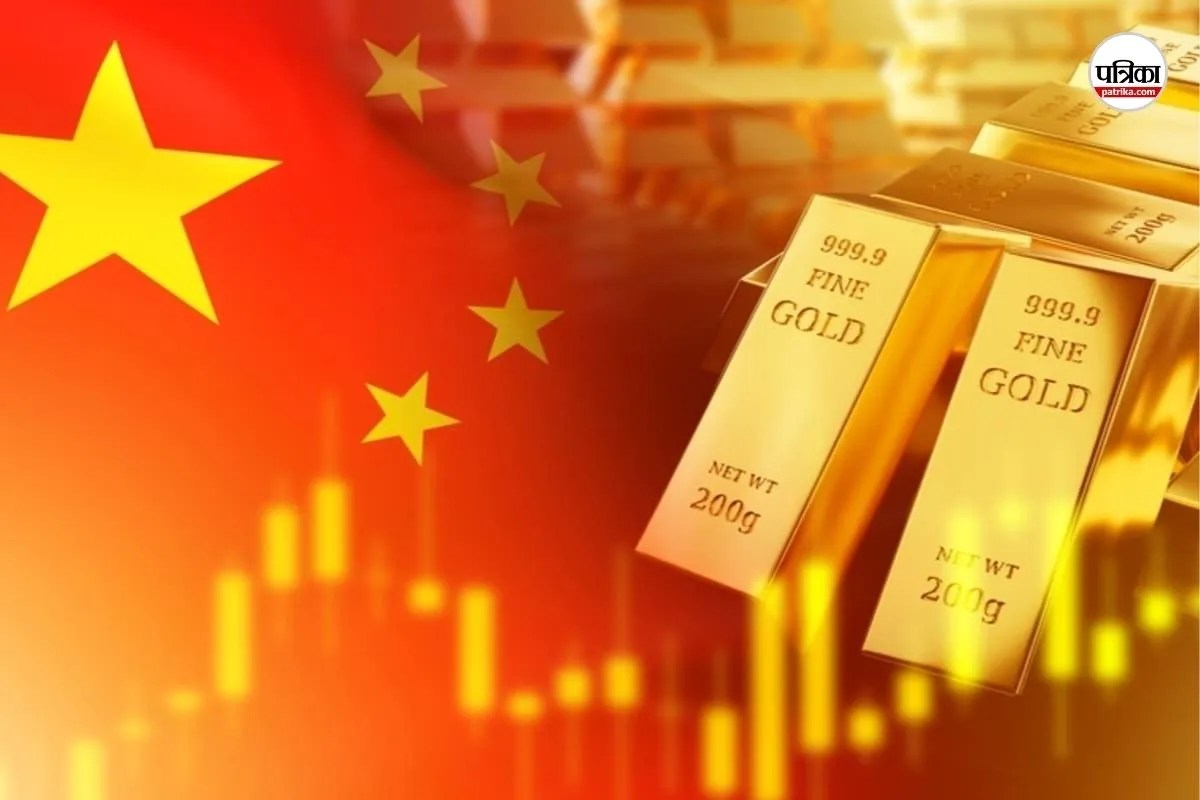
Deep beneath the humming streets of Beijing, behind reinforced steel that could withstand a nuclear winter, something heavy is moving. It doesn’t make a sound. It doesn't flicker on a digital ticker or flash in an app notification. It is the dull, buttery glow of 24-karat gold bars, stacked row upon row, slowly replacing the digital IOUs of the United States government.
For 18 consecutive months, the People’s Bank of China has been on a shopping spree that would make Midas blush. They aren't buying tech stocks or real estate. They are buying the oldest form of trust known to man.
Money, in its modern form, is a ghost. It is a collective hallucination backed by the "full faith and credit" of a government. But faith is a fragile thing. When you walk into a grocery store and see the price of bread has doubled, that is faith evaporating. When a superpower watches another superpower freeze its bank accounts over a geopolitical dispute, that is faith being weaponized.
China has been watching. And they have decided that the dollar—the green paper that has ruled the world since the end of World War II—is no longer a safe place to hide.
The Weight of a Golden Shield
Imagine a merchant in a bustling port five hundred years ago. He doesn't care about the local king’s decree or the latest paper decree from a distant capital. He wants to feel the weight of a coin in his palm. He wants to bite it. He wants to know that if the empire falls tomorrow, the metal in his hand will still buy him a ship home.
This is the "human element" currently driving global macroeconomics. It is a primal urge for physical certainty in an increasingly digital and volatile world.
The statistics are staggering, yet they often feel hollow until you realize what they represent. China’s gold reserves have climbed to over 2,260 tonnes. That isn't just a number on a balance sheet; it is a fortress. By diversifying away from the U.S. dollar, Beijing is effectively telling Washington: "We no longer believe your house is fireproof."
Consider the hypothetical situation of a mid-level bureaucrat in the Chinese State Administration of Foreign Exchange. Let's call him Mr. Chen. For decades, Mr. Chen’s job was simple: take the massive profits from Chinese exports—the iPhones, the plastics, the heavy machinery—and park that money in U.S. Treasuries. It was the "risk-free" bet. The U.S. dollar was the global anchor.
But then, the anchor started to drag.
Mr. Chen sees the U.S. national debt spiraling past $34 trillion. He sees inflation eating the purchasing power of those Treasuries. Most importantly, he saw what happened to Russia. When the West froze hundreds of billions of dollars in Russian central bank assets, the message was received loud and clear in Beijing. If you hold dollars, you are holding a leash that someone else controls.
Gold has no leash. It cannot be frozen by a SWIFT ban. It cannot be printed into oblivion by a central bank in Washington D.C. It simply is.
The Great De-Dollarization
We are living through a divorce. It’s messy, quiet, and incredibly expensive.
For nearly eighty years, the world operated on the Bretton Woods system. The dollar was the sun, and every other currency was a planet orbiting it. If you wanted to buy oil, you needed dollars. If you wanted to trade across borders, you needed dollars. This gave the United States an "exorbitant privilege." It could print money to pay for its wars, its social programs, and its consumer debts, because the rest of the world was forced to soak up those dollars to keep global trade moving.
That era is cracking.
The "market movement" mentioned in dry financial reports is actually a tectonic shift in how humans perceive value. Central banks across the "Global South"—nations like India, Turkey, and Singapore—are following China’s lead. They are all participating in a collective hedge against a future where the dollar is no longer the undisputed king.
It’s easy to get lost in the jargon of "reserve assets" and "foreign exchange liquidity," but think of it like a neighborhood. For years, everyone on the block used the same hardware store's gift cards as currency. Suddenly, people realized the store owner was printing more cards than he had hammers in stock. To make matters worse, the owner started telling certain neighbors they couldn't spend their cards because he didn't like their politics.
Naturally, the neighbors started looking for gold.
The Invisible Stakes for Your Wallet
You might ask why a gold vault in Beijing matters to a family in Ohio or a small business owner in Mumbai. The answer lies in the price of everything.
When China stops buying U.S. debt and starts buying gold, the demand for the dollar drops. When demand drops, the value of the currency eventually follows. This isn't a "game-changer" in the sense of a sudden explosion; it is a slow, relentless erosion. It means the clothes you wear, the gas you put in your car, and the electronics you buy become more expensive because your currency has lost its "muscle" on the international stage.
The market is currently in a state of high-tension "shuffling." Gold prices have recently hit all-time highs, not because people suddenly became obsessed with jewelry, but because fear is the most effective salesman in history.
Fear of what?
Fear that the digital ledger we’ve lived on for eighty years is about to be wiped clean.
There is a certain irony here. China, the workshop of the world and a pioneer in digital payments and CBDCs (Central Bank Digital Currencies), is retreating into the most ancient of assets. It is as if they are building a high-speed rail system but keeping a stable of horses in the back just in case the electricity fails.
The Psychology of the 18-Month Streak
Why 18 months? Why now?
The duration matters because it signals intent. A one-month purchase is a fluke. An 18-month streak is a strategy. It suggests that China is preparing for a period of extreme instability. They are bracing for a world where the financial system might fracture into two distinct blocks: one centered around the Dollar and the West, and another centered around the Yuan, Gold, and the BRICS nations.
This isn't just about money; it’s about sovereignty.
To hold gold is to claim independence. If you have ten billion dollars in a New York bank account, you are a guest. If you have ten billion dollars worth of gold in your own vault, you are the master of your own house.
We often mistake the silence of the markets for stability. We see the numbers tick up and down by half a percent and think the world is spinning as it always has. But the real shifts—the ones that change history—happen in the shadows. They happen in the quiet, steady accumulation of weight.
A World Without an Anchor
If the dollar loses its status as the world’s primary reserve currency, we enter uncharted waters. There is no "Plan B" waiting in the wings. The Yuan is not yet ready to take the crown, hampered by China’s own capital controls. The Euro is too fragmented. Bitcoin is too volatile for the grandpas running central banks.
So, we return to the metal.
Gold is the ultimate "no-trust" asset. You don't need to trust the person who sold it to you, and you don't need to trust the government of the country where it was mined. Its value is intrinsic, universal, and ancient.
The human element of this story is ultimately about the search for an anchor in a storm. As the geopolitical winds pick up, and as the debt-fueled structures of the 20th century begin to groan under their own weight, the world’s second-largest economy is deciding that "faith" is a luxury it can no longer afford.
They are choosing the cold, hard, heavy truth of gold.
As China continues to stack its vaults, the rest of the world watches the scales tip. We are witnessing the slow-motion sunset of an era. It’s a transition that won't be announced with a megaphone, but rather through the quiet thud of a gold bar hitting a pallet, repeated over and over, month after month, until the world we thought we knew has been completely redefined.
The next time you look at a dollar bill, look closely at the words printed on it: In God We Trust.
China has decided to put its trust in something it can weigh.