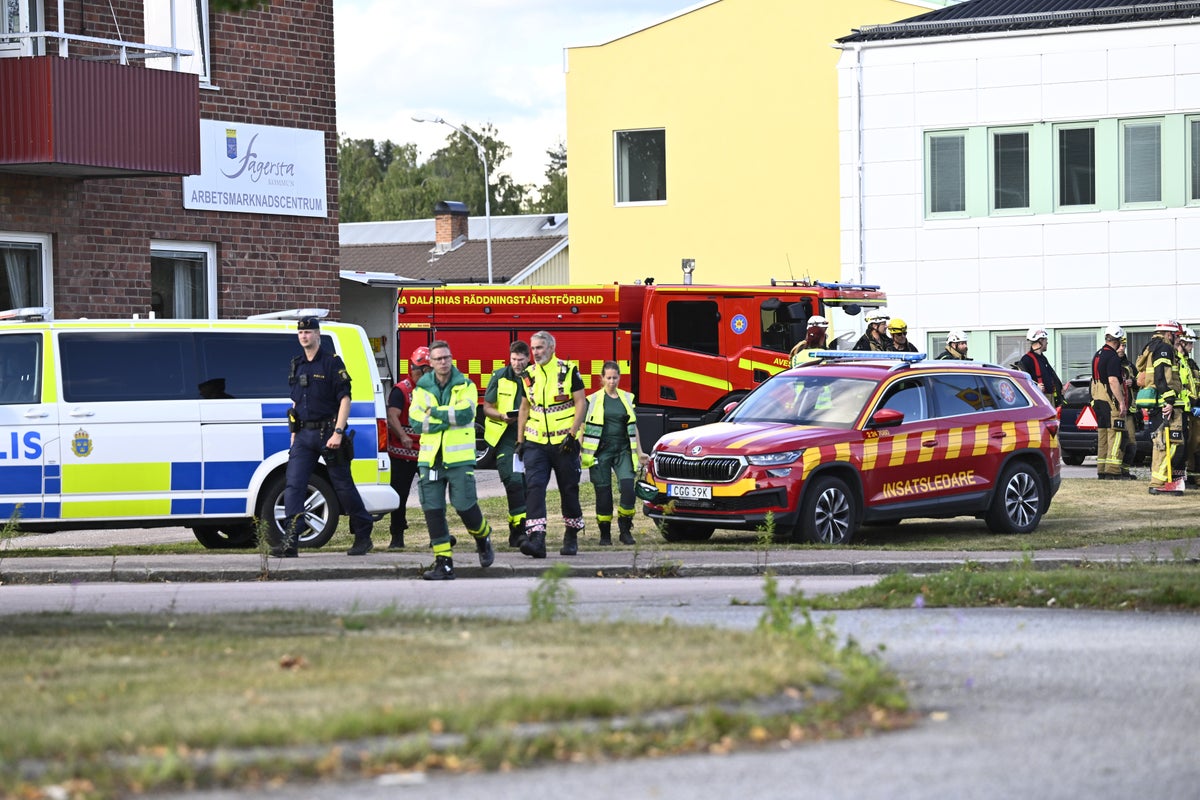
Several people were injured and one person taken into custody after an assailant armed with a sword attacked Brinell High School in Fagersta, central Sweden. The incident occurred in the early afternoon, sending shockwaves through the community of roughly 12,000 residents just as students returned from summer break. Swedish police and emergency services rushed to the scene, locking down nearby educational facilities while politicians in Stockholm scrambled to respond to yet another violent assault on a domestic institution.
This is not an isolated aberration. Sweden has spent the past decade watching its national myth of exceptional safety erode under a mounting wave of targeted institutional violence. When a masked attacker carrying an edged weapon breaches school doors, it triggers a grim national reflex. We have seen this script before. We saw it in Trollhättan, in Malmö, and in the devastating mass shooting in Örebro. Each time, the political class expresses shock, offers condolences, and promises institutional introspection. Then the news cycle fades, and the structural vulnerabilities remain entirely unaddressed.
The Illusion of Nordic Exceptionalism
For decades, the Swedish educational model rested on an open architecture. Campuses were designed as community hubs, featuring accessible cafeterias, minimal physical security, and a cultural baseline rooted in absolute trust. That architecture was built for a different era.
Modern threat assessors have long warned that open-door policies make soft targets out of provincial schools. Fagersta is a quiet industrial town, not a sprawling metropolis. Yet violence travels across municipal borders with ease, uninhibited by geography or local demographics. When an assailant walks into a building housing hundreds of teenagers aged sixteen to twenty, the open-campus philosophy transforms from an idealistic statement of trust into an operational liability.
Structural Blind Spots and Institutional Inertia
Why do these attacks keep recurring with such unsettling regularity? The answer lies in a systemic failure to connect radicalization, personal alienation, and institutional monitoring.
Consider the typical profile of perpetrators in these Scandinavian incidents. They are frequently young men marked by social isolation, historical grievances, and an acute crisis of identity or employment. Sweden's social welfare apparatus excels at broad support systems, but it often fails at targeted, high-acuity behavioral intervention. When a young person drops out of the social fabric, the warning signs accumulate in digital forums and isolated corners of the internet long before a blade is purchased or a school threshold is crossed.
Local authorities confirmed that Brinell High School had faced previous threats earlier in the year. Temporary lockdowns and brief police presence offer immediate relief, but they do nothing to solve the underlying rot. Schools are left to act as frontline defense units against complex psychological and ideological crises without the proper intelligence-sharing networks or physical infrastructure required to stop a determined attacker.
The Cost of Reactive Policymaking
Following the attack, Prime Minister Ulf Kristersson and opposition leaders issued standard statements of solidarity, emphasizing that the police were working intensively. Justice Minister Gunnar Strömmer echoed these sentiments, pointing to ongoing coordination between the government and law enforcement.
These responses mistake crisis management for prevention. Deploying tactical units and setting up crisis centers in local sports halls are necessary measures for a catastrophe in progress, but they represent a total failure of the preventative chain. Sweden is paying the price for a historical reluctance to harden soft targets, driven by a cultural aversion to turning schools into fortresses.
If educational institutions refuse to implement controlled access points, professional threat assessment teams, and early-warning intervention protocols, these headlines will return. The weapon changes, the town changes, but the systemic paralysis remains absolute. Until the Nordic model confronts the reality of domestic targeted violence with hard infrastructure and proactive mental health intervention rather than rhetorical sympathy, classrooms will continue to bear the cost of institutional denial.