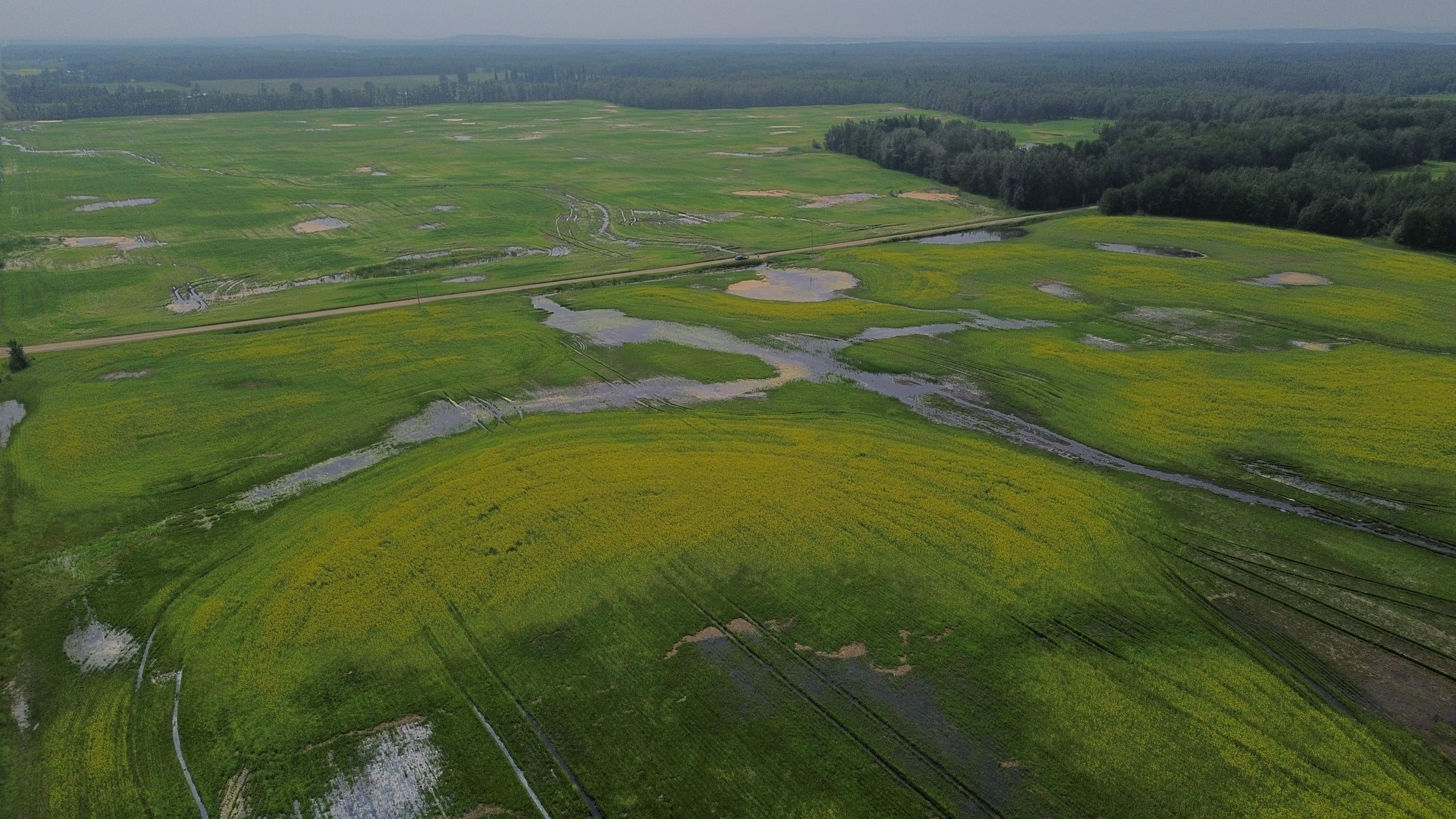
In mid-July 2026, rural municipal councils in Thorhild County and Westlock County declared states of agricultural disaster after record June rainfalls and relentless July storms inundated central Alberta farmland. Up to 50 percent of crop yields across the region face total loss as waterlogged soil suffocates canola, wheat, barley, and peas. Yet these formal municipal declarations carry zero legal power to trigger provincial or federal financial aid. They stand merely as symbolic alarms raised by municipal leaders toward higher levels of government that remain largely unresponsive.
The crisis in central Alberta reveals a glaring disconnect between agricultural reality and state support systems. While regional reeves and flooded grain growers battle standing water across hundreds of thousands of acres, public policy continues to treat catastrophic weather as an isolated anomaly rather than a structural threat to the food supply.
The Illusion of Municipal Disaster Declarations
When a county council votes unanimously to declare a state of agricultural disaster, neighboring communities often assume emergency funds will begin flowing immediately. They do not.
In Alberta, a municipal disaster declaration serves no statutory function under provincial financial frameworks. It operates purely as an administrative cry for help, a press release wrapped in official municipal stationery designed to catch the attention of the Ministry of Agriculture and Irrigation. Westlock County Reeve Christine Wiese and Thorhild County Reeve Trevor Dafoe have been explicit about this limitation. Their declarations do not unlock emergency checks, line items in provincial budgets, or tax relief for growers facing complete ruin.
The provincial response remains passive. When questioned about the inundated fields northeast of Edmonton, provincial spokespeople issue familiar statements promising that officials are monitoring conditions and communicating with commodity groups. Monitoring does not pump water out of drowned root systems. It does not replace rotting seeds that failed to germinate after a late spring snowmelt was immediately followed by 400 millimeters of rainfall.
This dynamic leaves local producers trapped in a bureaucratic vacuum. The municipality acknowledges their ruin but lacks the tax base to intervene. The province possesses the capital but hides behind monitoring protocols while waiting for autumn harvest numbers to confirm what is already obvious on the ground.
Insurance Policies That Reward Destruction Over Recovery
Farm financial safety nets in Western Canada were constructed around predictable risk profiles. They were built to handle brief dry spells or localized hail events.
They are failing spectacularly under prolonged inundation.
Crop insurance administered through provincial risk management agencies offers yield coverage that caps payouts based on historical averages. For many producers in Thorhild and Westlock, receiving an 80 percent yield guarantee fails to cover the skyrocketing cost of diesel, fertilizer, and machinery overhead accumulated prior to planting. Worse, insurance policy structures contain bizarre economic incentives that force farmers into dark calculations.
Consider the reality faced by multi-generational operators near Thorhild. When 30 percent of a canola crop rots underground due to oversaturated soil, the grower remains responsible for managing the surviving acreage. They must attempt weed management, pay for fuel to navigate mud-clogged equipment through soggy fields, and prepare for a meager harvest that may not cover fuel costs.
If an intense storm drops destructive hail on that exact same damaged field, insurance write-off protocols kick in far more generously. Farmers are openly admitting that severe hail damage offers a cleaner financial exit than fighting to salvage a drowned crop.
A risk management framework that leaves agricultural producers praying for extreme localized destruction because flooded crops receive inadequate support is fundamentally broken.
Crumbling Rural Drainage Systems and Policy Neglect
Excessive rain falls from the sky, but flooding is made worse by human design on the ground.
For decades, regional water management across rural Alberta focused heavily on moving water off fields quickly during spring runoff, assuming summers would bring extended heat and drought. Municipal ditch networks, culverts, and regional drainage systems were engineered for brief seasonal flows. They were never designed to manage sustained deluge events where hundreds of millimeters of rain accumulate over consecutive weeks.
Local seed growers and agricultural operators point out that ditch networks across Thorhild and Westlock counties routinely become backlogged. Water has nowhere to go. Instead of draining along natural watercourses toward river basins, rain sits stagnant in municipal ditches until it overflows onto adjacent private farmland.
This infrastructure failure creates overland flooding that drowns low-lying plots of peas, barley, and hay.
Crop Vulnerability Under Water Stress
Different crops react to root-zone saturation in vastly different ways:
- Pulse crops like field peas possess zero tolerance for standing water. Yellowing and root rot occur within 24 to 48 hours of oxygen deprivation.
- Barley crops suffer severe stress, yellowing quickly and shedding yield potential long before fields dry out enough to carry heavy equipment.
- Spring wheat shows slightly higher resilience against short-term standing water, yet prolonged moisture induces early heading, stunted stalk development, and grain quality degradation.
- Canola fields lose uniform pod development, leaving growers with uneven maturity that complicates timing for swathing or direct combining.
Producers cannot simply re-seed when fields remain underwater into mid-July. The growing window in northern agricultural zones is sharp and unforgiving. Once a planting window vanishes, the entire annual revenue for that acreage vanishes with it.
The Economic Ripple Across Canadian Supply Chains
Urban consumers rarely connect torrential rain in central Alberta to their weekly grocery bills until prices jump.
The losses in Thorhild and Westlock counties are not localized tragedies confined to a few dozen farm families. They represent a tightening node in the broader agricultural supply chain. When primary producers lose 30 to 50 percent of their crop, local economic velocity grinds to a halt. Equipment dealers report canceled orders for combines and tractors. Local grain elevators face lower volume throughput, driving up handling margins. Fertilizer suppliers hold unpaid credit lines extended to growers who cannot pay until harvest checks arrive.
Simultaneously, commodity market prices for wheat and canola feel upward pressure from yield reductions across northern growing belts. Livestock producers face parallel catastrophes. Cattle operations relying on local hay and silage production find forage fields under water or impossible to harvest with heavy machinery. When feed supplies tighten across central Alberta, livestock operators are forced to purchase imported hay at exorbitant rates or liquidate herds prematurely.
Every drowned acre in Westlock or Thorhild ripples through consumer price indexes over the following twelve months.
Overhauling Rural Infrastructure Strategy
Producers in northern regions are already discussing forming independent drainage networks and localized agricultural water management associations. They recognize that waiting for provincial bureaucracy to modernize municipal ditch infrastructure is a recipe for perpetual financial loss.
Effective reform requires moving past symbolic municipal declarations. Provincial authorities must establish regional drainage authorities equipped with capital to deepen channels, clean culverts, and construct controlled retention basins that keep surplus water off productive fields. Furthermore, agricultural insurance programs must adapt, offering tailored coverage for catastrophic water stress that mirrors the straightforward claim structures currently reserved for hail damage.
Without structural engineering investments and modern insurance policies, declaring an agricultural disaster remains nothing more than a formal record of an avoidable collapse.
For a closer look at the local coverage on these regional declarations, watch this CBC News report on Thorhild County disaster declaration. It offers direct insight into the challenges local grain growers and municipal officials face when heavy flooding hits northern Alberta farmland.