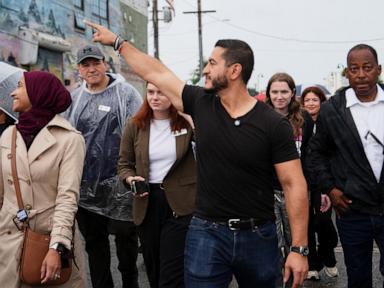
Forty-eight hours before polls open in Michigan, the state's Democratic primary race for the U.S. Senate has boiled down to a frantic, ground-level sprint through Detroit church pews and union halls. Abdul El-Sayed and U.S. Rep. Haley Stevens spent the final Sunday of the campaign chasing the exact same demographic groups across the Detroit metro area, highlighting a bitter ideological split within the party.
This isn't just another standard primary. With longtime incumbent Democratic Senator Gary Peters stepping aside, Michigan is witnessing its most competitive Democratic Senate primary battle in over three decades. Tens of millions of dollars in satellite and campaign spending have flooded the airwaves, but right now, television ads don't matter. Turnout does.
The Ground Game Inside Detroit Churches
If you want to understand how a high-stakes modern primary is actually won in Michigan, look at Sunday morning schedules. El-Sayed sat quietly beside his wife in a crowded Detroit church, blending into the congregation before standing up to address the room directly. Barely ten miles away, Stevens worked a separate room inside another prominent Black church, where local clergy championed her legislative record.
Black voters in Detroit remain the absolute center of gravity for any statewide Democratic primary. Both campaigns know that losing ground here spells disaster.
El-Sayed, backed by Senator Bernie Sanders and prominent figures on the party's left flank, leaned heavily into an economic justice message. His pitch focused on systemic reform and healthcare access, drawing supportive nods from churchgoers who spent months weighing their options.
Stevens countered with institutional muscle. Backed by Governor Gretchen Whitmer, outgoing Senator Gary Peters, and Senate Democratic leader Chuck Schumer, she pitched her four-term congressional experience as a steady hand for turbulent legislative fights. Stevens calls the final days of a tight campaign the "last word phenomenon"—a chaotic scramble where every candidate tries to leave a final, memorable impression.
Union Halls and Divergent Closing Strategies
As Sunday afternoon rolled on, both candidates shifted their operations toward labor strongholds and union halls. Michigan's working-class roots dictate that union endorsements carry immense weight, but winning the halls takes more than a badge of approval. It takes showing up when the room is hostile or skeptical.
Yet, as the clock ticked down to Monday night, their final strategies diverged sharply.
- El-Sayed Strategy: Anchored deeply in Detroit, focusing heavily on mobilizing a volunteer network reported at roughly 12,000 people to drive high urban turnout.
- Stevens Strategy: Relying on a statewide apparatus of institutional endorsements and long-standing political alliances built over years in federal office.
Satellite groups have poured more than $36 million into supporting or opposing the candidates, making the airwaves toxic with attack ads. But down on the pavement, exhausted field organizers are just trying to get committed voters to the ballot boxes before Tuesday night.
The winner of this brawl faces a brutal math problem on Wednesday morning: stitching a fractured Democratic coalition back together. Whoever emerges from Tuesday's primary immediately has to pivot toward a high-stakes general election showdown against Republican Mike Rogers in a battleground state that will help determine control of the U.S. Senate. For now, the speeches are over, the television ads are finishing their final runs, and the ballots will tell the story.