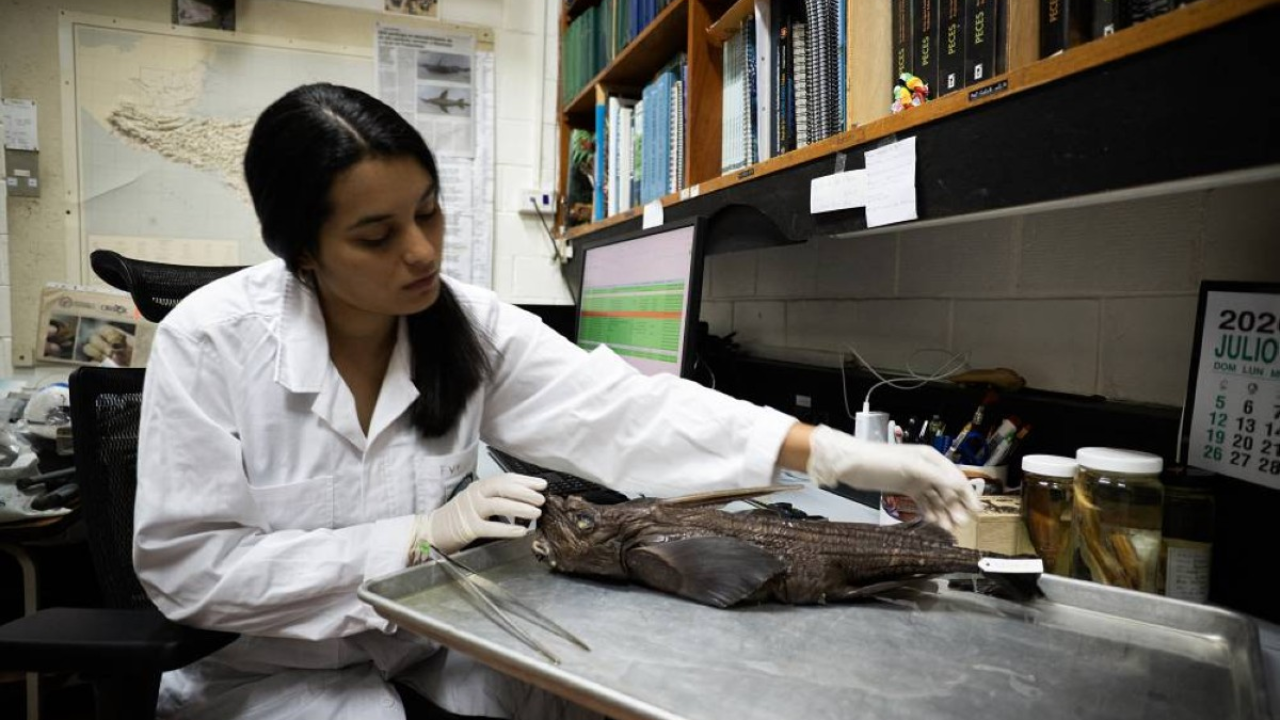
Deep beneath the pitch-black surface of the Pacific Ocean off Costa Rica, a four-hundred-million-year-old evolutionary lineage swam completely unnoticed by modern science until a team led by University of Costa Rica biology student Naidely Valeria Vidaurre-Quesada formally described Rhinochimaera costaricana. Three male specimens of this long-nosed chimaera, commonly known as a ghost shark, sat tucked away in institutional archives for over two decades before rigorous anatomical and genetic examination proved they belonged to an entirely new species. This discovery highlights a glaring blind spot in marine biology. The creatures living in the twilight zones of our oceans are frequently documented first by commercial or exploratory fisheries, only to languish in museum drawers while taxonomic backlogs delay their official recognition.
The first of these specimens was pulled from the abyss near Isla del Caño in the year 2000. Two more emerged in 2023 during regional fisheries surveys near Cabo Blanco. They drifted into storage facilities, catalogued simply as routine bycatch from depths ranging from 390 to 787 meters.
That is where the real work began.
The Anatomy of an Oversight
Taxonomy is slow, grueling labor. It demands an intimate familiarity with comparative anatomy and an unwillingness to accept convenience. Vidaurre-Quesada and her colleagues did not rely on quick field guesses. They undertook a meticulous morphological comparison, analyzing forty-nine distinct body measurements across more than ninety individual specimens representing the three previously recognized species within the Rhinochimaera genus: R. africana, R. atlantica, and R. pacifica.
The physical discrepancies were stark. Rhinochimaera costaricana possesses a noticeably shorter snout, a taller first dorsal fin accompanied by an elongated spine, and a wider gap separating its dorsal fins than its established relatives. Furthermore, the arrangement of dermal denticles—tiny, tooth-like scales along the tail—diverged significantly from existing taxonomic keys.
Physical metrics alone, however, rarely satisfy modern marine zoology. Environmental plasticity can trick even seasoned researchers into naming regional variants as distinct species. To eliminate any doubt, the team integrated molecular diagnostics. DNA sequencing laid bare the genetic reality. The Costa Rican specimens displayed genetic differences ranging from 3.9 percent to 4.7 percent when measured against the other three members of the genus. In the rigid arithmetic of molecular phylogenetics, those percentages represent millions of years of isolated evolution.
The Museum Paradox
Ghost sharks are cartilaginous fish related to sharks and rays, but they split from that common ancestor during the Devonian period. They possess internal skeletons made entirely of cartilage, venomous dorsal spines, and specialized lateral line systems designed to detect the faint electrical fields of living prey in absolute darkness. Finding a new member of this ancient family in the twenty-first century proves that the deep ocean remains a vast, unmapped frontier.
Yet the most provocative element of this discovery is not the animal itself. It is the timeline.
A specimen collected in 2000 sat unexamined for twenty-three years. This delay exposes a structural vulnerability within institutional science. Natural history museums and academic repositories are chronically underfunded and understaffed. Thousands of unidentified or mislabeled jars containing deep-sea organisms sit on shelves worldwide, gathering dust while taxonomists drown in backlog. Without energetic student researchers and cross-institutional collaborations—such as the partnership between the University of Costa Rica, the Costa Rica Fisheries and Aquaculture Institute (Incopesca), and Brazil's Federal University of Pará—these specimens would remain anonymous footnotes in ledger books.
Compounding the issue is our reliance on fisheries research vessels for deep-sea discovery. Dedicated oceanographic expeditions are astronomically expensive. Consequently, much of what we learn about the bathypelagic zone depends on accidental encounters by commercial trawlers or state-backed fisheries monitoring programs. When a fishing net sweeps the continental slope at 700 meters, it brings up structural data that marine biologists could otherwise never afford to collect.
Rhinochimaera costaricana stands as a testament to the power of looking backward at old collections while pushing forward with genetic sequencing. It proves that major biological revelations do not always require billion-dollar deep-sea submersibles. Sometimes, they require a fresh set of eyes willing to open a forgotten jar at the back of a museum warehouse in London and question what was assumed to be known.
The ocean has spent millions of years hiding its oldest residents in the cold, crushing pressure of the continental slope. The bottleneck is no longer our ability to reach them. It is our capacity to process what we have already brought to the surface.