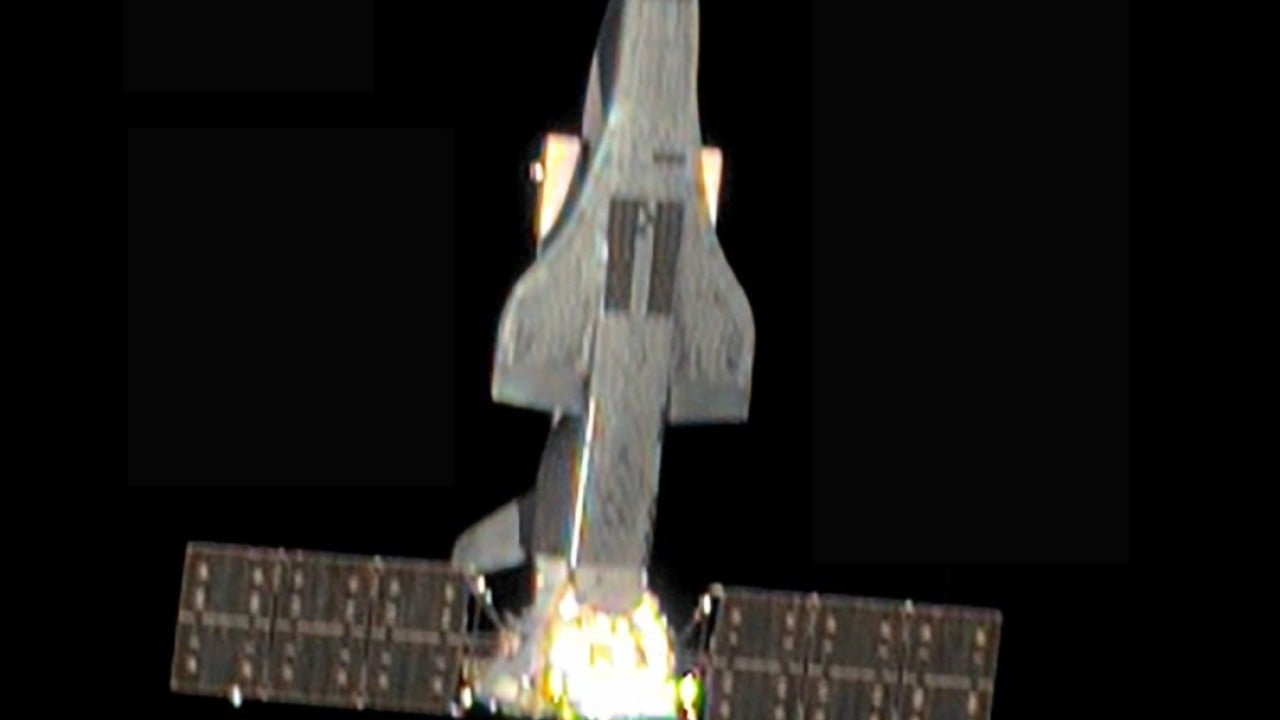
A simulated fleet of 40 Chinese reusable spaceplanes can saturate and overwhelm modern missile defense networks to strike any target on Earth within minutes, according to a peer-reviewed wargame study published by researchers at the Beijing Institute of Electronic System Engineering. By utilizing hypersonic glide trajectories at the edge of space, these vehicles bypass traditional radar horizons and kinetic interceptors designed for predictable ballistic arcs. The operational reality behind this theoretical war game reveals a fundamental shift in orbital warfare, pitting high-cost terrestrial defense architectures against low-observable, maneuvering aerospace platforms.
For decades, nuclear and conventional deterrence rested on a relatively stable mathematical equation. Intercontinental ballistic missiles follow high, parabolic trajectories that predictable physics govern from launch to reentry. Early warning satellites detect the intense infrared plume of a booster stage within seconds, while ground-based radars calculate the exact impact zone long before the warhead falls back into the atmosphere.
That predictability is dead.
When aerospace engineers model a coordinated strike using 40 hypersonic spaceplanes, the defensive calculus collapses under the weight of geometry and kinematics. Unlike ballistic warheads, a lifting-body spaceplane enters the upper atmosphere at orbital or sub-orbital velocities—often exceeding Mach 20—and uses aerodynamic lift to skip, bank, and change heading repeatedly. Defenders cannot draw a straight line backward to find the launch site, nor can they project a reliable arc forward to position interceptors.
The Physics of the Edge of Space
To understand why a 40-vehicle swarm presents an acute operational nightmare, you have to look at the altitude band between 40 and 100 kilometers above the Earth's surface. Defense analysts call this region near space. It is too high for conventional air-breathing fighter jets and surface-to-air missiles, yet too low for orbital satellites to maintain stable trajectories without burning massive amounts of propellant.
Standard ballistic missile defense systems, such as the Terminal High Altitude Area Defense or the Ground-Based Midcourse Defense network, rely on hit-to-kill interceptors. These kinetic kill vehicles operate best in the vacuum of space, where aerodynamic drag does not exist and targets cannot suddenly jink sideways. Once a target drops into the upper atmosphere, air resistance complicates interception, yet standard reentry vehicles still fall along a narrow, predictable corridor.
A reusable spaceplane changes the rules of aerodynamics in this thin air. Equipped with delta wings or a lifting-body fuselage, the craft generates substantial lift even at extreme altitudes. During a simulated strike, the vehicles execute lateral maneuvers spanning thousands of kilometers. A spaceplane launched on an easterly trajectory toward the Pacific can abruptly bank south or north, approaching a defended target from an azimuth where radar coverage is sparse or entirely absent.
Radar horizon limitations compound the problem. Because the Earth curves, ground-based phased-array radars cannot see low-altitude targets until they clear the horizon. A traditional ballistic warhead flying at an apogee of 1,000 kilometers is visible to long-range sensors from thousands of miles away. A hypersonic spaceplane gliding at an altitude of 60 kilometers remains hidden behind the curvature of the Earth until it is roughly 800 to 900 kilometers from its target. At Mach 15, the defender has less than four minutes between initial radar acquisition and impact.
Inside the Beijing Wargame Simulation
The specific study that triggered alarms across Western defense circles did not emerge from a fringe blog or state media propaganda. Researchers at the Beijing Institute of Electronic System Engineering—a core subsidiary of the China Aerospace Science and Industry Corporation—used advanced simulation software to test how an integrated air and missile defense network handles a massive, synchronized aerospace assault.
In the simulation, the attacking force deployed 40 spaceplanes in coordinated waves. Rather than flying in a tight, easily tracked formation, the vehicles dispersed across multiple orbital inclinations and atmospheric entry corridors. The simulation modeled realistic sensor degradation, communication latency, and interceptor reload times.
The results demonstrated a classic saturation attack executed at orbital speeds. Modern defense networks rely on centralized battle management systems to assign specific targets to specific interceptor batteries. When 40 maneuvering targets enter the battle space simultaneously from divergent angles, the tracking algorithms struggle to maintain custody of individual tracks. Worse, the extreme plasma sheath generated by hypersonic friction absorbs and scatters radio frequency energy, creating intermittent radar blackouts and false returns.
Defenders in the simulation were forced to fire multiple interceptors at each incoming vehicle to ensure a statistically acceptable probability of kill. Because high-end interceptors cost tens of millions of dollars each and exist in limited stockpiles, the simulated defensive shield ran out of ammunition long before the final wave of spaceplanes reached their designated coordinates.
Breaking Down the Kill Chain
Every long-range strike depends on a functional kill chain: finding the target, fixing its location, tracking its movement, targeting it with a weapon, engaging it, and assessing the damage. A spaceplane fleet compresses this timeline while simultaneously complicating the defender's counter-kill chain.
Consider the launch phase. If a spaceplane launches vertically atop a conventional heavy-lift rocket, early warning satellites will spot the boost phase immediately. However, if the vehicle utilizes a two-stage-to-orbit horizontal takeoff architecture—similar to concepts tested with the Tengyun project—it can launch from standard military airfields dispersed across the Chinese interior. A carrier aircraft hauls the spaceplane to high altitude before releasing it, hiding the initial launch signature beneath cloud cover and away from predictable spaceports.
Once in low Earth orbit, the spaceplane becomes a dormant threat. It does not need to strike immediately upon launch. A fleet of 40 vehicles could be placed into orbit days or weeks before a conflict escalates, masquerading as routine scientific, commercial, or satellite-servicing missions. When the order arrives, the vehicles fire their de-orbit engines simultaneously, dropping out of the sky with zero boost-phase warning.
Hardware Reality Versus Computer Models
Wargames are seductive because math on a silicon chip never suffers from thermal stress, micro-fractures, or supply chain bottlenecks. Veteran defense analysts know that a simulation proving 40 spaceplanes can overwhelm a defense grid is vastly different from building, maintaining, and launching 40 operational spaceplanes in the real world.
China has invested heavily in orbital plane technology, most notably through the Shenlong (Divine Dragon) experimental spacecraft. Since 2020, this reusable vehicle has completed multiple orbital missions, demonstrating the ability to remain in space for months, deploy sub-satellites, and land autonomously on a conventional runway at the Lop Nur test site. The Shenlong proves that Chinese engineers have mastered the basic aerodynamics, autonomous flight controls, and reentry thermal protection required for a reusable orbital vehicle.
Yet operating one or two experimental testbeds is a far cry from maintaining a combat-ready fleet of 40 strike platforms. Reusability in aerospace is notoriously unforgiving. During atmospheric reentry at Mach 25, leading edges and nose cones experience temperatures exceeding 1,600 degrees Celsius. Carbon-carbon composites and specialized ceramic tiles endure violent thermal expansion and contraction.
Think back to the American Space Shuttle program. NASA marketed the orbiter as a rapid-turnaround space truck capable of flying every two weeks. In practice, inspecting, repairing, and replacing thousands of fragile thermal protection tiles took months of painstaking manual labor between every flight. While modern materials science has advanced significantly since the 1980s, turning around 40 hypersonic spaceplanes for rapid, synchronized combat operations remains a monumental logistical hurdle.
Propulsion presents another major bottleneck. To execute the aggressive cross-range maneuvers modeled in the Beijing study, a spaceplane needs either massive internal propellant reserves—which eats into payload capacity—or advanced combined-cycle engines capable of transitioning seamlessly from air-breathing hypersonic flight to rocket propulsion. While Chinese aerospace institutes have published extensive research on rotating detonation engines and turbine-based combined-cycle propulsion, fielding 40 reliable, combat-rated propulsion systems is an industrial challenge of the highest order.
The Strategic Economics of Asymmetric Cost
Even if China never fields a fleet of 40 simultaneous strike spaceplanes, the underlying strategic logic of the study exposes a glaring vulnerability in Western military doctrine. The economics of modern missile defense are fundamentally broken.
An offensive hypersonic glide vehicle or reusable spaceplane is expensive to develop, but once production lines mature, the unit cost drops significantly. Meanwhile, the defensive interceptors required to stop them are technological marvels packed with miniaturized seekers, divert attitude control thrusters, and exotic sensors. A single Standard Missile 3 Block IIA costs roughly $30 million. A THAAD interceptor runs north of $12 million.
If an adversary forces you to fire three $20 million interceptors to stop one $15 million spaceplane, you lose the war of attrition before the first warhead detonates.
| System Type | Primary Operating Domain | Trajectory Predictability | Primary Defensive Countermeasure | Cost Exchange Ratio |
|---|---|---|---|---|
| Intercontinental Ballistic Missile | Exoatmospheric (Space) | High (Parabolic arc) | Midcourse hit-to-kill interceptors | Neutral to Favorable for Defender |
| Hypersonic Glide Vehicle | Upper Atmosphere (40–80 km) | Low (Skipping/Banking) | Glide-phase interceptors, EW | Heavily Favors Attacker |
| Reusable Spaceplane | Low Earth Orbit to Near Space | Extremely Low (On-demand de-orbit) | Space-based sensors, Directed Energy | Heavily Favors Attacker |
Furthermore, a reusable spaceplane fundamentally alters the cost equation if it survives the mission. Unlike an ICBM or an expendable hypersonic missile, which destroys itself upon impact, an orbital spaceplane can theoretically release kinetic or conventional payloads from near space, pull up using aerodynamic lift, and glide back to a friendly airfield to rearm. Even if only half the fleet survives a strike, the strategic calculus shifts from expendable munitions to reusable strike aircraft operating at orbital velocities.
The Blind Spots in Modern Missile Defense
Western defense planners are acutely aware that ground-based radars cannot track a spaceplane fleet across global distances. To close this gap, the United States Space Development Agency is currently deploying the Proliferated Warfighter Space Architecture—a massive constellation of hundreds of small satellites in low Earth orbit equipped with wide-field-of-view infrared sensors.
The concept is sound in theory. By looking down from orbit, infrared sensors can detect the intense thermal signature of a spaceplane's friction-heated skin against the cold background of the Earth, completely ignoring the radar horizon problem.
However, a spaceplane fleet introduces unique complications even for space-based tracking layers:
- Thermal Clutter and Decoys: During atmospheric entry, a spaceplane can deploy lightweight, high-drag decoys that heat up rapidly in the upper atmosphere, mimicking the infrared signature of the primary vehicle and blinding overhead sensors.
- Orbital Phasing Ambiguity: Because a spaceplane possesses onboard propulsion, it can alter its orbital plane out of view of ground stations. If an adversarial satellite network loses track of a spaceplane during a maneuver, reacquiring a low-observable object against the vast expanse of the Earth requires massive computational power and continuous sensor coverage.
- Anti-Satellite Cross-Fire: A spaceplane operating in low Earth orbit is not merely a strike vehicle; it is also a potent counter-space weapon. Before initiating a terrestrial attack, the same fleet of 40 spaceplanes could deploy co-orbital kinetic interceptors, high-powered microwaves, or robotic grappling arms to blind and disable the very tracking satellites designed to watch them.
Historical Precedents and the Dyna-Soar Echo
The idea of using winged, piloted or autonomous spacecraft to bypass air defenses and strike targets anywhere on Earth is not a modern Chinese invention. It is the realization of a Cold War obsession that both Washington and Moscow abandoned decades ago due to technological immaturity.
In the late 1950s, the United States Air Force poured hundreds of millions of dollars into the X-20 Dyna-Soar program. The name was a contraction of Dynamic Soaring. The concept was identical in principle to the vehicles modeled in the Beijing study: launch a small delta-winged spaceplane atop a Titan booster, let it skip along the upper atmosphere to extend its range, drop a nuclear weapon or conduct reconnaissance over the Soviet Union, and land on a conventional runway.
The Pentagon canceled Dyna-Soar in 1963. The computing power of the vacuum-tube era could not calculate complex hypersonic aerodynamics in real time, and early ablative heat shields could not survive repeated flights without total reconstruction.
The Soviet Union pursued a parallel track with the Spiral program and later the massive Buran shuttle, while the US eventually built the secretive, unmanned X-37B. Operated by the US Space Force, the X-37B has spent thousands of days in orbit across multiple classified missions, testing advanced materials, autonomous reentry, and orbital maneuvering.
What separates the current Chinese trajectory from the X-20 or the X-37B is scale and doctrine. Washington has treated the X-37B primarily as an orbital testbed and endurance platform. The research emerging from Beijing indicates a doctrinal shift toward mass production and swarm tactics—treating reusable spaceplanes not as boutique experimental craft, but as the vanguard of a conventional global strike force.
The Gray Zone of Deterrence and Escalation
Perhaps the most dangerous aspect of a 40-spaceplane strike capability has nothing to do with aerodynamics or radar cross-sections. It lies in the realm of strategic ambiguity and accidental escalation.
During the Cold War, early warning systems could distinguish between a conventional tactical skirmish and a strategic nuclear exchange. A massive launch of liquid-fueled ICBMs from fixed silos meant one thing, triggering immediate retaliatory protocols.
A fleet of maneuvering spaceplanes destroys that clarity. When 40 vehicles de-orbit simultaneously and begin banking toward targets in the Indo-Pacific or North America, early warning operators have no way of knowing what is inside their payload bays. Are they carrying conventional tungsten rods designed to destroy aircraft carriers and hardened command bunkers? Are they deploying electronic warfare payloads to fry regional power grids? Or are they carrying thermonuclear warheads?
Because the flight time from de-orbit to impact is measured in single-digit minutes, national command authorities face an impossible compression of decision-making time. Waiting until impact to determine whether an attack is conventional or nuclear risks losing command-and-control infrastructure in a decapitation strike. Launching a nuclear counter-attack based on ambiguous radar tracks risks starting an apocalyptic war over a conventional strike.
Hypothetical scenario: Imagine a regional crisis over maritime territory escalates rapidly. Telemetry indicates 30 orbital vehicles have initiated de-orbit burns over the Pacific, with projected tracks overlapping both naval bases in Guam and early warning radars in Alaska. With less than six minutes before potential impact and no ability to verify payload types, the defending nation's leadership must choose between absorbing a potentially catastrophic first strike or authorizing an immediate, irreversible retaliatory launch.
The Engineering Reality Check
Before defense budgets are entirely upended by projections of unstoppable spaceplane swarms, healthy skepticism is warranted. Academic papers published by defense institutes—whether in Beijing, Moscow, or Washington—often serve dual purposes. They advance genuine engineering concepts, and they simultaneously lobby domestic leadership for funding while signaling strategic deterrence to foreign adversaries.
Simulating 40 spaceplanes in a digital environment allows researchers to assume ideal atmospheric conditions, flawless satellite communications, and zero mechanical failures. In reality, hypersonic flight remains one of the most brutal environments in physics. Tiny manufacturing imperfections in a leading edge can trigger boundary-layer transition, turning smooth laminar airflow into violent turbulent heating that melts through an airframe in seconds.
Furthermore, maintaining stealth and communications during a hypersonic glide is an unsolved paradox. The plasma sheath that blocks enemy radar also blocks the spaceplane's own GPS receivers and satellite data links. A spaceplane flying blind through ionized plasma must rely entirely on high-precision inertial navigation systems, which inevitably drift over thousands of kilometers, degrading terminal accuracy unless the vehicle slows down enough in the final seconds to open a sensor window—at which point it becomes vulnerable to terminal point-defense weapons.
Yet dismissing the Beijing study as mere theoretical posturing would be a fatal mistake. History shows that when Chinese aerospace institutions publish foundational studies on swarm dynamics, hypersonic aerodynamics, and orbital maneuvering, hardware testing inevitably follows within a few years. The physical barriers are immense, but they are engineering problems, not violations of the laws of physics.
Every missile defense architecture built over the last forty years was designed to catch bullets fired from predictable guns. The emergence of maneuvering orbital fleets means the bullets now have wings, brains, and the ability to wait silently above the atmosphere until the exact second they choose to fall.