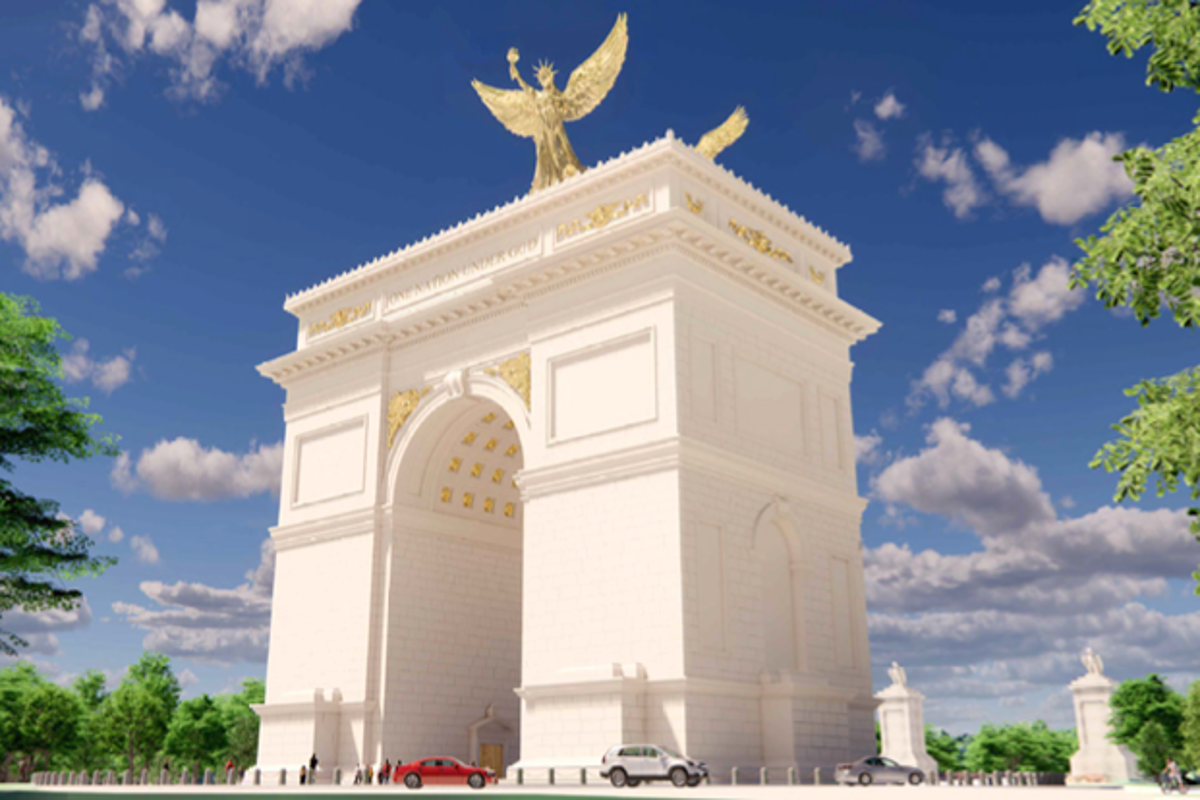
Construction for the Trump administration’s proposed 250-foot "Independence Arch" in Washington, D.C.'s Memorial Circle is slated to begin with excavation work, despite an ongoing federal lawsuit and mounting protests from preservationists and veterans. Interior Secretary Doug Burgum announced the aggressive timeline, pushing forward a project designed to physically alter the capital's historic core before Congress has granted explicit statutory authorization.
For decades, the architectural blueprint of the National Mall has operated under stringent federal oversight. The current clash highlights a profound constitutional and statutory standoff between executive branch ambition and established legislative processes.
The Legal Fault Lines
At the heart of the litigation sits the Commemorative Works Act of 1986. Enacted by Congress to prevent the haphazard cluttering of federal parkland in the District of Columbia, the statute mandates a rigorous, multi-step approval framework for any new monument, sculpture, or memorial.
Public Citizen Litigation Group, representing a coalition of three Vietnam War veterans and a retired senior architectural historian, filed suit in the U.S. District Court for the District of Columbia to halt the development. The legal challenge argues that the administration has completely bypassed Congress. Furthermore, critics point out that the project lacks clearance from the National Capital Planning Commission and has not cleared mandatory evaluations through the Federal Aviation Administration regarding airspace proximity to Ronald Reagan National Airport.
The administration counters these legal roadblocks by pointing to historical precedents and past, unfulfilled congressional discussions regarding monumental treatments for Memorial Circle. Proponents argue that the traffic roundabout has remained an underutilized space for generations and that private funding mechanisms bypass the need for direct taxpayer appropriations. However, legal experts emphasize that private financing does not exempt a project from federal land-use laws or congressional authorization mandates.
Breaking the Sacred Sightlines
Beyond the statutory arguments lies a deeper architectural and emotional debate. The proposed site sits directly between the Lincoln Memorial and Arlington National Cemetery.
For nearly a century, the open vista across Memorial Bridge has served a specific symbolic function. Urban planners deliberately preserved the reciprocal line of sight between the Lincoln Memorial and Arlington House, the historic mansion overlooking the cemetery. This visual link was intentionally designed to signal national reunification and healing following the bloodshed of the American Civil War.
Plaintiffs in the lawsuit argue that a towering, white-and-gold structure stamped with religious inscriptions will permanently sever this historic dialogue. An independent National Park Service environmental assessment acknowledged that the structure would introduce adverse effects to surrounding sightlines, disrupting the visual relationship between multiple historic landmarks. Veterans involved in the suit describe the scale of the 250-foot monument not as a tribute, but as an imposition that overshadows the solemnity of the adjacent military cemetery.
The Race Against Time and Judiciary
The administration has tied the construction schedule directly to the nation's upcoming milestone celebrations, aiming for completion by the 250th anniversary of the United States. This compressed timeline leaves a narrow window for federal judges to weigh the merits of the plaintiffs' motion for preliminary injunctions.
As heavy machinery prepares to break ground at Memorial Circle, the case transforms into a high-stakes test of executive authority over federal public spaces. Whether the courts will intervene to halt construction before permanent structural changes take root remains the pivotal question hanging over the capital.
The legal briefs are filed, the excavation schedules are locked, and the shovel is poised to hit the turf.