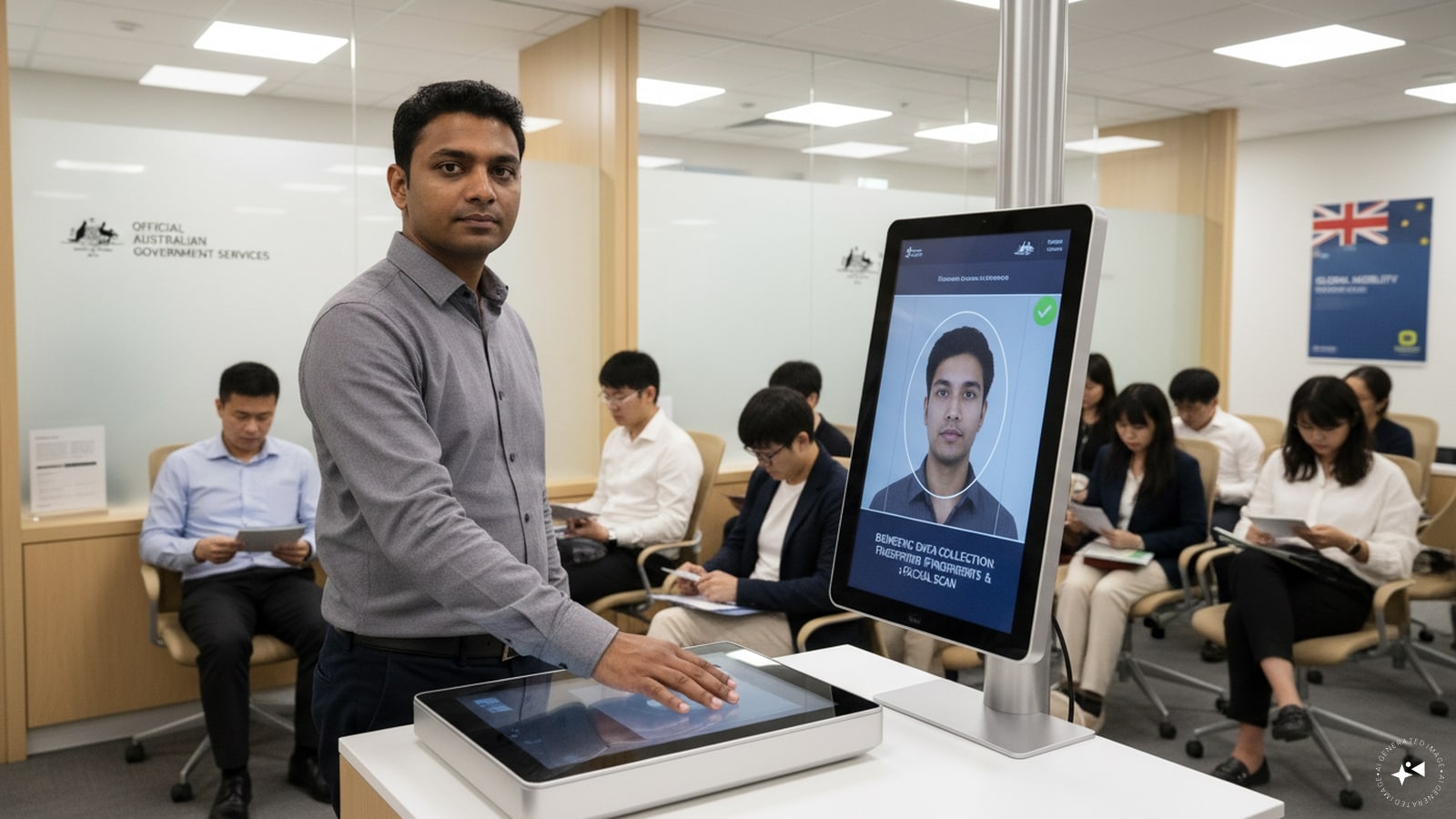
Australia is expanding mandatory biometric collection for Indian visa applicants, meaning nearly every traveller flying from New Delhi, Mumbai, or Bengaluru to Sydney or Melbourne will soon have to submit digital fingerprints and a high-resolution facial scan before their application is even touched by a case officer. Until now, this requirement hit only select visa subclasses or applicants flagged by risk algorithms. Under the expanded rollout managed by the Department of Home Affairs and its commercial partner VFS Global, physical attendance at an Australian Biometric Collection Centre (ABCC) is becoming the baseline price of entry for Indian tourists, students, and business visitors alike.
If you hold an Indian passport, your visa application is no longer a purely online affair. You can still upload your bank statements, employment letters, and itineraries through ImmiAccount from your living room, yet the clock on your visa processing will not actually start ticking until you physically walk into a collection center, pay a separate biometric service fee, and hand over your physical identity markers. Don't forget to check out our earlier post on this related article.
Canberra frames this as routine border modernization. It is anything but routine. When you strip away the diplomatic press releases, this expansion represents a massive shift in how Western nations police high-volume mobility corridors, turning commercial visa contractors into frontline intelligence gatherers while shifting the logistical and financial burden directly onto the traveller.
The Architecture of the New Visa Hurdle
For years, Australia prided itself on a largely paperless visa system. While the United Kingdom and the Schengen Area forced Indian applicants to trek to visa centers for fingerprints and physical passport drop-offs, Australia allowed most visitor and student applicants to apply entirely online. If your paperwork was clean, you received a PDF grant notice via email without ever leaving your home. If you want more about the context of this, National Geographic Travel provides an in-depth breakdown.
That convenience is disappearing. Once you submit your online application and pay the standard visa charge—already among the steepest in the developed world—ImmiAccount generates a Biometric Requirement Letter. You typically have 14 days to book an appointment and complete the collection. Miss that window without securing a formal extension, and your visa application risks outright refusal, taking your non-refundable application fee down with it.
At the VFS Global center, the actual capture takes less than ten minutes. An operator scans all ten of your fingers using a dry-inkless optical scanner and captures a high-definition digital photograph of your face without glasses or head coverings (except for documented religious reasons, provided the full facial features from hairline to chin remain clearly visible).
Who Gets Caught in the Net and Who Escapes
The rules do not apply uniformly across every single human being crossing the border, though the exemptions are narrow and strictly enforced.
- The Standard Tourist and Business Traveller (Subclass 600): Historically, many low-risk applicants in this stream bypassed biometrics. Under the expanded framework, blanket collection applies across Indian collection jurisdictions regardless of prior travel history to Australia or other Five Eyes nations.
- International Students (Subclass 500): India remains one of Australia's largest sources of international students, and this cohort faces near-universal biometric screening as Canberra tightens integrity checks across its vocational and higher education sectors.
- Temporary Work and Skilled Visas: Applicants for Subclass 482 and related work streams are fully integrated into the physical capture workflow.
- Children and Diplomats: Children under the age of five are generally exempt from fingerprint scans, though they still require a facial photograph. Accredited diplomats and certain official government passport holders remain exempt under international reciprocal agreements.
To see how this plays out in practice, consider a hypothetical example. Suppose a software engineer in Pune plans a two-week family holiday to Queensland. She applies online six weeks before departure, assuming her clean travel history to Europe and the US guarantees a quick turnaround. Instead, she receives a biometric demand letter. Because appointment slots in Pune are booked out for ten days, she has to take a day off work, travel to Mumbai with her spouse and two children, pay four separate VFS biometric service fees, and wait another three weeks for security vetting to clear. Her spontaneous holiday just became an expensive logistical campaign.
Why Canberra Is Tightening the Screws Now
Governments rarely spend millions expanding physical biometric infrastructure unless something in their existing risk model has broken. In Australia's case, three converging pressures forced the Department of Home Affairs to abandon its hands-off digital approach in India.
First is the sheer volume of fraud and identity manipulation that exploded following the post-pandemic reopening. Between 2022 and 2024, Australia saw record-breaking application numbers from South Asia. Alongside genuine tourists and students came organized networks exploiting the entirely remote nature of ImmiAccount. Without a physical touchpoint prior to arrival, bad actors could submit fraudulent documents under fabricated or borrowed identities, secure a visa grant, and only face biometric scrutiny at an Australian airport gate—by which point they were already on Australian soil, able to lodge onshore protection claims that can take years to adjudicate.
Second is the Five Eyes intelligence-sharing apparatus. Australia does not collect your fingerprints in isolation. Through the Migration 5 (M5) partnership—linking the immigration authorities of Australia, the United States, the United Kingdom, Canada, and New Zealand—biometric data collected in New Delhi or Chennai is cross-checked against criminal, immigration, and security databases across all five countries in near real time. If an applicant overstayed a visa in Toronto five years ago under a slightly altered name or different passport number, a ten-print scan exposes the match instantly.
Third is domestic political pressure inside Australia. Net overseas migration became a toxic political flashpoint in Canberra, prompting consecutive governments to promise tougher border integrity without formally capping tourist numbers. Expanding biometrics allows ministers to project strength on border security while keeping the lucrative Indian tourism and education pipelines open.
The Hidden Financial and Logistical Tax on Travellers
On paper, adding a biometric step sounds minor. In a country as vast and geographically uneven as India, it is a major friction point that disproportionately penalizes travellers living outside Tier-1 metros.
Australia does not operate its own biometric collection offices in India. It outsources the physical capture to VFS Global, which maintains centers in major hubs like New Delhi, Mumbai, Bengaluru, Chennai, Hyderabad, Kolkata, Ahmedabad, Chandigarh, Jalandhar, Kochi, and Pune. If you live in Guwahati, Bhubaneswar, Jaipur, or Indore, getting your fingerprints scanned means buying domestic flight or train tickets, booking hotels, and losing two to three days of productivity.
| Cost and Friction Factor | Old Digital-Only Process | Expanded Biometric Mandate |
|---|---|---|
| Physical Travel Required | None for most visitor visas | Mandatory trip to an ABCC hub |
| Government Visa Fee | Paid online via ImmiAccount | Unchanged, paid online via ImmiAccount |
| Contractor Service Fee | None | Mandatory VFS biometric fee per person |
| Processing Clock Start | Immediate upon online submission | Delayed until biometrics are uploaded |
| Lead Time Buffer Needed | 3 to 4 weeks | 6 to 8 weeks minimum |
Then there is the creeping monetization of visa processing. When you pay the Australian government for a Subclass 600 visa, you expect that fee to cover the administrative cost of evaluating your application. Instead, you are pushed into a commercial ecosystem where a private contractor charges a mandatory service fee just to capture your data, while aggressively upselling "Prime Time" appointments, SMS tracking alerts, and "Platinum Lounges" to desperate travellers facing tight flight deadlines.
When peak travel seasons hit—such as the Indian summer school holidays in May and June, or the Diwali and Christmas rush between October and December—appointment bottlenecks at VFS centers become acute. Travellers who wait until the last minute to apply often find zero standard appointments available within their 14-day compliance window, forcing them either to pay inflated premium-slot fees or watch their travel plans collapse.
Data Privacy and the Permanence of Biometric Records
Unlike a passport number, a credit card, or a password, you cannot cancel your fingerprints if a database is breached. Once your ten-print scan and facial geometry are digitized, transmitted across commercial servers, and stored in government repositories, that surrender is permanent.
Under Australian privacy law, the Department of Home Affairs is permitted to retain biometric records for extended periods—often up to 10 years or more depending on visa outcomes and security classifications—and share them with both domestic law enforcement and foreign partner agencies. While VFS Global operates under strict contractual requirements to purge biometric data from its local capture terminals shortly after successful transmission to Canberra, the handoff itself introduces an extra layer of private-sector exposure.
Travellers rarely pause to consider what happens when a biometric match triggers a false positive or flags a historical discrepancy. Automated facial recognition and fingerprint algorithms are remarkably accurate, yet they are not infallible. Damaged fingerprints—common among manual laborers, elderly applicants with worn skin ridges, or individuals with certain dermatological conditions—frequently fail automated quality checks. When the scanner rejects a print, the applicant is pushed into manual review queues that can stall a visa decision for months with zero transparency from the department.
How to Navigate the Expanded System Without Losing Your Trip
If you are planning to travel to Australia from India, treating the visa process as an afterthought will cost you money. The margin for error has shrunk dramatically, and surviving the new workflow requires disciplined timing.
Submit Your Online Application First, Then Immediately Book
Do not wait until you have finalized every hotel reservation before lodging your ImmiAccount application. Because you cannot book a biometric appointment without the specific Transaction Reference Number (TRN) generated on your Biometric Requirement Letter, your priority is triggering that letter as early as possible. You can apply for a tourist visa months in advance of your intended travel date.
Watch the 14-Day Compliance Window Like a Hawk
The moment you submit your application, check your ImmiAccount messages and email spam folders daily. The 14-day countdown begins the day the letter is issued, not the day you open it. If you are applying as a family, every single applicant—including children—must have their own individual appointment booked, even if you plan to walk into the center together.
Protect Your Fingerprints Before Your Appointment
It sounds trivial, yet countless applicants face delays because their prints cannot be read clearly. Avoid applying henna (mehndi) to your fingertips in the weeks leading up to your VFS visit; dense henna stains can interfere with optical sensors and force you to reschedule. If you have cuts, severe dryness, or peeling skin on your fingers, treat them beforehand so the scanner captures clean ridge patterns on the first pass.
Bring Physical Copies of Everything Even Though It Is Digital
Never walk into a collection center assuming the staff can pull up your file on their screen. Print clear, crisp copies of your valid passport bio-page, your official Biometric Requirement Letter showing the barcode clearly, and your VFS appointment confirmation. Any mismatch between the passport number on your ImmiAccount profile and the physical passport you hand over at the counter will halt the capture on the spot, forcing you to file a correction request with Home Affairs while your 14-day clock keeps ticking down.
Australia wants Indian tourists, Indian business executives, and Indian tuition dollars, yet its border apparatus now treats every single applicant as a data point to be verified, cataloged, and cross-referenced before they ever board a plane. Until Canberra and New Delhi negotiate a trusted-traveller fast track, your fingerprints are the real boarding pass.