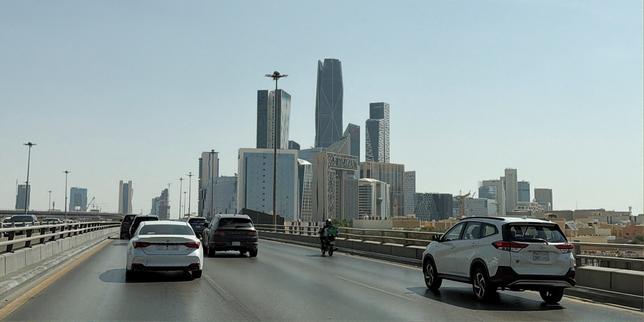
Repeated aerial strikes targeting the King Abdullah Financial District (KAFD) in Riyadh—specifically resulting in structural damage to the Public Investment Fund (PIF) headquarters—demonstrate a fundamental vulnerability in centralized economic diversification strategies. When a state concentrates its financial administration, sovereign wealth management, and foreign direct investment (FDI) infrastructure within a single geographic perimeter, that zone ceases to function purely as a commercial hub and becomes a high-value asymmetric target. Understanding this dynamic requires separating the immediate physical damage to glass-and-steel skyscrapers from the systemic friction it introduces to capital markets, sovereign risk premiums, and regional security architecture.
The Architecture of Asymmetric Targeting
Modern urban financial districts rely on physical density to generate agglomeration economies—the productivity gains achieved when firms, talent, and capital locate near one another. In Riyadh, KAFD was engineered to internalize these gains, housing the PIF, major domestic banks, and regional headquarters for multinational corporations. Yet density creates a dual-use vulnerability. Under asymmetric warfare doctrine, non-state actors or regional adversaries do not need to achieve tactical military victory or destroy an entire city to alter state behavior. They only need to disrupt the perception of invulnerability.
The mechanism operates through three distinct channels:
- Symbolic Decapitation: The PIF tower is not merely office space; it is the operational nerve center of Vision 2030, managing hundreds of billions of dollars in assets intended to transition the Saudi economy away from hydrocarbon dependency. Striking this specific structure sends an immediate signal to global institutional investors that the state's primary economic engine is within kinetic reach.
- Cost-Exchange Asymmetry: Air defense interception systems—such as Patriot or THAAD batteries—require interceptors costing millions of dollars per launch to neutralize low-cost unmanned aerial vehicles (UAVs) or ballistic projectiles costing a fraction of that amount. Even when kinetic interception succeeds, falling debris damages high-cost commercial real estate, forcing the defender into an unfavorable economic attrition curve.
- Psychological Friction on Human Capital: Foreign direct investment depends on expatriate executive talent willing to relocate to the host jurisdiction. Repeated security alerts and visible damage to premier commercial towers increase the personal risk calculation for international personnel, complicating corporate relocation mandates regardless of tax incentives or regulatory reforms.
Distinguishing Verified Mechanics from Analytical Hypotheses
In analyzing recurring strikes on Riyadh's financial infrastructure, rigorous assessment requires separating established operational realities from market projections.
Known Operational Facts:
- Physical Concentration: KAFD concentrates regulatory bodies, the Saudi Exchange (Tadawul), and the PIF within a 1.6-square-kilometer footprint, creating a single point of geographic exposure for the kingdom's non-oil financial sector.
- Kinetic Vulnerability of Curtain-Wall Architecture: Modern high-rise towers utilize unitized glass curtain walls designed for thermal efficiency and wind load resistance, not blast overpressure or shrapnel impact. Even minor external detonations or falling interception debris shatter exterior glazing, forcing prolonged building evacuations and interior remediation.
- Mandated Corporate Presence: The Saudi Regional Headquarters (RHQ) program requires multinational firms to establish physical executive hubs in Riyadh to secure state contracts, artificially accelerating occupancy density in zones like KAFD.
Educated Hypotheses on Market Impact:
- Insurance Repricing: Commercial property and terrorism reinsurance underwriters covering Riyadh assets will likely adjust risk models upward. While sovereign backing absorbs direct balance-sheet losses for state-owned entities like the PIF, private developers and foreign tenants face higher premiums and stricter force majeure exclusions.
- Capital Allocation Delays: Institutional limited partners evaluating joint ventures with Saudi entities are unlikely to withdraw entirely due to the sheer scale of available capital. Instead, deal timelines will lengthen as compliance and physical security teams conduct extended due diligence on business continuity protocols.
The Sovereign Risk Transmission Mechanism
Financial markets price geopolitical risk through yield spreads and equity risk premiums rather than binary exit decisions. When a financial center experiences repeated physical breaches, the transmission mechanism affects the broader economy through specific balance-sheet channels.
First, sovereign debt issuance faces upward yield pressure. While Saudi Arabia maintains strong fiscal buffers and low debt-to-GDP ratios relative to G20 peers, international bond buyers demand compensation for tail-risk volatility. Even a marginal basis-point increase across multi-billion-dollar sovereign and quasi-sovereign issuances—such as PIF green bonds—translates into substantial cumulative borrowing costs over a ten-year maturity profile.
Second, the valuation of domestic commercial real estate relies on projected occupancy rates and rental yields. KAFD required massive upfront capital expenditure to construct. If security incidents slow the absorption rate of Grade-A office space or require retrofitting existing structures with blast-resistant glazing and hardened perimeter defenses, the internal rate of return (IRR) on the district's real estate assets compresses.
Third, operational continuity becomes a hard expense. Financial institutions operating inside KAFD must maintain redundant off-site data centers, mirrored trading floors, and decentralized leadership protocols. Running parallel infrastructure erodes the very cost efficiencies that a centralized financial district was built to provide.
Limitations of Kinetic and Regulatory Countermeasures
State authorities typically respond to infrastructure strikes with two primary tools: layered air defense upgrades and strict information control. Both approaches face structural limitations when applied to a global financial hub.
Kinetic air defense networks, regardless of radar sophistication, cannot guarantee a 100 percent interception rate against low-altitude, terrain-hugging drones or saturation salvos. Furthermore, the physics of high-altitude interception means that neutralizing a warhead directly above a dense urban core still results in heavy metallic debris raining onto glass rooftops and pedestrian plazas. Kinetic defense mitigates catastrophic structural collapse, yet it cannot prevent the localized damage and visual spectacle of shattered high-rises.
Similarly, narrative management—restricting domestic reporting or downplaying physical damage—fails to insulate international capital markets. Global financial institutions rely on satellite imagery, private security intelligence firms, and internal employee reporting networks. Attempts to obscure the extent of structural damage to landmark towers increase information asymmetry, which institutional investors penalize more harshly than transparent risk disclosure.
Strategic Imperatives for Institutional Operators
For multinational corporations, sovereign partners, and institutional asset managers operating within Riyadh, treating physical security as a static compliance checkbox is no longer viable. Capital preservation and operational resilience require immediate structural adjustments across three domains.
1. Geographic Decentralization of Critical Functions
Firms establishing regional headquarters to satisfy regulatory mandates must decouple their physical executive presence from their operational infrastructure. Front-office relationship teams can maintain required footprints inside KAFD, while back-office operations, liquidity management, and primary data servers must be distributed across secondary jurisdictions or hardened, low-profile facilities outside the primary target perimeter.
2. Dynamic Force Majeure and Insurance Auditing
Corporate legal teams must audit existing commercial leases, construction contracts, and joint-venture agreements within the kingdom. Standard war-risk exclusions in commercial property policies often leave severe coverage gaps when damage stems from asymmetric drone strikes or falling interceptor debris rather than declared interstate war. Contracts must explicitly allocate remediation costs and operational downtime liabilities between state-affiliated landlords and private tenants.
3. Redundant Human Capital Protocols
Organizations must institute tiered relocation and remote-execution frameworks that allow senior decision-makers to rotate out of high-density zones during periods of elevated regional tension without breaching statutory residency minimums. Building modular executive continuity ensures that a localized kinetic strike on a single tower disrupts physical glass rather than institutional decision-making.