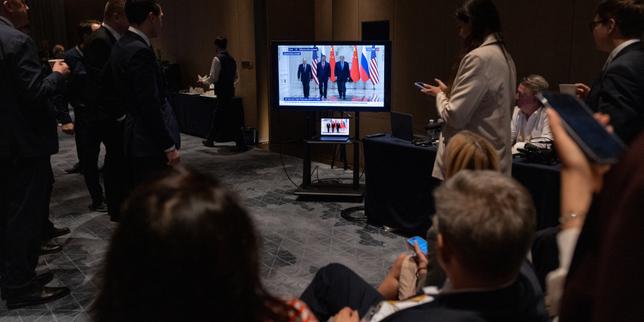
Cold rain hits the tall glass windows of the Federal Chancellery in Berlin with a dull, persistent thud. Inside, the air smells of damp wool coats, bitter espresso, and floor wax. On November 19, 2026, nearly forty delegations from across Europe and beyond have gathered under the grey German sky for a meeting of the Coalition of the Willing. Among the dark suits and whispered briefings walk two men who carry the specific, heavy gravity of American power: special envoys Steve Witkoff and Jared Kushner.
Wait.
Look at the choreography of this room, and you will see the quiet terror that keeps half a continent awake at three in the morning. Every diplomatic ticker in Paris, London, and Washington reduces this day to a sterile string of nouns: security guarantees, Article 5-like frameworks, multinational deployment exercises, post-war architecture. Yet behind the frosted glass of the conference rooms, nobody is actually debating syntax. They are negotiating the exact price of a human life, and whether a signature on a piece of heavy linen paper can stop a tank column four hundred miles to the east.
The Anatomy of a Hesitation
To understand what happened when the American envoys stepped onto the tarmac in Berlin, consider a hypothetical character—let us call her Olena—sitting in a fourth-floor apartment in Kharkiv. She is thirty-four, a structural engineer who spent the past four years learning the precise acoustic difference between an outgoing artillery shell and an incoming glide bomb. When Olena hears on her battery-powered radio that American emissaries are meeting European leaders in Germany to discuss "security guarantees," she does not hear diplomatic progress. She hears a question she cannot afford to get wrong: Should I unpack my winter coats, or keep my passport taped to the inside of my coat pocket?
For Olena, and for millions living along the jagged scar of eastern Europe, the language coming out of Berlin carries a terrifying ambiguity. Since its launch in the spring of 2025, the Coalition of the Willing—spearheaded by Britain, France, and Germany—has tried to build a safety net for Ukraine. On the surface, the numbers look reassuring. Just one day before the Berlin summit, the European Commission proposed up to 45 billion euros in fresh financial assistance, stacked atop an existing 90-billion-euro support loan meant to carry Kyiv through 2026 and 2027. Chancellor Friedrich Merz stood before the cameras, holding a jagged fragment of the Berlin Wall in his hand, urging Vladimir Putin to end the bloodshed so Europe would never again live divided.
The symbolism was immaculate. The reality inside the closed sessions was far colder.
While European capitals discussed what a Multinational Force for Ukraine might look like after a ceasefire, the American position drew a hard, unyielding line in the wet sand. Washington made it clear that under any post-war arrangement, there will be no American troops on Ukrainian soil and no United States military bases. Instead, the American envoys—fresh from high-stakes conversations that included a phone call from Donald Trump shortly after his trilateral meeting in Shenzhen with Putin and Xi Jinping—pushed a concept they called an "Article 5-like" security guarantee.
When "Like" Does All the Heavy Lifting
Anyone who has ever bought insurance after a house fire knows the difference between a binding contract and a polite assurance. In diplomacy, that gap is measured in blood.
NATO’s actual Article 5 is a tripwire wired directly to the world’s largest military arsenals; an attack on one member is legally an attack on all. An "Article 5-like" arrangement, by contrast, is a house built without a foundation. It mimics the silhouette of collective defense while stripping away the automatic obligation to fight. It does not specify which nation will send soldiers, how many minutes or months they will take to arrive, or whether they will be legally required to fire a single shot if Russian forces cross a ceasefire line.
I remember standing years ago in a muddy staging ground near the Polish border, watching convoys of donated generators wait three days for customs stamps while hospitals forty miles away ran surgeries by flashlight. That is the distance between political will and physical reality. Bureaucracy moves at the speed of ink; artillery moves at the speed of sound. When you tell a country that has already been invaded twice in a single generation that its future survival rests on a promise similar to a real alliance, you are asking them to bet their children’s survival on a footnote.
Why, then, do the American envoys keep returning to this formula? Look closely at the two men representing Washington in Berlin. Jared Kushner, constantly typing notes onto his MacBook during sessions, approaches statecraft like a distressed real estate restructuring—searching for a compromise where every party walks away claiming a win. Alongside Steve Witkoff, he has spent hours in direct conversation with Moscow, operating on the belief that Vladimir Putin might privately entertain an "Article 5-like" framework if it keeps formal NATO expansion off the table.
Here lies the central trap of the Berlin summit. Guarantees muscular enough to convince Volodymyr Zelenskyy to sign a ceasefire—and to persuade Olena in Kharkiv to unpack her bags—are the exact guarantees the Kremlin refuses to tolerate. Conversely, a watered-down arrangement acceptable to Moscow offers Kyiv little more than a gentleman’s agreement with an expiration date tied to the next American election cycle.
The Ghosts in the Chancellery
History rarely repeats itself cleanly, yet it has a habit of rhyming in the same rooms. In 1994, Ukrainian diplomats signed the Budapest Memorandum, surrendering the world’s third-largest nuclear arsenal in exchange for "security assurances" from the United States, the United Kingdom, and Russia. They were told at the time that the phrasing was ironclad, that the signatures of great powers carried moral and strategic weight. Twenty years later, when green men without insignia marched into Crimea, those assurances evaporated into thin air.
That ghost sat at the polished table in Berlin on November 19.
Every European leader in that hall knows what happens if the Coalition of the Willing fails to turn rhetoric into steel. Even Supreme Allied Commander Europe Alexus Grynkewich had previously noted that full NATO membership remains the cheapest, most credible way to secure the continent. Yet with Washington floating scenarios where Kyiv might even be asked to withdraw from parts of the Donbas in exchange for elusive security arrangements, the burden shifts onto European shoulders that are still struggling to rearm.
Consider what happens next in capitals like Paris, London, and Berlin. European governments say they are willing to deploy defensive forces to Ukraine once the guns fall silent, and coalition troops are already running defensive deployment exercises on allied territory. Still, parliaments have not yet legally fixed the rules of engagement. If a French or British soldier is stationed near the Dnieper River under a European flag, without American air cover or intelligence backing, and a drone strike hits their barracks at dawn, who gives the order to shoot back? Without Washington acting as the ultimate backstop, a European peacekeeping force risks becoming either a passive spectator or a hostage.
The Invisible Ledger
It is easy to feel lost in the fog of these negotiations, and honesty demands admitting that even the diplomats walking out of the Chancellery do not know if their math will hold. The numbers on the page—45 billion euros here, thirty-seven nations there, joint drone production deals, private-sector reconstruction pledges—create the comforting illusion of momentum.
Yet war is never decided in the press briefing room.
It is decided in the quiet calculation of a father in Lviv deciding whether to send his seventeen-year-old son abroad before his eighteenth birthday. It is decided in the boardroom of a Munich engineering firm weighing whether to build a factory in western Ukraine or leave its capital safely parked in Frankfurt. If the security architecture emerging from Berlin looks like a patchwork quilt rather than a reinforced concrete wall, private capital will stay away, refugees will remain in exile, and Ukraine will bleed out economically even if a ceasefire holds.
A peace deal without teeth is not peace; it is merely an intermission paid for by the weaker side.
Late that Thursday evening in Berlin, the motorcades finally pulled away from the Chancellery, red taillights smearing across the wet asphalt as the American envoys headed back toward the airport. Inside the building, staffers cleared away the half-empty water glasses and gathered the briefing binders stamped with coalition crests. Four hundred miles east, Olena sat beside a dark window in Kharkiv, listening to the hum of a distant generator, waiting to find out whether the ink drying in Germany was strong enough to hold back the night.