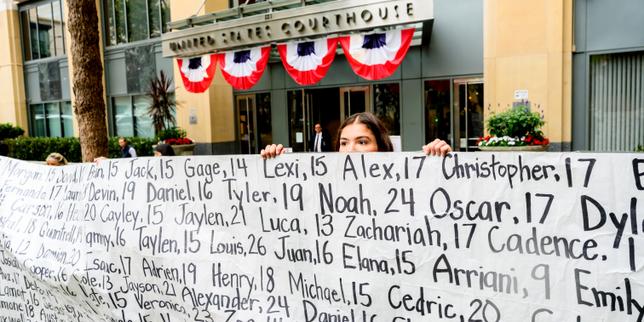
Light spills across the polished hardwood of an Oakland courtroom floor, casting long, geometric shadows that stretch toward the jury box. Outside, the morning air hums with the distant roar of Bay Area traffic and the rhythmic chanting of parents holding handmade signs. Inside, the room smells of aged paper, floor wax, and a sharp, electric anticipation.
This is not just another corporate dispute over intellectual property or breach of contract. This is a reckoning.
When Megan O’Neill, a deputy attorney general for California, stood before the jury to deliver her opening statement, she did not start with dry statutes or dense financial calculations. She started with human vulnerability. She spoke of developing brains, of chemical rewards sought in the quiet hours of midnight, and of an invisible architecture built not to connect people, but to capture them.
Consider what happens inside a typical suburban home at midnight. A fourteen-year-old lies awake in the dark, the pale blue glow of an Instagram screen illuminating a tired face. The thumb moves downward. Refresh. Another post. Refresh. An endless ribbon of images, validation, and curated perfection flows past, engineered with the mathematical precision of a casino slot machine.
According to the coalition of state attorneys general driving this landmark federal trial, that midnight scroll is no accident. It is a design choice.
For years, technology giants operated under an unwritten social contract. They promised to shrink the globe, to bring friends closer, to organize the world's information. But beneath the altruistic marketing veneer, a different machine was humming. Internal corporate documents, dragged into the harsh light of judicial discovery by state investigators, tell a story of calculated trade-offs. One internal study bluntly noted that the youngest users are the most valuable targets, capturing a chilling corporate philosophy: the product works best when the user is most defenseless.
The state prosecutors laid out their core argument with devastating simplicity. Meta, the parent company of Instagram and Facebook, allegedly knew its products harmed children's mental health, stoked anxiety, triggered eating disorders, and fostered compulsive usage patterns. Yet, according to the state's legal team, the company buried those internal warnings, publicly defended its safety measures, and continued deploying psychological hooks like infinite scrolling and intermittent reward loops.
Time and again, the state argued, profits won.
The stakes of the next six to eight weeks in U.S. District Judge Yvonne Gonzalez Rogers’ courtroom are astronomical. The coalition of states is seeking financial penalties that could theoretically reach staggering heights, touching numbers that rival the annual revenue of the tech titan. More importantly than the money, the plaintiffs are demanding fundamental operational changes. They want the architecture rewritten. They want the infinite feeds broken, the algorithmic manipulation stripped away, and a return to a digital space where human well-being supersedes daily active user metrics.
Meta’s defense team pushed back immediately, setting the stage for a brutal legal war of attrition. Paul Schmidt, counsel for the tech giant, argued to the jury that the internal emails and documents presented by the state were cherry-picked out of context, weaponized to construct a narrative that misrepresents the company's actual safety efforts. Meta maintains that it has spent years pioneering age-verification tools, parental controls, and teen accounts, acting proactively long before these lawsuits ever materialized. From the defense's perspective, the state is attempting to penalize a single company for broad, systemic societal challenges that plague the entire modern internet.
Yet the shadow of recent history hangs heavily over the defense table. Just weeks prior, a state trial in New Mexico handed Meta a major defeat over similar allegations of youth mental health harms. The legal momentum is shifting. Comparisons to the landmark tobacco litigation of the 1990s are no longer just rhetorical flourishes used by ambitious politicians; they are becoming the organizing framework for how courts view corporate liability in the digital age.
As the trial progresses, the courtroom will hear testimony not just from legal experts and state regulators, but from high-profile executives, including Meta CEO Mark Zuckerberg and Instagram head Adam Mosseri. They will be forced to answer for the internal memos, the late-night strategy sessions, and the metrics that measured success in human attention spans.
The trial in Oakland is more than a courtroom battle over liability and ledgers. It is a collective mirror held up to modern society. It forces us to confront an uncomfortable truth about the tools we invited into our pockets, our bedrooms, and the minds of our children.
The courtroom silence deepens as the first witness takes the stand. The documents are displayed on giant monitors. The arguments begin. And somewhere out there in the quiet rooms of the world, another screen glows in the dark.