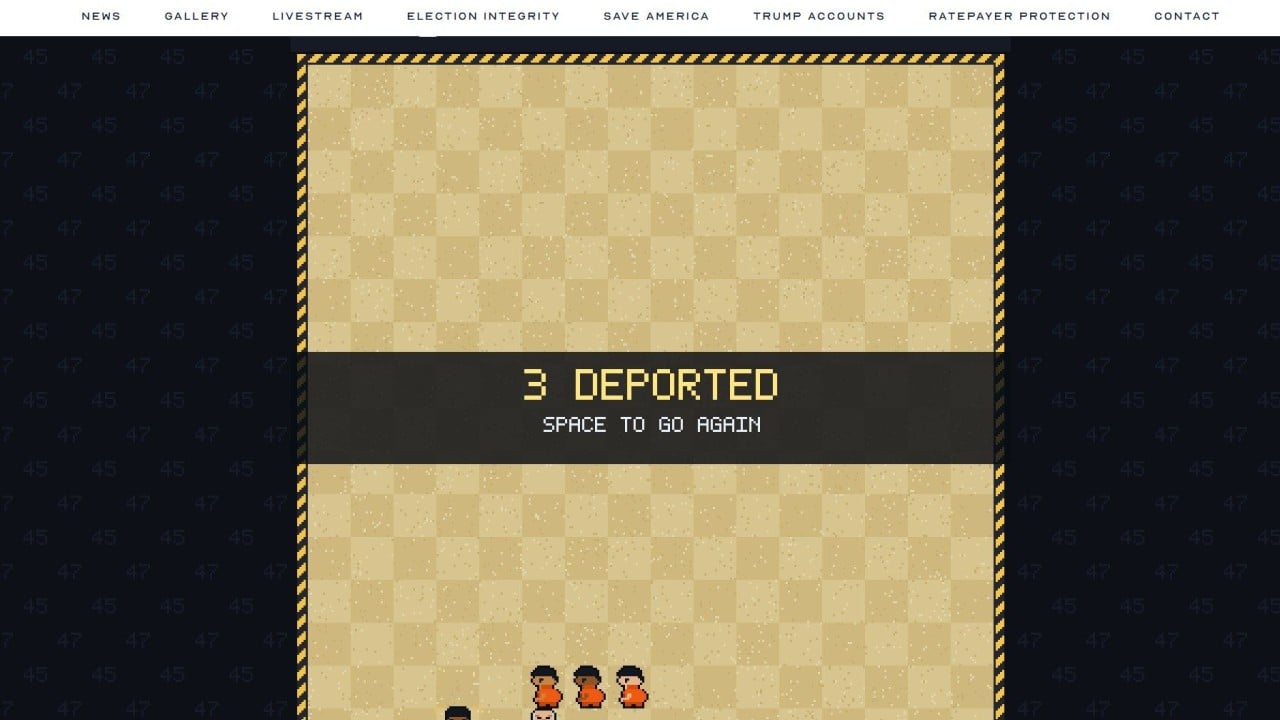
Political communication has shifted from traditional press releases to interactive digital assets designed to maximize engagement, bypass media gatekeepers, and turn policy enforcement into playable media. The release of the White House online arcade suite represents a structural evolution in political marketing. Rather than relying on passive text or televised speeches, the administration has deployed retro-style browser games like Rio Run and Build the Wall to codify its hard-line immigration and enforcement agendas into shareable cultural artifacts. This strategy leverages the mechanics of gamification to achieve specific ideological and behavioral outcomes among digital native demographics.
The Attention Economy and Policy Gamification
Modern political survival relies on capturing fragmented attention spans. Traditional news cycles no longer dictate public perception entirely; instead, algorithmic platforms reward virality, novelty, and emotional resonance. By packaging contentious state actions—such as mass deportations and border barrier construction—into arcade loops reminiscent of classic titles like Snake and Tetris, the administration lowers the barrier to entry for political messaging.
Gamification transforms passive observers into active participants. When a user controls a digital avatar chasing crossers along the Rio Grande or stacks blocks to seal a frontier, the psychological distance between complex geopolitical policy and entertainment collapses. The core objective of this design is memetic propagation. Users do not merely consume the information; they generate high scores, share screenshots on social channels, and debate the appropriateness of the imagery, thereby doing the distribution work for the political apparatus.
The Structural Mechanics of the Arcade Suite
The application features distinct functional modules, each mapping directly to a pillar of the administration's domestic platform.
- Enforcement Simulation: Titles that simulate border patrols and deportations utilize linear feedback loops. The user receives immediate positive reinforcement points for capturing digital targets, establishing a direct behavioral association between state coercion and winning.
- Infrastructure Automation: Block-stacking games that frame physical barriers as defensive puzzles recontextualize civil engineering projects as urgent security necessities, framing spatial separation as a winning puzzle state.
- Economic Incentivization: Modules dedicated to investment accounts and resource distribution embed state-backed financial policy into casual mechanics, normalizing long-term fiscal proposals through repetitive, low-stakes interaction.
This architecture deliberately abstracts complex legal, humanitarian, and economic realities into binary win states. Nuance is systematically stripped away, replaced by the binary logic of score accumulation.
The Strategic Calculus of Counter-Messaging
Critics from human rights organizations and advocacy groups frequently frame these digital initiatives as cruel, dehumanizing, or unserious. However, evaluating these tools through a traditional governance lens misses the operational intent. The administration does not design these assets to persuade ideological opponents. The primary function is twofold: solidifying base loyalty through shared inside jokes and cultural signifiers, and provoking predictable outrage from political adversaries.
Outrage functions as free amplification in modern media ecosystems. When institutional critics condemn the arcade suite as offensive, they signal its relevance to wider audiences, driving traffic to government platforms and validating the administration's posture as an unyielding combatant against conventional political norms. This creates an asymmetric communications advantage where conventional condemnations inadvertently serve as promotional fuel.
The deployment of state-sponsored casual games marks a permanent shift in how executive power communicates its mandates. Policy has become software, and software has become a vehicle for ideological tribalism. The implications extend far beyond immigration debates, setting a precedent for how future administrations will utilize interactive media to codify executive priorities into everyday digital consumption.
Monitor the velocity of user-generated content and secondary parodies derived from official state digital releases rather than tracking traditional media editorial coverage to measure the true cultural penetration of gamified policy initiatives.