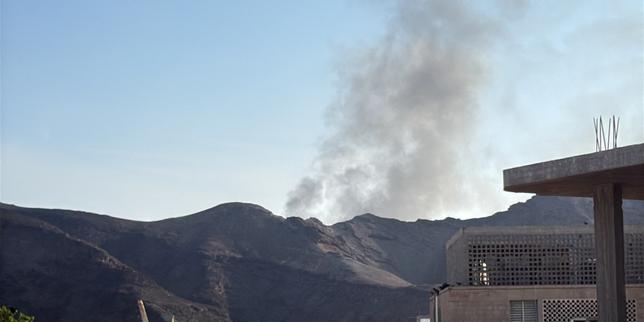
Dust.
In southern Yemen, it does not merely settle on windshields or coat the cracked leather of soldiers’ boots; it hangs in the humid air off the Gulf of Aden like a heavy, suffocating curtain that blurs the horizon until you cannot tell where the desert ends and the sea begins. When you stand at a checkpoint north of the city, listening to the low, rhythmic thrum of diesel engines idling in the heat, the geopolitics that fill diplomatic cables in Riyadh, Washington, and Tehran evaporate into something much simpler and infinitely more terrifying. You are looking at asphalt, sandbags, and young men gripping Kalashnikovs, waiting to see if the horizon will suddenly erupt into fire. If you enjoyed this piece, you should look at: this related article.
For months, the international headlines treated Yemen as a frozen conflict, a quieted front line tucked away behind louder, newer crises. Then came the shift. The Yemeni government camp—an uneasy, fractured coalition bound together by necessity rather than affection—began redeploying heavy reinforcements around Aden. Armored pickups kicked up plumes of ochre earth along the coastal highways and mountain passes. Artillery pieces were hauled into defensive positions overlooking the approaches to the temporary capital. To a casual observer reading a wire dispatch, it looked like routine military posturing, a dry chess move on a distant board.
Look closer, however, and you will see the panic beneath the steel. The Houthi movement, emboldened by years of entrenched control in the north and a willingness to test every boundary of regional deterrence, is pressing outward once again, casting a long, menacing shadow toward the port city that serves as the beating heart of the internationally recognized government. For another look on this event, refer to the recent update from NBC News.
The Architecture of a Threatened Sanctuary
To understand why the movement of a few thousand troops around Aden matters to anyone living thousands of miles away, you have to strip away the acronyms and look at the geography of survival. Picture a house whose upper floors have been completely taken over by an aggressive, heavily armed squatter. The original family has retreated to the basement—a single, cramped room with one door leading to the street, through which all food, medicine, and income must pass.
Aden is that basement.
Since Sanaa fell to the Houthis in 2014, Aden has functioned as the reluctant, battered temporary capital of Yemen’s internationally recognized government. It is a city built inside the crater of an extinct volcano, a natural fortress facing the Bab el-Mandeb Strait, one of the most critical maritime chokepoints on earth. Every barrel of oil, every container of electronics, every grain shipment passing between Europe and Asia must thread the needle just off Aden’s coast. If Aden falls, or even if its perimeter buckles under sustained Houthi artillery and drone barrages, the internationally recognized Yemeni state ceases to exist as a territorial reality.
Consider a hypothetical day in the life of Tariq, a fictional composite drawn from the countless port workers and mechanics who keep Aden breathing. Tariq wakes before dawn to the sound of generators sputtering out as the neighborhood fuel ration runs dry. He walks past walls pocked with shrapnel from the 2015 battle for the city—scars that never healed, only faded under layers of sun-bleached political posters. At the port, cranes groan as they unload sacks of imported wheat. Over ninety percent of Yemen’s food comes through ports like this one. When Tariq hears rumors in the market that Houthi units are massing along the northern front lines in Lahij or Abyan, he does not think about United Nations resolutions or regional power balances. He thinks about the price of flour tomorrow morning. He thinks about whether the road to his sister’s village will be cut by checkpoints before sunset.
That is the invisible stake of the current redeployment. Military convoys rolling toward Aden’s perimeter are not merely defending a government; they are trying to hold open the last windpipe of a nation gasping for air.
Inside the Fractured Shield
Yet the tragedy—and the immense danger—of the defensive buildup around Aden lies in the nature of the defenders themselves. A naive reading of the news assumes that "the government camp" is a unified army marching in lockstep under a single flag. Anyone who has spent time on the ground in southern Yemen knows that is a comforting fiction.
Think of the anti-Houthi coalition not as a solid brick wall, but as a dry-stone fence stacked hastily during a storm. The stones—the Presidential Leadership Council, the Southern Transitional Council, the Giants Brigades, and various local tribal militias—are held together entirely by the downward pressure of a common threat. Remove that pressure, or push against one corner too hard, and the stones grind against each other, threatening to collapse inward.
Inside Aden itself, the dominant security force is the Southern Transitional Council, a movement that openly seeks the secession of South Yemen and the restoration of the independent state that existed prior to 1990. Beside them, sometimes uneasily, stand forces loyal to the broader Yemeni republic, alongside elite Salafi-leaning fighters of the Giants Brigades, whose disciplined assaults proved decisive in pushing the Houthis back from Shabwa and Marib in previous years.
When commanders order reinforcements to encircle Aden, they are executing a delicate, nerve-wracking balancing act. They must bring enough firepower to deter a Houthi offensive from the north without triggering turf wars among rival brigades inside the city limits. Every checkpoint added to the ring around Aden requires negotiations over who commands it, whose flag flies above the sandbags, and who controls the flow of goods and taxes passing through. It is exhausting, fragile work, conducted under the constant hum of reconnaissance drones overhead.
Why the Front Lines Are Shifting Now
Why, after months of fragile de-escalation and quiet back-channel talks between Saudi Arabia and the Houthis, is the threat to Aden flaring back into urgent military mobilization?
History offers a blunt lesson about the Houthi movement: they rarely negotiate from a position of stillness. For over a decade, from their mountain strongholds in Saada to their seizure of Sanaa and their campaign across the Red Sea, the Houthis have operated on a consistent strategic rhythm. They use periods of relative calm to regroup, replenish stockpiles, and absorb smaller rivals, only to apply sudden, concentrated pressure on a vulnerable point just as diplomatic frameworks appear close to solidification.
By threatening the approaches to Aden—whether through troop concentrations in neighboring governorates, renewed skirmishes along the Dhale and Lahij front lines, or the implicit menace of ballistic missiles and armed drones—the Houthis achieve multiple objectives at once. First, they remind the Presidential Leadership Council that no corner of Yemen is beyond their reach. Second, they signal to regional backers, particularly Saudi Arabia and the United Arab Emirates, that any peace deal ignoring Houthi demands on oil revenues, port control, and civil servant salaries will be met with immediate escalation on the ground.
It is a high-stakes game of brinkmanship played with live ammunition. For the soldiers ordered into the trenches outside Aden, the geopolitical logic is cold comfort. Many of them have not been paid regularly in months, their salaries eroded by a collapsing currency that has split in two—one value in the Houthi-controlled north, another, far weaker value in the government-controlled south. A sack of rice in Aden costs several times what it did a few years ago, turning survival into a daily mathematical puzzle for families living on a soldier’s meager stipend.
The Anatomy of an Urban Chokehold
If you have never lived in a city bracing for a siege, it is difficult to grasp how fear alters the physical texture of daily life. It is not always loud. Often, it is a sudden quietness in the streets after dusk. It is the sight of shopkeepers pulling down corrugated metal shutters an hour earlier than usual. It is the subtle shift in conversation at qat-chewing gatherings in the afternoon, where jokes about local politicians give way to whispered calculations about fuel reserves and escape routes.
Aden has already survived one catastrophic battle in 2015, when Houthi fighters pushed all the way into the city’s residential neighborhoods, turning apartment blocks into sniper nests and leaving entire districts in ruins before a coalition intervention drove them out. The memory of those months is seared into the collective nervous system of every resident over the age of fifteen. They remember the water pumps failing in the blistering summer heat, when temperatures regularly climb above forty degrees Celsius. They remember hospitals running out of anesthetic while wounded civilians arrived in the beds of pickup trucks.
When new reinforcements roll through the streets of Crater, Khor Maksar, and Sheikh Othman, residents watch them with a mixture of relief and dread. Relief, because an unguarded perimeter is an open invitation to invasion. Dread, because the arrival of heavy weaponry is an unmistakable acknowledgment that the truce was an illusion, and that the storm may be returning.
Let us be candid about the uncertainty hanging over southern Yemen right now: nobody, not even the generals drawing arrows on maps in fortified command centers, knows with certainty whether this mobilization will successfully deter a full-scale assault or merely mark the opening chapter of a bloody new offensive. Military deterrence is a psychological gamble. You pile up sandbags, deploy armored vehicles, and position elite brigades at strategic bottlenecks in the hope that your enemy looks through their binoculars, calculates the cost of advancing, and decides to stay put.
What happens if they advance anyway?
The geography around Aden leaves little room for error. To the north, rugged mountain passes funnel traffic down toward the coastal plain. If Houthi forces manage to punch through the forward defensive lines in Dhale or Lahij, the terrain opens up into flat, exposed stretches leading straight into Aden’s outer suburbs. In that scenario, the battle would swiftly devolve into brutal urban warfare—the kind that destroys infrastructure, displaces hundreds of thousands of civilians, and paralyzes the port facilities that millions across southern Yemen depend on for food and medicine.
The Echo Beyond the Strait
There is a persistent temptation in the rest of the world to view Yemen’s internal front lines as an isolated tragedy, tragic for its people perhaps, yet safely contained within the borders of the Arabian Peninsula. That comfort has always been a mirage, and today it is thinner than ever.
Aden sits directly on the doorstep of the global economy. The waters just beyond its harbor carry a massive share of the world’s seaborne trade and energy supplies. We have already seen how instability along Yemen’s coastline can send shockwaves through international shipping lanes, forcing vessels to reroute around the southern tip of Africa, driving up freight costs, and fueling inflation in markets far removed from the Middle East.
A destabilized Aden—or worse, an Aden embroiled in active warfare—would dismantle the last remaining institutional counterweight to Houthi dominance along the southern Red Sea and the Gulf of Aden. It would shatter the fragile framework of United Nations-mediated peace efforts, likely triggering a broader regional escalation that neither Gulf states nor Western powers are eager to confront. Every armored vehicle moving into defensive position around Aden is, in a very real sense, holding back a domino whose fall would reverberate across global supply chains and regional security architectures alike.
What Remains When the Convoys Pass
Stand again at that dusty checkpoint on the northern edge of Aden as the sun drops behind the jagged volcanic peaks, turning the sky a bruised purple. The heat begins to lift, replaced by a warm, salt-heavy breeze blowing in from the sea.
A column of military trucks rumbles past, headlights cutting narrow beams through the swirling grit. In the back of the last vehicle, a young soldier leans his head against the metal railing, his eyes half-closed from exhaustion, a faded scarf wrapped around his neck to keep out the dust. Behind him lies a city of over a million people—mothers boiling tea over gas stoves, fishermen mending nets along the shore, children chasing a deflated football down a narrow alley. Ahead of him lies the darkness of the desert and the hills where an unforgiving enemy watches and waits.
Diplomats will continue to draft statements calling for restraint. Analysts will continue to map troop movements and count artillery pieces. Yet the fate of Aden, and the fragile future of Yemen itself, rests tonight on that thin, dusty line of tired men standing watch in the dark, hoping the horizon stays quiet until morning.