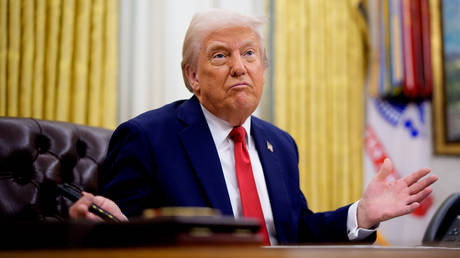
Donald Trump recently sat down for an interview that sent ripples through the higher education world and international relations circles. He touched on a topic that’s been a massive point of contention for years—the presence of roughly 500,000 Chinese students in the United States. His take was surprisingly nuanced for someone known for hardline "America First" rhetoric. He basically admitted that while he could shut the door, he won’t. It’s a complicated dance between national security fears and the cold, hard cash that keeps American research labs running.
Why the US Needs Chinese Students More Than You Think
Money talks. Honestly, it screams when it comes to university budgets. International students, particularly those from China, often pay full tuition. They aren't getting the same financial aid packages or in-state discounts that local kids rely on. This revenue stream props up departments that would otherwise crumble. If you suddenly removed half a million high-paying students, your local state university would likely have to jack up prices for everyone else or cut programs entirely.
Beyond the checkbook, there’s the brainpower. Many of these students are in STEM fields—science, technology, engineering, and math. They’re the ones doing the heavy lifting in labs, helping American professors secure grants and push the boundaries of innovation. Trump acknowledged this reality. He knows that if the US stops being the destination for the world’s brightest, some other country will happily take them.
The Security Risk vs Economic Reward Tangle
You can’t talk about Chinese students in the US without talking about the FBI’s concerns. For years, intelligence agencies have warned about "non-traditional collectors" of intelligence. The fear is that some students might be pressured by the Chinese government to send back sensitive research. It's a valid concern. We've seen cases of intellectual property theft and undeclared ties to foreign military institutions.
However, a blanket ban is a blunt instrument that usually does more harm than good. Trump’s comments reflect a realization that a total shutdown would be a self-inflicted wound. He mentioned that he could tell them he doesn't want them, but he recognizes the value they bring. It’s about balance. You want the talent, but you have to vet the person. We’re seeing more rigorous background checks and restrictions on specific sensitive technologies, which is a much more surgical approach than a total lockout.
Trump and the Global Talent War
The world is in a literal war for talent. If a brilliant AI researcher from Shanghai can’t get a visa to study at Stanford, they’ll go to Oxford, Toronto, or stay in Beijing. When they stay home or go elsewhere, the US loses the chance to "capture" that talent. Historically, the US has been great at this. Students come for the degree, fall in love with the culture (or the salaries), and stay to start companies. Those companies create American jobs.
Trump’s stance seems to be shifting toward a "keep the best and brightest" model. He’s floated the idea of giving green cards to foreign graduates of US universities. It’s a pragmatic move. Why train someone for four to six years at a top-tier institution only to kick them out so they can compete against us from abroad? It makes zero sense.
The Cultural Impact on American Campuses
Walk across any major university campus today. You'll see a global melting pot. This diversity isn't just about optics. It prepares American students for a global economy. If you’re a business major in Ohio and you’ve never worked on a project with someone from a different cultural background, you’re going to struggle in the real world.
There are challenges, of course. We see "echo chambers" where international students stick together, and sometimes there’s friction over political issues. But the overall benefit of having these perspectives in a classroom is massive. It forces everyone to sharpen their arguments and think outside their own bubble.
What This Means for Future Policy
Expect the vetting process to get even tighter. We aren't going back to the wide-open borders of the early 2000s. The government will continue to scrutinize students coming for high-tech research fields like quantum computing or semiconductors.
But the door remains open. Trump’s rhetoric suggests that as long as the "deal" benefits America, the students are welcome. It’s a transactional view of education. If you bring money, brains, and don’t steal secrets, you’re in. If you’re a risk, you’re out. It's simple in theory, but incredibly difficult to execute without accidentally chilling the environment for everyone.
Practical Steps for International Students and Universities
If you're an international student or an administrator, the landscape is shifting. You need to be proactive.
- Prioritize Transparency: Students must be 100% honest about their funding sources and any affiliations with foreign government entities. Any shadow of a doubt can lead to a visa denial or worse.
- Focus on Compliance: Universities need to invest heavily in their export control offices. Knowing exactly who is in which lab and what data they can access is no longer optional.
- Diversify Recruitment: Relying too heavily on one country is a business risk. Schools are already looking toward India, Vietnam, and Nigeria to balance their portfolios.
- Advocate for Retention: If you're a business leader, push for immigration policies that make it easier for high-skilled graduates to stay. The degree is only half the value; the career that follows is where the real economic impact happens.
The "student problem" isn't going away. It’s a permanent fixture of our geopolitical reality. We have to be smart enough to protect our secrets without starving our innovation engine of the fuel it needs to run. Trump’s admission that he wants to keep the doors open—despite his tough-on-China stance—shows that even the loudest critics recognize the necessity of this exchange. Keep an eye on visa processing times and new Department of Justice initiatives; those will be the real indicators of how this policy plays out on the ground.