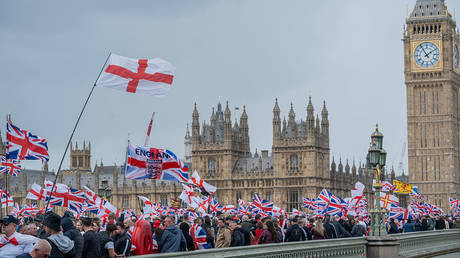
The "Unite the Kingdom" movement is not a singular organization or a traditional political party, but a volatile convergence of anti-immigration sentiment, populist frustration, and digital-first activism. While its supporters frame the movement as a patriotic defense of British identity and border security, critics and monitoring groups identify it as a mobilization vehicle for far-right ideologies. At its core, the movement leverages specific grievances—ranging from the housing of asylum seekers in local communities to perceived failures in policing—to create a broad, often chaotic front against the current political establishment.
The Anatomy of a Modern Mobilization
To understand Unite the Kingdom, you have to look past the Union Jacks and the placards. This isn't your grandfather’s street protest. The movement functions as a decentralized network that lives and breathes on platforms like Telegram and X. It lacks a formal board of directors, which is exactly why it is so difficult for authorities to pin down.
The momentum behind these gatherings often stems from a "vanguard" of influential figures who have spent years building independent media brands. These individuals don't just report the news; they curate a specific reality for their followers. When a protest is called under the "Unite the Kingdom" banner, it serves as a physical manifestation of an online ecosystem. The goal is simple: visual dominance. By filling central London or provincial town squares, the movement seeks to prove that their digital reach translates into real-world power.
The Tommy Robinson Factor
You cannot talk about this movement without addressing Stephen Yaxley-Lennon, known to the world as Tommy Robinson. While he often claims to be just a journalist or a concerned citizen, he is the undisputed sun around which this particular solar system orbits. His ability to draw thousands to the streets of London is a testament to a decade of brand building.
His legal battles and "documentaries" serve as the primary content engine for the movement. For his supporters, he is a martyr for free speech. For his detractors, he is a dangerous agitator. Regardless of which side you land on, the mechanics of his influence are undeniable. He uses high-production-value livestreams to bypass traditional media, creating a direct feedback loop with his audience that allows for rapid mobilization. When he speaks of "uniting the kingdom," he is calling for a coalition of disparate groups—football firms, disaffected working-class voters, and online libertarians—to stand under one flag.
The Fuel and the Fire
Why now? The surge in this movement isn't happening in a vacuum. It is the result of a profound sense of abandonment felt in many parts of the country.
For years, the political center ignored the growing resentment regarding the scale of small boat crossings in the English Channel. When people feel that their concerns are dismissed as "prejudice" by the London elite, they look for someone who will validate their anger. The Unite the Kingdom movement provides that validation. They take complex geopolitical issues and boil them down to a simple narrative: "They are replacing you, and the government is helping them do it."
The Infrastructure of Discontent
The movement thrives on local controversies. Whether it’s the use of a specific hotel to house migrants or a change in local policing priorities, these organizers are experts at "hyper-localization." They take a specific, local grievance and plug it into their national narrative.
This creates a self-sustaining cycle. A local protest breaks out; it gets filmed and uploaded to social media with "Unite the Kingdom" branding; the footage goes viral, attracting more people to the next event. The digital infrastructure—the bots, the influencers, and the algorithmic boosts—acts as a force multiplier. What might have been a fifty-person standoff in a parking lot ten years ago can now become a national news story within three hours.
The Financial Engine Behind the Scenes
Protests are expensive. Large-scale events in Trafalgar Square or outside Parliament require stages, massive LED screens, professional sound systems, and legal teams. The question of who pays for Unite the Kingdom is often shrouded in mystery, but the patterns are visible if you know where to look.
A significant portion of the funding comes from grassroots micro-donations. Through platforms that allow for recurring "memberships" or one-off "tips" during livestreams, the movement has tapped into a lucrative revenue stream. This is the democratisation of political funding, used for a very specific agenda. There are also persistent questions about high-net-worth donors, both domestic and international, who view the destabilisation of the UK's political status quo as a desirable outcome. While hard evidence of "foreign interference" is often talked about in intelligence circles, the more immediate reality is a highly efficient, tech-savvy fundraising machine that operates right under the noses of regulators.
The Policing Dilemma
The British police are stuck in a nearly impossible position. If they use a heavy hand, they provide the movement with the "police state" imagery it craves for its next viral video. If they are perceived as too lenient, they face accusations of "two-tier policing" from the other side of the political spectrum.
The movement has weaponized the concept of "two-tier policing." By highlighting instances where other groups—such as climate protesters or pro-Palestine marchers—were handled differently, they create a sense of systemic injustice among their followers. This narrative is incredibly effective. It turns every arrest of a "patriot" into further proof that the system is rigged against the native population. This isn't just about tactics; it's about the erosion of trust in the one institution that is supposed to be neutral.
The Role of Counter-Protests
Every Unite the Kingdom event is met by an opposing force, usually under the "Stand Up To Racism" banner. These counter-protests are essential to the movement’s survival. Without an "enemy" to shout at across a police line, the energy of the event dissipates.
The conflict provides the drama. It provides the "content" that drives social media engagement. When you see two groups of people screaming at each other while held back by a thin blue line, you aren't seeing a political debate; you are seeing a carefully choreographed piece of political theater where both sides use the other to justify their own existence.
The Extremist Pipeline
The most concerning aspect for security services is the "pipeline." While the majority of people attending a Unite the Kingdom rally may simply be angry about immigration or the economy, these events act as a funnel.
At the edges of these crowds, more radical elements operate. Groups that were banned or driven underground, like remnants of National Action or newer, more decentralized accelerationist cells, see these rallies as recruiting grounds. They look for the young, the angry, and the most vocal, pulling them away from "patriotic" rhetoric and toward genuine extremist ideology. The movement acts as a "gateway drug" to more dangerous beliefs, providing a sense of community and purpose to individuals who feel marginalized by modern society.
The Failed Response of the Political Class
For too long, the response from Westminster has been a mix of condescension and avoidance. Politicians have either tried to ignore the movement entirely, hoping it will go away, or they have issued boilerplate condemnations that only serve to reinforce the "us versus them" narrative.
This failure has created a vacuum. In the absence of a serious, adult conversation about national identity, the impacts of globalization, and the realities of migration, the loudest voices in the room win. The Unite the Kingdom movement didn't invent the divisions in British society; it simply moved in and furnished them. Until the government addresses the underlying economic and social anxieties that drive people into the arms of populist agitators, the "patriotic protest" will remain a permanent fixture of the British urban landscape.
The Digital Fortress
The movement is currently building its own alternative digital world. They are moving away from mainstream platforms that can "shadowban" or de-platform them and are instead investing in their own servers, their own video hosting sites, and their own encrypted communication channels.
This is a strategic retreat to higher ground. By controlling the platform, they control the narrative entirely. There is no fact-checking, no counter-argument, and no moderation. This creates an echo chamber so thick that it becomes impenetrable to outside information. When a supporter of Unite the Kingdom walks onto the street, they are carrying a reality that has been meticulously constructed and reinforced 24 hours a day.
Beyond the Street
The true power of this movement isn't found in how many people show up to a rally on a Saturday afternoon. It is found in how they have shifted the Overton Window—the range of policies acceptable to the mainstream population.
Issues that were once considered the fringes of political discourse are now being debated in the halls of power. By consistently pushing the boundaries of what can be said and what can be demanded, Unite the Kingdom has forced the traditional parties to react. They have become the "ghost in the machine" of British politics, influencing policy from the outside without ever having to win an election. This is the new reality of political power in the 21st century: influence is no longer measured in votes, but in the ability to disrupt and dominate the national conversation.
The movement is a symptom of a deeper malaise, a warning light on the dashboard of British democracy. You can arrest the leaders and you can ban the marches, but you cannot legislate away the feeling of a population that believes it has lost its country. The flags will keep flying and the crowds will keep gathering as long as the fundamental questions of who we are and where we are going remain unanswered by those in charge.