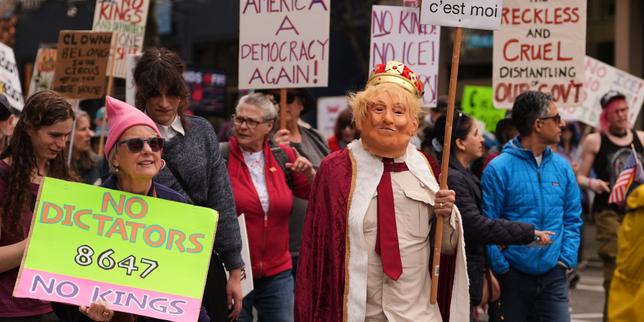
The rain in Paris didn't fall; it drifted. It was a fine, grey mist that clung to the wool of coats and the cardboard of hand-painted signs, turning the Place de la République into a sea of dampened resolve. High above the crowd, the bronze statue of Marianne—the personification of the French Republic—looked out over a mosaic of umbrellas. She holds an olive branch in one hand and a tablet of laws in the other. On this Saturday, she felt less like a monument and more like a witness.
To the casual observer, it was a protest. To those standing in the mud, it was a pulse check for democracy.
The "No Kings" demonstrations didn't start in France, but they found a particular, jagged resonance there. This was the city that once invented the guillotine to solve the problem of unchecked power. Now, decades into a new millennium, the grievance wasn't about bread prices or powdered wigs. It was about the global shift toward a brand of leadership that feels more like an inheritance than a mandate. Specifically, it was about the return of Donald Trump to the American presidency and the shadow that shadow casts across every border.
Consider Elena. She is a thirty-four-year-old teacher who took the Metro from the 19th Arrondissement. She isn't a professional activist. She doesn't usually spend her weekends chanting in the rain. But she felt a phantom weight on her chest when she saw the news.
"It’s the language," she told me, her voice competing with a drum circle nearby. "When one man says he is the only one who can fix it, he isn't talking to citizens. He is talking to subjects."
The Invisible Border
It is easy to dismiss a protest in Paris as a local grievance or a typical display of French civic restlessness. That would be a mistake. The "No Kings" movement, which ignited simultaneous fires of dissent from London to Tokyo and New York, represents a fundamental break in how we perceive national boundaries.
When the most powerful office on earth is occupied by someone who openly flirts with the idea of immunity and "day one" dictatorships, the fallout doesn't stop at the Atlantic. It travels. It travels through trade agreements that dictate what Elena pays for groceries. It travels through climate accords that determine if her students will have a habitable planet. Most importantly, it travels through the zeitgeist. It gives permission to every local strongman and aspiring autocrat to tighten their grip.
The facts are stark. In the United States, the legal battles surrounding the executive branch have centered on a terrifyingly simple question: Is the President above the law? The Supreme Court’s recent rulings on presidential immunity have sent a shiver through the international legal community. If the "King" cannot be prosecuted, then the "King" cannot be contained.
Paris understands this better than most. The French identity is built on the ruins of a monarchy. Every time a Parisian steps onto the cobblestones, they are walking on a history that says no to the divine right of rulers.
A Symphony of Discontent
Walking through the crowd, you realize the anger isn't a monolith. It is a chord made of different, jarring notes.
There were the climate activists, terrified that a "drill, baby, drill" philosophy in Washington would undo ten years of agonizingly slow progress in ten months. There were the labor unions, sensing a global rollback of worker protections. And then there were the people who were simply tired. Tired of the noise. Tired of the feeling that the world is tilting on its axis and they have no way to grab the railings.
The numbers were staggering. Estimates suggest tens of thousands marched in Paris alone, joining a global tally that reached into the millions. This wasn't a fringe gathering. It was a demographic cross-section.
One man, who identified himself only as Jean-Pierre, held a sign that read Citizen, Not Subject. He spoke about the psychological cost of the current era. "We spent centuries trying to prove that the law is a circle that surrounds us all," he said. "Now, we are being told it is a line, and some people stand on the side where the rules don't reach. If that happens in America, it happens everywhere."
The logic is hard to argue with. The United States often exports its culture through movies and music, but its most potent export has always been its democratic norms. When those norms are swapped for a cult of personality, the "American Dream" becomes a global nightmare for those living under the thumb of authoritarianism.
The Stakes We Don't See
We often talk about politics as if it is a game of chess played on a board far away from our kitchen tables. We focus on the polling data, the rhetoric, and the rallies. But the real stakes are the quiet things.
The stakes are the ability to trust that the person in power won't use the machinery of the state to settle a personal grudge. The stakes are the survival of the independent press. The stakes are the idea that truth is a shared reality, not a weaponized opinion.
In London, the "No Kings" march wound past Parliament, a reminder that even the oldest constitutional systems are fragile. In Washington D.C., the protest stood at the gates of the White House, a physical manifestation of the checks and balances that are currently being tested to their breaking point.
The movement chooses the word "King" for a reason. It is visceral. It bypasses the jargon of political science and hits a primal nerve. A president is an employee. A king is a master. The global outcry is a collective refusal of that promotion.
The Architecture of the Crowd
Despite the gravity of the subject, there was a strange, defiant joy in the air.
Protests are often portrayed as chaotic or angry. This felt more like a massive, outdoor classroom. People were discussing the nuances of international law. They were sharing snacks. They were helping each other keep signs dry. In an age of digital isolation, where most of our political engagement happens behind a glowing screen, the physical act of standing in the rain with 50,000 strangers is a radical reclamation of space.
It serves as a reminder that power is a borrowed thing. It is granted by the people, and it can be scrutinized by the people.
The "No Kings" day wasn't just about one man. It was about a trend. It was a reaction to the rise of the "strongman" archetype—the leader who claims that the system is broken and only their iron will can fix it. History is a long, bloody record of what happens when people believe that lie.
Beyond the Pavement
What happens when the umbrellas are folded and the crowds disperse?
The critics say these marches change nothing. They point to the fact that the policies continue, the rhetoric intensifies, and the "King" remains on his throne. But they miss the point of the spectacle.
The point isn't to change the mind of the man in the high tower. The point is to change the minds of the people on the street. It is to show them they are not alone in their unease. It is to build a network of solidarity that can be activated when the stakes get even higher.
The "No Kings" movement is a signal flare. It is the world telling the American executive branch: We are watching. Your decisions have consequences that do not stop at your shoreline.
As the sun began to set over Paris, the light turned a bruised purple. The rain finally stopped. The crowd began to thin, heading back to the Metro, back to their apartments, back to the lives that would be affected by decisions made thousands of miles away.
Elena folded her cardboard sign carefully, making sure not to smudge the ink. She didn't look defeated. She looked like someone who had just finished a long, necessary shift at work.
She looked toward the statue of Marianne. The bronze figure remained unmoved, her hand still holding the tablet of laws. In the fading light, the laws seemed more prominent than the olive branch. It was a silent, cold reminder that peace only exists as long as the rules apply to everyone.
The square was empty by midnight, but the mud was covered in thousands of footprints. They were messy, overlapping, and deep. They were the marks of people who refused to be erased, standing on ground that has seen empires rise and fall, and knowing that no crown is heavy enough to keep the truth down forever.