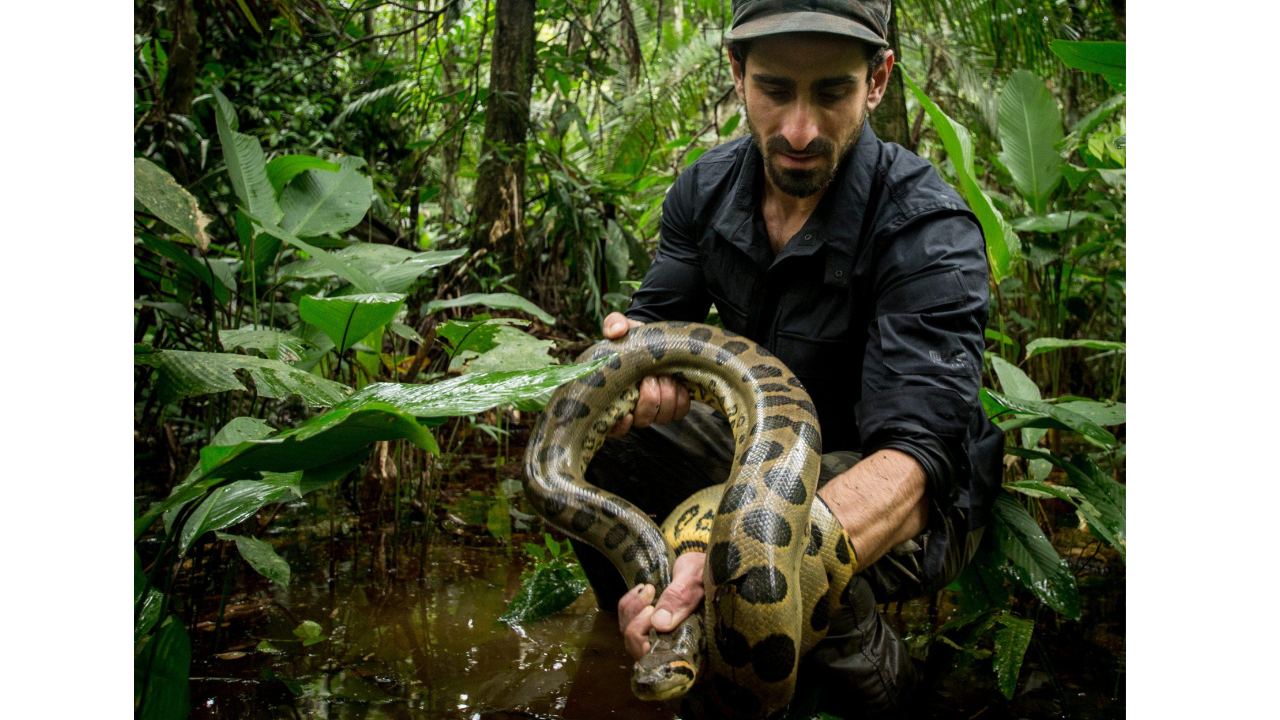
At eighteen, most kids are figuring out how to do their own laundry or staring blankly at a college syllabus. Paul Rosolie was wading chest-deep through blackwater tributaries in southeastern Peru, trying not to get crushed by twenty-foot green anacondas or bitten by bushmasters whose venom turns human tissue into liquid.
Mud. Sweat. The deafening, relentless roar of ten million insects vibrating at once. You might also find this related story insightful: Christa Pike’s Post-Execution Statement Exposes a Legal System Running on Empty.
If you have ever stood inside a genuine primary rainforest, you know that the word "nature" feels completely inadequate. Nature is a city park. Nature is a postcard of a mountain lake. The Western Amazon—specifically the Madre de Dios region where Rosolie first set foot in 2006—is an overwhelming, suffocating, magnificent biological engine that does not care if you live or die.
To understand how a kid from New Jersey ended up guarding 160,000 acres of that wilderness through his organization, Junglekeepers, you first have to strip away the romantic gloss we usually slap onto conservation stories. This isn't a tale about a saint hugging trees. It is a story about obsession, grief, mud-caked boots, and a desperate race against chainsaws. As highlighted in recent articles by USA Today, the results are worth noting.
The Lie of the Endless Forest
When you fly over the Amazon basin, the green stretches to the horizon like an infinite ocean. That visual tricks the human brain. We look down from thirty thousand feet and think, There is so much of it. Surely a few roads won't hurt.
Consider a hypothetical scenario to see why that thinking is fatal. Imagine your body's circulatory system—not as a neat diagram in a textbook, but as a living, breathing web of arteries and microscopic capillaries. Now imagine someone takes a razor blade and slices straight through the main artery in your thigh. You wouldn't say, "Well, ninety-nine percent of my skin is still intact." You would bleed out in minutes.
In the Amazon, roads are the razor blades.
In the mid-2000s, right around the time a teenage Rosolie was arriving in Peru with a backpack and a notebook, construction accelerated on the Interoceanic Highway—a massive paved artery designed to link the Atlantic coast of Brazil with the Pacific ports of Peru. On paper, it promised economic salvation for isolated communities. On the ground, it acted like a fuse wired directly into a powder keg.
Before the asphalt hardened, the forest along the corridor was largely inaccessible, protected by its own sheer difficulty. Once the trucks rolled in, everything changed. Illegal gold miners poured into the riverbeds, pumping liquid mercury into the water to separate flecks of gold from the silt. Loggers followed, carving "fishbone" patterns of dirt tracks deep into the jungle to haul out ancient mahogany and ironwood trees that had stood since before the Renaissance.
Rosolie didn't read about this in a policy brief. He watched it happen in real time.
He watched pristine oxbow lakes—where giant river otters once hunted and black caimans sunned themselves on fallen logs—turn into toxic, lunar wastelands of churning mud and abandoned dredging machinery. He smelled the diesel fumes hanging over rivers that used to smell like wet earth and crushed orchids.
When you witness that kind of destruction at nineteen or twenty years old, it rewires your nervous system. You stop seeing the forest as a place to visit, and you start seeing it as a patient on an operating table while the surgeons are arguing in the hallway.
Who Exactly Is Paul Rosolie
To the wider public, Rosolie first became a recognizable name through spectacle—most famously a 2014 television special where he attempted to be swallowed alive by an anaconda while wearing a custom-built protective suit. Critics mocked it. Conservation purists rolled their eyes. Even Rosolie later admitted the broadcast didn't turn out the way he envisioned, failing to convey the urgent message about habitat loss he had hoped to deliver.
But focusing on a single television stunt misses the point entirely. If you spend enough time in the jungle, you realize that getting anyone in the outside world to care about a patch of dirt five thousand miles away requires breaking through a wall of apathy. Most people will scroll past a graph showing deforestation rates in Madre de Dios without blinking. Tell them about a guy wrestling a giant snake in the dark, and suddenly they are listening.
Strip away the media noise, and what remains is a self-taught naturalist who spent nearly two decades learning the language of the Neotropics the hard way. He didn't arrive with a PhD and a corporate grant. He arrived as a field assistant, sleeping in leaky tents, nursing botfly larvae under his skin, and learning how to track jaguars by reading faint claw marks on buttress roots and listening to the alarm calls of red howler monkeys.
There is a specific kind of humility the jungle forces upon you. You learn quickly that you are slow, clumsy, and nearly blind compared to everything else living there. A harpy eagle can spot a sloth moving an inch per minute through dense canopy from two hundred yards away. A pit viper can sense the heat radiating off your ankles in pitch darkness.
Rosolie fell in love with that humbling reality. More importantly, he formed deep, lasting bonds with the indigenous communities and local Peruvian woodsmen—people like Juan Julio Durand, a former logger who knew every bend of the Las Piedras River and eventually became one of Rosolie’s closest allies.
And that alliance reveals the biggest misconception outsiders hold about saving the rainforest.
Why Buying Land Isn't Enough
If you ask someone on the street how to save the Amazon, they will usually say, "Buy the land and make it a park."
It sounds logical. It sounds clean. It is also completely detached from how the frontier actually works.
In remote regions like the Las Piedras watershed, a government title or a conservation deed sitting in a filing cabinet in Lima means nothing to an illegal logger with a Stihl chainsaw and a shotgun. Without people physically standing on that land, watching the river bends, and patrolling the boundary lines, a "protected" forest is just an unguarded warehouse.
Consider what happens next when a conservation group buys a plot of jungle and walks away:
- First come the scouts, slipping up the river at night in motorized canoes to mark high-value timber.
- Next come the timber crews, felling trees that took four hundred years to grow, dragging them out with heavy tractors that crush everything in their path.
- Then come the poachers, shooting tapirs, spider monkeys, and macaws to feed the mining camps.
- Finally, once the valuable trees are gone, the land is burned to clear space for cattle pasture or illicit crops.
By the time a satellite image alerts an office in Washington or London that the canopy has disappeared, the ecosystem is already dead.
Rosolie and his co-founders realized early on that if they wanted to protect the Las Piedras corridor, they couldn't just draw lines on a map. They had to hire the very people who knew the forest best—including former loggers and local indigenous residents—and pay them a steady, dignified wage to become full-time forest rangers.
That is the beating heart of Junglekeepers, the non-profit organization Rosolie co-founded to secure the threatened wilderness of Madre de Dios.
Inside the 160,000-Acre Shield
Numbers can feel sterile, so let’s make 160,000 acres tangible.
Imagine Manhattan. Now multiply Manhattan by roughly eleven. Picture that entire landmass covered not in concrete and steel, but in unbroken, multi-tiered emerald canopy rising two hundred feet into the humid air.
This specific stretch of forest along the Las Piedras River acts as a critical biological buffer. To the north and west lie massive national parks and territories belonging to uncontacted indigenous tribes—people who have lived in complete isolation for centuries and whose survival depends entirely on the intact forest keeping the outside world at bay. To the south lies the creeping advance of the Interoceanic Highway, bringing gold miners, agricultural speculators, and illegal logging syndicates straight toward the river.
Junglekeepers sits directly in the doorway.
Through a combination of conservation concessions—legal agreements with the Peruvian government that grant long-term stewardship rights over public forestlands—and direct land protection, Rosolie and his team have stitched together a massive contiguous shield of over 160,000 acres.
But the real magic isn't in the legal paperwork. It is in the ranger stations built out of salvaged wood and corrugated tin along the riverbanks.
It is in the daily patrols. Imagine waking up at four in the morning in ninety-five percent humidity, pulling on damp boots, and hiking ten miles through tangled lianas and knee-deep swamp mud to check camera traps and look for fresh machete cuts on boundary trees. When rangers find an illegal logging camp or a hidden trail cut by poachers, they document the coordinates, dismantle the unauthorized structures, and notify environmental enforcement authorities.
And notice the shift in local economics that makes this sustainable. A local woodsman in Madre de Dios often faces a brutal choice: watch his family struggle in poverty, or take a high-paying, dangerous job cutting down trees for illegal timber bosses. Junglekeepers offers a third door. By paying competitive salaries to local rangers, the forest becomes worth more standing than cut down. The man who once knew how to find the biggest ironwood tree to fell it now uses that exact same tracking instinct to protect it.
The Invisible Stakes We All Share
It is easy to read about a river in Peru and feel a polite, distant sympathy before moving on with your day. After all, most of us will never see a wild jaguar drinking from the Las Piedras at dusk, or hear the eerie, metallic cry of a screaming piha echoing through the mist.
Why should someone sitting in an apartment in Chicago, London, or Tel Aviv care whether 160,000 acres of Peruvian jungle survive the next decade?
Because the Amazon is not just a collection of exotic animals. It is the planet’s thermostat and water pump.
Every single day, the trees of the Amazon basin pull billions of tons of water up through their roots and exhale it into the atmosphere through their leaves, creating massive "flying rivers" of vapor that drift across South America and regulate rainfall patterns thousands of miles away. At the same time, those towering trunks lock away hundreds of billions of tons of carbon—carbon that, if released through burning and clearing, accelerates global climate instability at a speed human infrastructure simply cannot adapt to.
Scientists have warned for years about an approaching ecological tipping point. If deforestation and climate stress push past a critical threshold—estimated at roughly twenty to twenty-five percent of the total basin—the Amazon could begin converting from a wet, self-sustaining rainforest into a dry, degraded savanna.
Once that dieback begins, no amount of money or technology will put it back together.
When you look at the work Rosolie and his rangers are doing on the Las Piedras, you aren't looking at a niche charity project. You are looking at frontline defense for global climate stability. Every acre kept intact keeps carbon in the wood, keeps mercury out of the water, and keeps a wall standing between industrial encroachment and the last uncontacted human cultures on Earth.
What Keeps the Fight Alive
There is nothing glamorous about conservation when the cameras are turned off.
Funding dries up. Equipment rots in the tropical dampness. Illegal operators threaten rangers when they push too close to lucrative timber claims. There are days when the sheer scale of global deforestation feels like trying to empty an ocean with a teaspoon, and even the most hardened field workers sit on a wooden dock at night wondering if any of it will hold.
Yet the forest itself offers a strange kind of fuel.
When rangers pull the memory cards from motion-activated cameras deep inside the protected zone, the screen lights up with proof that the shield is working. Jaguars—fat, muscular, and unafraid—strolling down the exact trails where loggers used to walk. Giant armadillos digging in the leaf litter. Tapirs leading striped calves down to the water. Harpy eagles returning to nest in the crowns of emergent kapok trees.
Nature has a ferocious will to recover, provided we simply stop hitting it with an axe.
Two decades ago, a teenager stepped off a boat onto the muddy banks of the Peruvian Amazon with zero credentials and a stubborn refusal to look away from what was happening to the wild world. He didn't wait for permission from an institution, and he didn't wait until the problem felt manageable. He just stayed, learned the river, earned the trust of the people who lived there, and started building a wall out of human resolve.
Tonight, while cities hum under artificial light and satellites blink silently in orbit, a handful of rangers are sitting around a small fire beside the Las Piedras River, listening to the night chorus rise out of the dark, keeping watch over a forest that is still breathing because someone decided it was worth standing in the mud to defend.