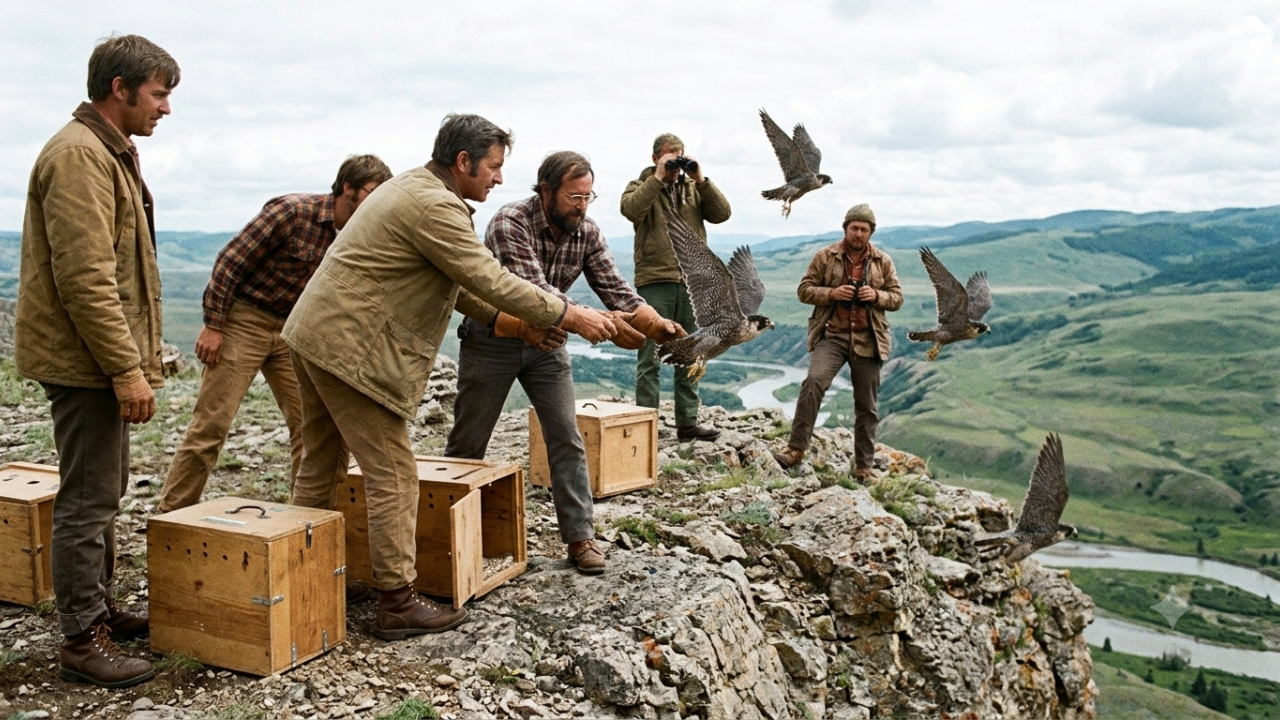
By the early 1970s, the American peregrine falcon was essentially gone east of the Mississippi River. Not rare. Gone. You could spend months scanning every cliff face from Maine to Georgia and never spot a single breeding pair.
Then, in the summer of 1974, a small team of biologists at Cornell University did something most wildlife officials thought was impossible. They raised peregrine falcons in captivity and released them into the wild using an ancient falconry technique called hacking. Those first few releases kicked off one of the biggest wildlife recovery programs in modern history, eventually putting more than 6,000 captive-bred falcons back into North American skies.
If you look up at a skyscraper in New York, Chicago, or Toronto today and see a crow-sized raptor tearing past the glass at 200 miles per hour, you're looking at the direct result of that 1974 breakthrough.
Why Peregrine Falcons Vanished in the First Place
People love to blame habitat loss for every endangered species, and usually they're right. With peregrines, though, the culprit was chemistry.
After World War II, synthetic pesticides—specifically DDT—flooded American agriculture and suburban mosquito-control programs. The chemical didn't kill adult falcons outright. Instead, it accumulated in their tissues as they ate smaller birds that had ingested contaminated insects.
When female peregrines tried to produce eggs, the DDT interfered with calcium metabolism. The resulting eggshells were paper-thin. When the adult birds sat on the nests to incubate them, the eggs literally crushed under their weight.
By the mid-1960s, surveys confirmed the worst. The eastern population of Falco peregrinus anatum had collapsed completely. Western populations were hanging on by a thread, down roughly 80 to 90 percent from historical numbers. In 1970, the U.S. government listed the peregrine falcon as endangered, and in 1972, the Environmental Protection Agency finally banned most uses of DDT in the United States.
Banning the poison stopped the bleeding, sure. You still can't bring back a bird that no longer exists in half a continent just by passing a law.
Tom Cade and the 1974 Cornell Experiment
Enter Dr. Tom Cade, an ornithologist at Cornell University. Cade founded The Peregrine Fund in 1970 with a simple, stubborn idea. If wild peregrines couldn't reproduce on their own, biologists would breed them in barns and release the chicks into the wild.
At the time, mainstream conservationists mocked the idea. Breeding large raptors in captivity at any meaningful scale had never been done. Falcons are high-strung, territorial, and notoriously picky about mates. Many experts argued it was a waste of money and that captive-raised birds would never learn how to hunt real prey once released.
Cade and his team proved them wrong in 1973 when they successfully hatched 20 peregrine chicks at Cornell's "Hawk Barn." Having chicks in a lab was only half the battle. You can't just open a cage door and hope a young predator figures out survival on its own.
In 1974, The Peregrine Fund conducted its first experimental releases. They placed young birds in man-made wooden nest boxes perched high on cliffs and specially built towers—including sites at the Shawangunk Ridge in New York and along the Chesapeake Bay.
The technique was borrowed straight from medieval falconry. It's called hacking.
How Hacking Actually Works
If you've never seen a hack site in operation, it looks absurdly low-tech for a high-stakes scientific mission. Biologists place flightless chicks—usually around four to five weeks old—inside a large wooden box with a barred front facing out over a drop-off.
For the first week or two, the birds stay inside. Attendants drop food through a chute in the roof so the young falcons never associate humans with meals. If a falcon imprints on people, it's useless in the wild. It'll beg for food from hikers or attack joggers.
Once the birds' flight feathers grow in, biologists quietly remove the bars at night. The young peregrines step out onto the ledge, test their wings, and take their first clumsy flights. Attendants keep leaving quail or chickens on top of the box for several weeks while the juveniles figure out how to catch pigeons and songbirds on their own. Eventually, the falcons stop coming back to the box for handouts, disperse, and become fully independent wild predators.
The 1974 releases didn't go off without a hitch. Great horned owls picked off several young falcons at night, teaching biologists a brutal lesson about where to place hack towers. In inland forested areas, owls rule the dark, and naive young peregrines were easy targets. Coastal marshes and high urban buildings, where great horned owls rarely hunt, turned out to be much safer bets.
What Most People Get Wrong About the Recovery
There's a popular myth that scientists simply cloned the exact genetic strain of eastern peregrine falcon and put it back where it belonged. That's not true, and honestly, it's one of the most interesting parts of the story.
Because the original eastern anatum subspecies was completely wiped out, Tom Cade couldn't use local birds for breeding stock. Instead, The Peregrine Fund built a genetic melting pot. They brought in birds donated by falconers and researchers from across the globe—including tundra peregrines from the Arctic, Peale's peregrines from the Pacific Northwest, western anatum birds, and even falcons from Scotland, Spain, and Chile.
Purists hated this. Some taxonomists argued that releasing a mix of subspecies polluted the genetic integrity of North American wildlife.
Cade didn't care about textbook taxonomy. He wanted a bird that could survive in the modern eastern United States, and natural selection would sort out the rest. He was right. Within a few generations, those mixed-heritage birds adapted seamlessly to eastern climates, bred rapidly, and filled the ecological void left by the original population.
Why Peregrine Falcons Moved Into Big Cities
If you want to see a peregrine falcon today, don't bother hiking deep into the wilderness. Walk down Wall Street or look up at the Campanile clock tower at UC Berkeley.
Wild peregrines naturally nest on sheer cliff faces overlooking open valleys or water, where they can spot prey from miles away and dive at terrifying speeds. To a peregrine falcon, a 40-story office building in downtown Minneapolis or Baltimore is just a really nice cliff with zero great horned owls and an unlimited buffet of fat, slow city pigeons.
Biologists realized this early on during the release programs. Starting in the late 1970s and accelerating through the 1980s, teams began hacking young falcons directly from skyscraper rooftops and suspension bridges.
One of the most famous early urban pioneers was a female named Scarlett, released in 1978 in Maryland. She set up shop on the 33rd floor of the USF&G building in downtown Baltimore. Even though she never found a wild mate at first, biologists slipped captive-bred chicks into her nest box, and she raised them fiercely. She became a local celebrity, proving that raptors and rush-hour traffic could coexist.
Today, New York City alone hosts one of the densest urban peregrine populations on earth, with dozens of breeding pairs nesting on bridges, skyscrapers, and church spires across all five boroughs.
The Numbers Behind the Comeback
By the time The Peregrine Fund wrapped up its eastern and midwestern release programs in the late 1990s—working alongside partners like the Raptor Center at the University of Minnesota—the scale of the achievement was staggering:
- Over 6,000 captive-bred peregrines were released across the United States and Canada.
- By 1999, the breeding population in the U.S. and Canada had rebounded to roughly 1,650 pairs, blowing past the federal recovery goals.
- On August 25, 1999, the U.S. Fish and Wildlife Service officially removed the American peregrine falcon from the Endangered Species List.
It remains the gold standard for endangered species recovery. Unlike programs that drag on for decades with millions of dollars spent and little to show for it, the peregrine project worked because it tackled the root cause (banning DDT), used a practical, repeatable field method (hacking), and didn't let rigid bureaucratic perfectionism get in the way of saving the species.
Current Threats That Still Need Watching
Delisting the peregrine falcon in 1999 wasn't the end of the story. Wildlife populations don't stay healthy on autopilot, and peregrines still face real dangers in 2026.
Avian influenza has hit raptor populations hard over the past few years. Because peregrines hunt waterfowl, shorebirds, and gulls—species that frequently carry Highly Pathogenic Avian Influenza (HPAI)—falcons are heavily exposed when they eat infected prey. State wildlife agencies across the Midwest and East Coast have documented noticeable drops in nesting success at several long-standing bridge and cliff sites following major bird flu outbreaks.
Window collisions and urban hazards also take a steady toll. Fledglings taking their first flights off downtown skyscrapers frequently slam into reflective glass or get trapped in building ventilation shafts. While urban nest boxes offer great protection from predators, cities remain concrete obstacle courses for inexperienced flyers.
Second-generation rodenticides pose another quiet threat. Even though peregrines primarily eat other birds rather than rats, bioaccumulation still happens when raptors prey on scavengers or songbirds exposed to environmental toxins and newer chemical flame retardants.
How You Can Actually See and Support Peregrines Today
You don't need a biology degree or expensive spotting scopes to experience the legacy of that 1974 release firsthand. If you want to track or support local peregrine populations right now, take these concrete steps:
- Check live nest cams between March and June. Dozens of conservation groups and building managers run 24/7 livestreams of urban nest boxes—including famous sites in Richmond (Virginia), Pittsburgh, San Francisco, and Columbus. Watching a tiercel (male) bring a pigeon back to feed fuzzy white eyases (chicks) beats anything on television.
- Visit coastal hawk watches in September and October. During fall migration, thousands of peregrines funnel down coastlines along the Atlantic and Great Lakes. Spots like Cape May Point in New Jersey, Hawk Mountain in Pennsylvania, and Duluth's Hawk Ridge offer front-row seats to migrating falcons cutting across the ridge lines.
- Report banded birds to the USGS Bird Banding Laboratory. Almost every urban peregrine chick still gets a numbered aluminum leg band and a colored visual ID band before it leaves the nest. If you photograph a perched falcon with clear leg bands, submit the numbers and location to the USGS online portal. Biologists rely on citizen sightings to track lifespan, dispersal distances, and survival rates.
- Advocate for bird-safe glass in your city. If you work in commercial real estate, architecture, or local government, push for fritted or UV-patterned glass on new mid-rise and high-rise buildings, and support "Lights Out" initiatives during spring and fall migration windows.
Back in 1974, putting a handful of captive-hatched chicks into wooden boxes on a New York ridge looked like a long shot. Fifty-plus years later, every time a peregrine stoops over a city skyline at highway-shattering speed, it proves what happens when sharp science meets stubborn execution.