The dust on the road between the Democratic Republic of Congo and Uganda does not care about international borders. It rises in identical red clouds behind the tires of motorbikes, coats the leaves of the banana trees in the same dull rust, and settles deep into the lungs of the people who walk it every day. To the men and women crossing the frontier with sacks of cassava or bundles of clothing, the line between the two nations is mostly an abstraction. It is a checkpoint, a formality, a minor delay in a long day of survival.
But viruses do not recognize passports either.
When a microscopic strand of RNA wrapped in a protein coat slips across that same invisible line, the abstraction vanishes. It is replaced by something brutally concrete. A fever. A ache in the joints that feels, at first, like the exhaustion of a hard day’s work. Then, the vomiting begins. Within days, five people are dead. The provisional ledger of a new Ebola outbreak has begun, typed out in cold digital font on laptops in Geneva and Kinshasa.
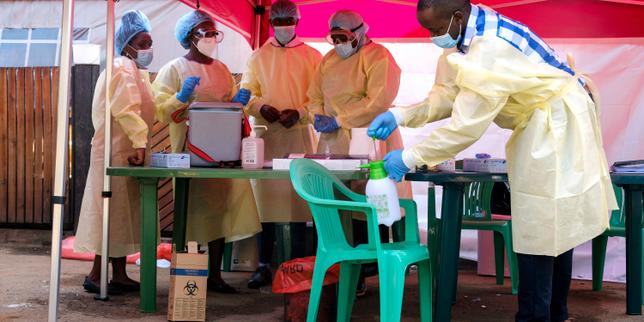
The spreadsheets tell you the numbers, the dates, and the geographical coordinates. They do not tell you about the silence that settles over a village when the realization hits. They do not describe the smell of chlorine that soon replaces the scent of woodsmoke and roasting maize, or the terrifying sight of human beings transformed into faceless, plastic-clad figures looking like astronauts dropped into the equatorial forest.
To understand what is happening right now along the Congolese-Ugandan border, you have to look past the data points. You have to look at the dirt.
The Sound of a Cough in the Night
Consider a woman named Marie. She is not a statistic, though if things go badly, she will become one. She lives in a small community in North Kivu, an area that has seen more than its share of grief. For years, the conflict here has been a background hum—the occasional sound of distant gunfire, the rumors of militia movements, the constant, wearying necessity of keeping one eye on the escape route.
When her brother came home from the fields three weeks ago complaining of a headache, Marie did what any sister would do. She wiped his brow with a damp cloth. She sat by his side in the dim light of their home, listening to his breathing grow heavier, more ragged. When he became too weak to lift a cup of water, she held it to his lips.
This is how Ebola works. It weaponizes love.
The disease thrives on the very impulses that make us human: the urge to comfort the sick, to wash the bodies of the dead, to gather together in grief. The virus is a hitchhiker that uses human empathy as its vehicle. By the time the local clinic sounded the alarm, Marie’s brother was gone, and three other members of the household were burning with the same fire.
The official reports call this an "epidemiological cluster."
In reality, it is a family being erased from the inside out. The tragedy of Ebola is not just that it kills; it is that it isolates. It turns the touch of a mother’s hand into a threat. It transforms the communal mourning that has sustained these societies for generations into an act of biological danger. When the burial teams arrive in their white personal protective equipment, they carry the body away in a double-zippered bag, denying the family the final, crucial closure of a traditional funeral. The grief is left unexpressed, curdling into anger and deep suspicion.
The Friction of Geography
The Democratic Republic of Congo is a titan of a country, a vast expanse of green that holds some of the most isolated terrain on earth. Yet, it is paradoxically hyper-connected by human movement. The northeast region, where this latest outbreak has ignited, is a dense web of trade routes, displacement camps, and porous borders.
Uganda sits right next door. The boundary between them is less of a wall and more of a sieve.
Thousands of people cross this border every week. Traders bring gold and timber out of the Congo; they return with soap, plastics, and cooking oil from Uganda. Fishermen move across Lake Albert without a thought to where the water changes jurisdiction. It is a vibrant, chaotic ecosystem of survival.
But when an outbreak occurs, this mobility becomes a logistical nightmare. Tracking a virus in a place with paved roads, centralized databases, and stable electricity is difficult enough. Tracking it across a conflict zone where people are constantly fleeing violence, where there are no formal addresses, and where a contact might jump on the back of a boda-boda motorcycle taxi and disappear into a bustling market town forty miles away within hours?
It is like trying to trace a single drop of ink dropped into a rushing river.
The health workers tasked with this job are not just fighting a virus. They are fighting geography. They are walking miles into the brush, mapping out chains of transmission on pieces of paper held down by stones against the wind. They have to ask hard, intrusive questions of terrified people: Who did you touch? Who sat next to you on the bus? Where did they go?
Every unnamed contact is a ticking clock. If a person infected in DRC crosses into Uganda and slips through the screening points unnoticed, the virus finds a whole new population of susceptible hosts. The fire spreads to a new forest.
The Architecture of Distrust
There is a temptation, when reading about these outbreaks from a comfortable distance, to view the resistance of local populations as a product of ignorance. Why do they hide the sick? Why do they throw stones at the health vehicles? Why don't they just trust the medicine?
The truth is far more complicated, and far more uncomfortable.
Imagine living in a region that has been neglected by the central government for decades. Imagine watching various armed groups roam the countryside, extorting and killing with impunity, while the international community looks the other way. Suddenly, a strange illness appears. Within days, white SUVs belonging to foreign NGOs fill the roads. Millions of dollars in aid money pour into the area, but that money is earmarked strictly for Ebola. It cannot be used to fix the broken school, or to dig a clean water well, or to protect the village from the rebels hiding in the hills.
To a local resident, the message seems clear: the world does not care if we are shot by militias, or if our children die of preventable malaria. They only care about Ebola because they are afraid it might leave our borders and reach theirs.
The distrust is not irrational. It is the logical conclusion of history.
When the response teams arrive with their thermometers and their isolation tents, they are stepping into a landscape saturated with trauma. The medical intervention, no matter how scientifically sound, is often perceived as an invasion. If the responders do not understand that history—if they do not spend the time to sit with the elders, to listen to the grievances, and to acknowledge the fear—their needles and vaccines will remain useless inside their cold-boxes.
The Tools We Have, The Fear We Hold
We are not helpless. This is not 1976, when the virus was first identified near the Ebola River and doctors could do little more than watch patients bleed to death.
Today, we possess formidable weapons. We have highly effective vaccines that can create a ring of immunity around an outbreak if deployed quickly enough. We have experimental monoclonal antibody treatments that can dramatically increase the survival rate if administered in the early stages of the disease. The science has advanced at a breathtaking pace.
But science requires infrastructure to work. It requires cold-chain refrigeration that can keep vaccines at sub-zero temperatures in places where the power grid is nonexistent. It requires a level of security that allows health workers to enter villages without the fear of being ambushed by rebel factions.
More than anything, it requires time.
The five deaths recorded in this provisional toll are a warning shot. They represent the period before the response machine fully spined up. They are the individuals who slipped through the cracks before the checkpoints started using infrared thermometers, before the public health announcements began broadcasting from local radio towers in Swahili and Lingala.
The coming weeks will determine whether those five names remain a tragic, contained incident or whether they are the preface to a much longer, darker chapter. The response is a race against incubation periods. The virus takes anywhere from two to twenty-one days to manifest inside a human body. That means the reality on the ground today is actually a reflection of what happened two weeks ago. We are always looking at the ghost of the virus, trying to predict where its physical form will strike next.
The Red Dust Settles
Late in the afternoon, the heat along the border country becomes heavy, almost liquid. At a small market near the crossing point, a young man stops his motorcycle. He turns off the engine, wipes the red dust from his forehead with the sleeve of his shirt, and looks at the health worker standing by the side of the road with a plastic bottle of hand sanitizer.
The young man is hesitant. He has heard the rumors. He has heard that the foreigners brought the disease, that the isolation centers are places where people go to die, that the whole thing is a political ploy to delay elections or extract resources.
The health worker does not argue. She does not quote statistics from the World Health Organization. She does not use clinical jargon. Instead, she speaks quietly, in the local dialect, asking about his family, about his journey, about how the road was from the north. She offers him a basin of chlorinated water to wash his hands.
For a long moment, the space between them feels immense, filled with all the history, suspicion, and fear that has accumulated in this corner of the world for a century.
Then, the young man steps forward. He plunges his hands into the water, the sharp scent of chlorine rising into the warm air, cutting through the smell of the dust. It is a tiny, ordinary action. But in that single choice to trust, the line between life and death shifts just a fraction of an inch.