The air in northern Galilee doesn’t just carry the scent of pine and ripening olives anymore. It carries a vibration. It is a low-frequency hum that settles in the marrow of your bones before you even hear the whistle of an incoming Katyusha. For the families who have lived here for generations, the landscape has stopped being a sanctuary and has become a map of trajectories.
Benjamin Netanyahu stood before a map of his own recently. With the clinical detachment of a grand architect, he announced that Israel is widening its ground invasion into southern Lebanon. He spoke of "security zones" and "degrading capabilities." But maps are two-dimensional things. They don't show the laundry still hanging on balconies in Tyre or the way a child in Kiryat Shmona flinches when a car doors slams.
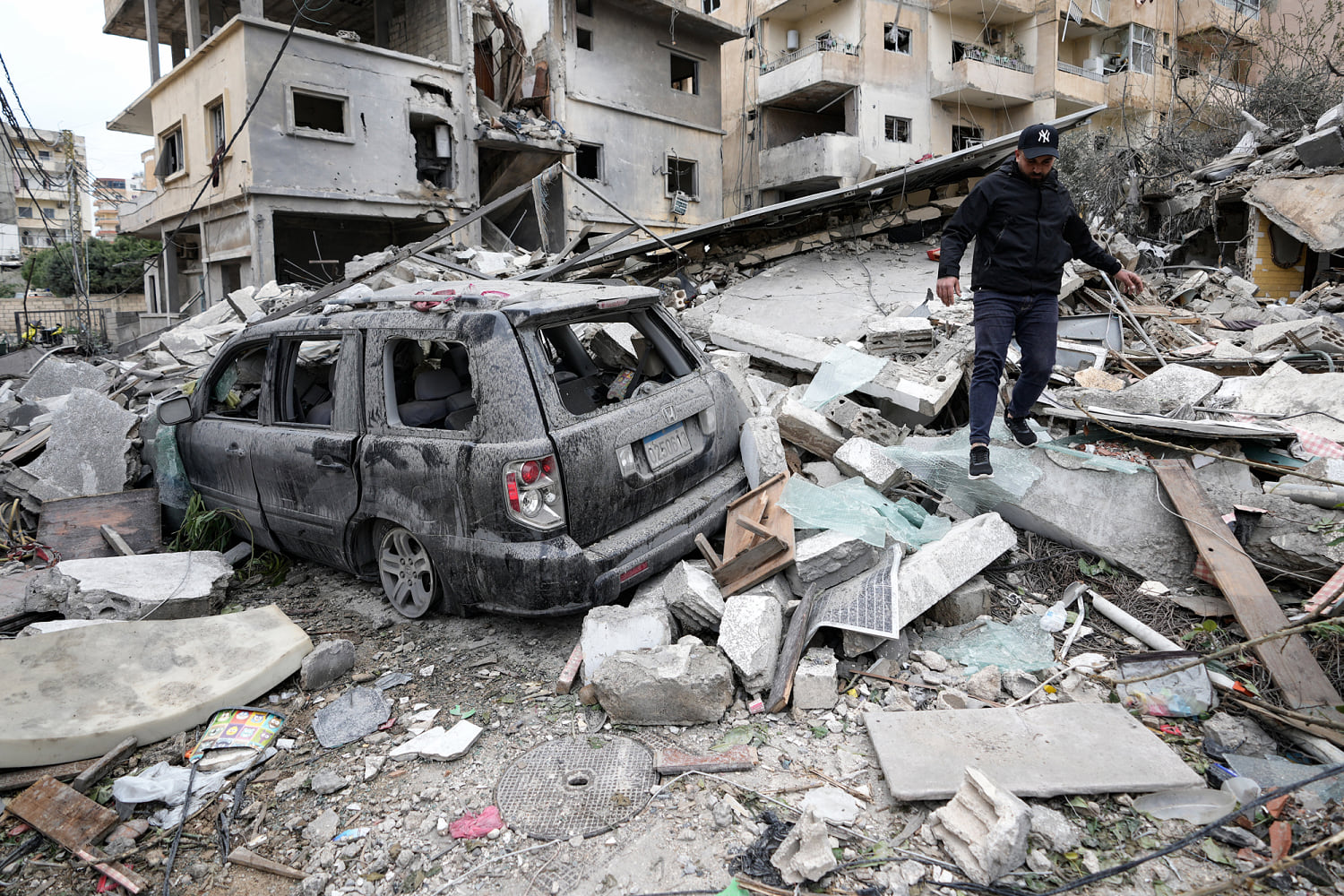
The decision to push deeper past the Litani River isn't just a tactical adjustment. It is a tectonic shift. For over a year, this has been a war of shadows and long-distance strikes. Now, it is becoming a war of dirt, boots, and the kind of intimate destruction that leaves permanent scars on the geography of the Levant.
The Geometry of Fear
To understand why a prime minister would choose to expand a front while already bogged down in the sands of Gaza, you have to look at the geometry of the border. Imagine a string stretched tight between two points. That was the Blue Line. Now, imagine that string being pulled into a jagged, bloody circle that encompasses dozens of Lebanese villages and thousands of Israeli hectares.
The official logic is simple: Hezbollah has spent years carving out a subterranean kingdom. We aren't talking about mere basement hideouts. These are sophisticated arteries of concrete and steel, stocked with enough munitions to turn the northern half of Israel into a cratered wasteland. Netanyahu’s argument is that you cannot prune a hedge that is made of poison ivy; you have to dig out the roots.
But roots go deep.
Consider a hypothetical farmer named Elias in a village near Marjayoun. He isn't a combatant. He is a man who knows the temperament of his goats and the exact day the rains will turn his soil to clay. When the order comes to "widen the operation," Elias doesn't see a strategic necessity. He sees the end of a lineage. He sees his ancestral home becoming a coordinate on a target list. For every Hezbollah launcher neutralized, a thousand stories like Elias’s are silenced or sent screaming into the interior of Lebanon as refugees.
The Weight of 1982
History in this part of the world isn't a book on a shelf. It is a ghost that sits at the dinner table. When the Israeli Cabinet talks about a "buffer zone," the older generation feels a cold shiver of recognition. They remember 1982. They remember an invasion that was supposed to be a quick, surgical strike to push the PLO back 40 kilometers.
That "surgical" move turned into an eighteen-year occupation.
The danger of widening a war is that the war often decides it likes its new home. It settles in. It breeds its own justifications for staying. Netanyahu is betting that modern technology—drones that see through walls and AI-driven targeting—can prevent the quagmire of the eighties. But technology cannot solve the fundamental physics of resentment.
Every foot of Lebanese soil occupied is a foot of soil that must be defended. Every soldier stationed in a "security belt" becomes a stationary target for a guerrilla force that knows every cave and crevice of the limestone hills. Hezbollah isn't a conventional army that can be forced into a signed surrender on a battleship. They are a ghost insurgency, woven into the very fabric of the villages Israel is now entering.
The Invisible Stakes
While the headlines focus on the movement of tanks, the real crisis is happening in the silence of the displaced. On the Israeli side, over 60,000 people are living in hotels, their lives packed into suitcases, their businesses shuttered, their children attending makeshift schools in corridors. They are the "internal refugees" of a high-tech state.
Netanyahu’s promise to "return the residents of the north to their homes" is the engine driving this expansion. It is a powerful, emotional mandate. If a government cannot guarantee the safety of its own borders, what is it for?
But there is a haunting irony at play. To make the north safe enough for a mother in Metula to tuck her kids in without fear, the military must create a wasteland on the other side. This creates a vacuum. And in the Middle East, a vacuum is never filled by peace. It is filled by the next generation of radicals, fueled by the sight of their homes collapsing under the weight of an "expansion."
The Sound of the Shift
The widening of the invasion means the artillery fire will become a constant rhythm, a metronome for a region on the brink. We are no longer talking about "clashes." We are talking about a full-scale regional realignment.
The logistical tail of such an operation is massive. It requires thousands of reservists to leave their jobs as software engineers, teachers, and bus drivers to hold the line. It requires the Lebanese state—already a fragile, flickering ghost of a country—to withstand a pressure that would break much stronger nations.
The rhetoric from Jerusalem is one of resolve. "We will continue to hit Hezbollah with fire they never imagined," Netanyahu says. And he is right; the firepower is unimaginable. It is precise. It is devastating. It is absolute.
But as the tanks roll past the old rusted signs of previous wars, the question isn't whether Israel can win the tactical battle. They almost certainly can. The question is what happens to the human soul when the "widen" button is pressed.
The Finality of the Dust
When the smoke eventually clears—and it always does, eventually—the map will look different. There will be new lines drawn in the dirt. There will be "closed military zones" where there used to be orchards.
The tragedy of the "widening" is that it assumes there is a limit. It assumes that if you just go five miles further, or ten miles deeper, you will finally find the horizon of safety. But safety in this land isn't found in a buffer zone. It isn't found in the range of a Kornet missile or the ceiling of an Iron Dome interceptor.
As the sun sets over the Mediterranean, casting long, bloody shadows over the hills of Southern Lebanon, the only certainty is the dust. It rises from the tracks of the Merkava tanks, it rises from the ruins of the houses in the valley, and it settles on everyone equally. It blinds the soldier, the insurgent, and the farmer alike.
We are watching a tragedy expand its borders. We are watching the map grow larger while the world for the people living on it grows smaller, tighter, and much more dark. The hum in the bones is getting louder. Soon, it will be the only thing left to hear.
The earth is shaking, and this time, it isn't the tectonic plates. It’s us.