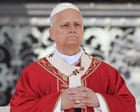
The diplomatic floor at the Vatican has always been slippery, but it has never been this bloodstained. On Palm Sunday, March 29, 2026, Pope Leo XIV—the first American to hold the keys of St. Peter—effectively declared a moral insurgency against the administration of his own home country. By quoting the prophet Isaiah to tell world leaders that God ignores the prayers of those with hands full of blood, Leo didn't just offer a homily; he issued a formal indictment of the theological infrastructure currently propping up the U.S.-Israeli war in Iran.
This is no longer a mere disagreement over foreign policy. It is a fundamental schism over who owns the narrative of Christ in an era of "preventive" global conflict.
The Theology of Overwhelming Violence
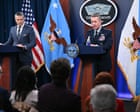
The catalyst for this papal eruption was not a classified intelligence brief, but a public prayer. Days earlier, U.S. Defense Secretary Pete Hegseth stood before military and civilian workers in Washington and invoked the divine to sanction overwhelming violence of action against enemies who "deserve no mercy."
For the Vatican, this was the red line. The Church spent centuries moving away from the Crusader mentalities that Hegseth’s rhetoric mirrors. To hear a high-ranking official of the world’s most powerful military use the language of the pews to justify the preemptive strikes on Iranian infrastructure that began on February 28 is, in the eyes of Rome, a high-order heresy.
Leo XIV is uniquely positioned to dismantle this. Unlike his predecessors, he understands the American "God and Country" brand from the inside. When he tells a crowd in St. Peter’s Square that Jesus cannot be used to justify war, he is speaking directly to the voters in America who are being told the opposite by their own televised preachers and political leaders.
A Pope Born of the Heartland
The irony of the current crisis is that many in the Trump administration initially viewed the election of an American Pope in 2025 as a strategic win. They expected a pontiff who understood American exceptionalism. Instead, they got a man who views it as a spiritual threat.
Leo’s background in the American Midwest has given him a visceral distaste for the "prosperity gospel" and its militant offshoots. He sees the current administration’s framing of the Middle East conflict—now entering its second bloody month—as a distorted economy of faith.
- The Minab Strike: On March 6, an aerial strike hit an elementary school in Iran, killing 165 children.
- The Vatican Response: The official Vatican newspaper, L’Osservatore Romano, published a front-page photo of a mass grave for these children with the headline "The Face of War."
- The Political Spin: Washington framed the strike as collateral damage in a "holy" defense of democratic values.
Leo XIV is systematically stripping away those rhetorical shields. By stating that God "rejects" the prayers of these leaders, he is attempting to sever the umbilical cord between the American religious right and the Pentagon's war room.
The Jerusalem Lockdown
While the rhetoric heated up in Rome, the reality on the ground in Jerusalem turned physically restrictive. For the first time in centuries, Israeli police prevented the Latin Patriarch and top Catholic leadership from entering the Church of the Holy Sepulchre for Palm Sunday rites.
The official line was security. The reality felt like a retaliatory strike against a Church that refuses to get in line.
This move has backfired, drawing condemnation even from populist allies like Italy’s Giorgia Meloni. It has also turned the Vatican into an unlikely champion for religious freedom in a zone where it is rapidly evaporating. The Church is no longer just a mediator; it is a participant in the friction.
The Myth of the Just War
The administration’s reliance on the "Just War" theory—a Catholic doctrine—is being dismantled by the very institution that created it. Cardinal Pietro Parolin, the Vatican Secretary of State, has been blunt: the concept of "preventive war" has no standing in modern Catholic teaching.
The Vatican’s refusal to join Trump’s "Board of Peace" in February was the first signal of this total decoupling. Rome sees the board as a vehicle for unilateralism disguised as diplomacy. By sticking to the United Nations framework, the Pope is signaling that the era of "Christian nations" acting as global vigilantes is over.
The Semantic Battlefield
Leo XIV warned diplomats in January that "war is back in vogue" because of a collapse in shared language. He noted that words like "peace," "justice," and "defense" are being hollowed out and refilled with military objectives.
When Hegseth prays for "every round to find its mark," he is using the language of spiritual precision for the purpose of kinetic destruction. Leo XIV’s response is to return to the "gentle face of God"—a tactical move to make the administration's rhetoric look increasingly alien to the actual Gospel.
The Growing Risk of a Domestic Schism
This conflict is bleeding back into the United States. American bishops are now forced to choose between their Commander-in-Chief and their Pope. Cardinal Robert McElroy in Washington has already called the war "morally unjustifiable," creating a direct friction point within the capital itself.
The Trump administration has characterized this as the "Vatican getting political." Leo XIV would argue he is simply being pastoral. The danger for the White House is that if the Pope continues to frame the war as a sin rather than a strategy, the domestic support for the conflict—which relies heavily on a religious base—could crater.
The administration has ten days before it reportedly plans to expand strikes on Iranian energy facilities. Leo XIV has ten days to convince the world that the blood on those leaders' hands will never be washed away by a prayer.
If you are following the shifts in global Catholic influence, ask me to analyze how the Vatican is leveraging its diplomatic ties with Middle Eastern Muslim leaders to bypass U.S. mediation.