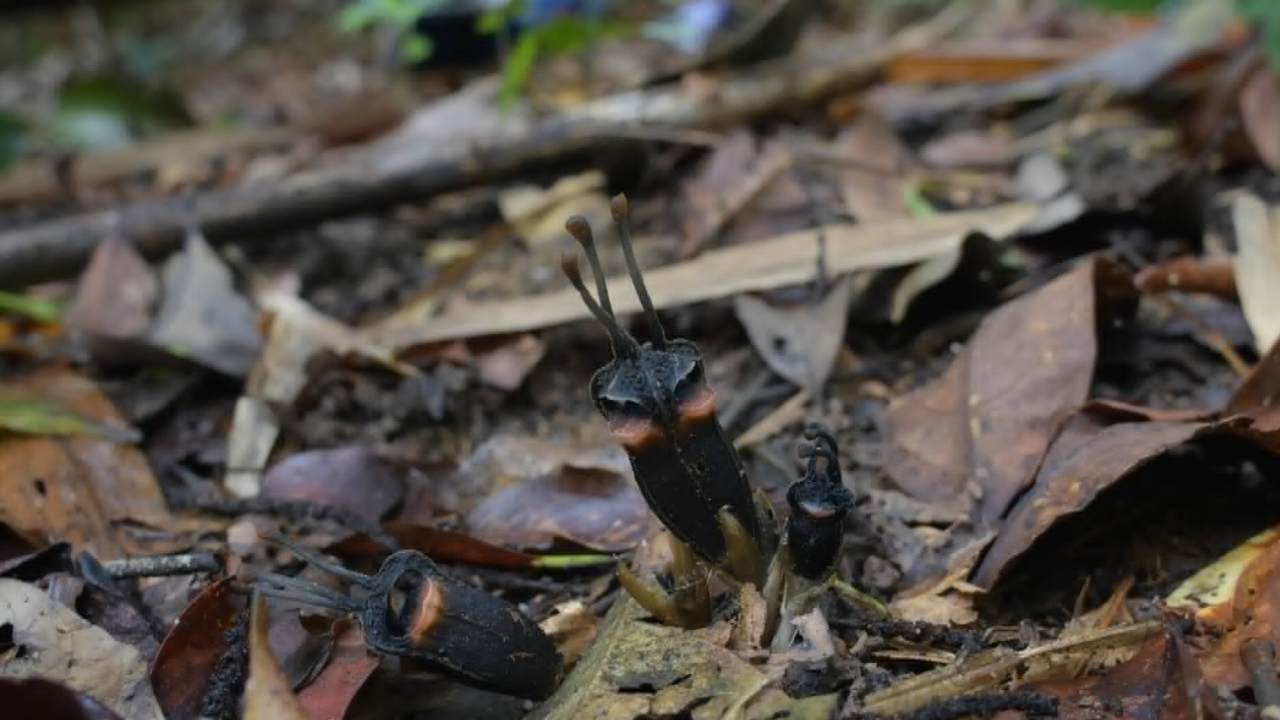
Imagine walking through a lush national park in western Thailand and stepping right over a plant that looks like it crawled straight out of a horror movie. It has no green leaves, no branches, and absolutely zero use for sunlight. Instead of photosynthesizing, it lurks beneath the soil as a total freeloader, stealing nutrients from underground fungal networks.
Meet Thismia daemona, freshly dubbed the devil flower by botanists. Described in the journal PhytoKeys by researchers from Chulalongkorn University and Prince of Songkla University, this eerie organism is shaking up what we thought we knew about subterranean plant life. But here is the brutal reality: fewer than 50 individual plants are known to exist, and the species is practically born critically endangered. For an alternative perspective, read: this related article.
What Makes the Devil Flower So Strange
Most plants you encounter depend on bright skies and green chlorophyll to survive. Thismia daemona laughs at that rule book. Belonging to a bizarre group often called "fairy lanterns," this species spends nearly its entire life hidden underground. It only surfaces for a tiny window of time to flower and fruit.
The physical appearance matches its terrifying nickname. Its outer petals form a thick, reddish-orange collar, while the inner petals fuse into a dome topped with three slender, club-shaped horns. It looks like a tiny, dark demon standing on the forest floor. Inside its floral tube, you will find intricate ridges and a net-like pattern coated in microscopic white hairs, paired with translucent blue pollen-producing parts. Related insight on the subject has been published by BBC News.
Why Botanists Are Stunned by Its Location
Finding a member of the Thismia genus is rare enough, but finding this specific variation in Thailand breaks geographical expectations. Botanists spotted the initial specimens in Thong Pha Phum National Park within Kanchanaburi Province, roughly 3,100 feet up in mountain forests mixed with small bamboo.
Most related species prefer wet lowland forests across places like Malaysia, Borneo, and Sumatra. Pushing this lineage further north into a dry patch of mountain forest caught researchers entirely off guard. Genetic analysis suggests its closest known relative lives hundreds of miles away on the island of Borneo. That creates a massive evolutionary puzzle about how these underground parasites spread across such vast distances.
The Grim Math of a Critically Endangered Discovery
Discovering a brand-new species usually brings pure excitement. For the devil flower, the celebration was cut short by grim conservation math.
Researchers calculated that the entire known population occupies an area smaller than a tenth of a square mile—roughly the size of a football field. Because every single known individual belongs to this one isolated population inside a park frequented by tourists, the International Union for Conservation of Nature has preliminarily stamped the species as Critically Endangered.
Paper protection inside a national park does not mean safety. When a species relies on such hyper-specific microhabits and fragile underground fungal networks, human foot traffic, shifting weather patterns, or local habitat disruption can wipe them out overnight.
Protecting organisms like Thismia daemona requires looking past large, charismatic mammals and paying attention to the weird, hidden ecosystems living right beneath our boots. Conservation efforts will have to lean heavily on surrounding local communities to ensure these fragile forest floors stay undisturbed, giving this bizarre little demon flower a fighting chance to survive.