The air inside the currency exchange office in central Tehran smells faintly of old paper, cheap cardamom tea, and quiet panic.
It is mid-morning, but the neon lights flicker like dying stars. Behind a thick pane of scratched security glass, a clerk named Mehdi slides a stack of depreciated rials across the counter. He does not look the customer in the eye. He doesn't need to. The numbers flashing on the digital board behind him tell the entire story of a nation slowly being squeezed by an unseen, tightening vice.
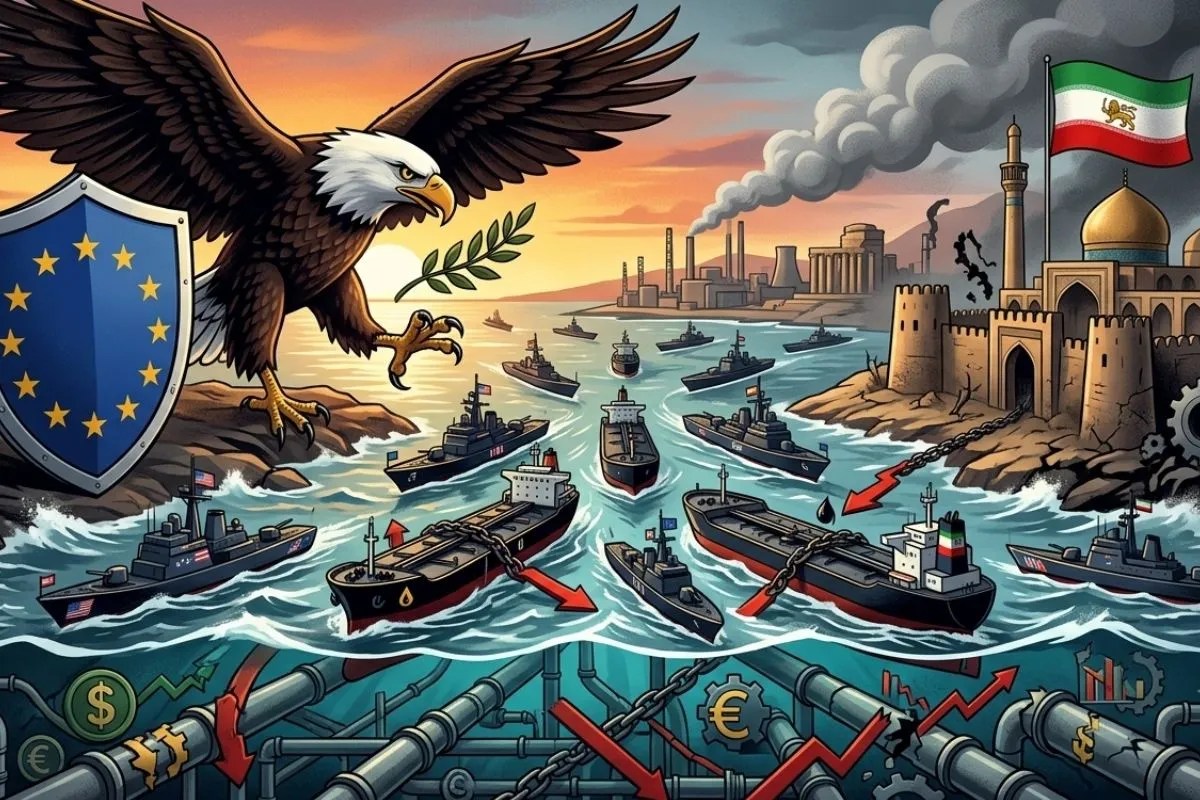
Far across the ocean, in the wood-paneled corridors of Brussels and the secure briefings of Washington, officials are tracking numbers of an entirely different kind. They are charting tanker routes, tracing shadow fleet transponders, and mapping the complex web of front companies that keep a government afloat.
They call it Operation Economic Outcast.
To a diplomat, it is a policy framework. To a sanctions enforcement officer, it is a puzzle of logistics. But to the people standing in line outside Mehdi’s window, it is the cold reality of a chokehold.
The Architecture of Isolation
Money has a habit of finding water. It flows through cracks, slips past borders, and disguises itself in the mundane language of international trade. For decades, Iran’s oil and financial apparatus mastered this art. When one door closed, a dozen clandestine windows cracked open in the humid ports of the Persian Gulf, through illicit ship-to-ship transfers under the cover of night, and via a maze of shell corporations registered in tax havens that existed only as a stack of folders on a lawyer's mahogany desk.
Then came the shift.
The European Union, long known for its diplomatic hesitation and preference for measured dialogue, made a decisive turn. By formally aligning with Washington’s aggressive push to sever Tehran’s remaining economic lifelines, Brussels changed the weather.
This was not merely about politics. It was about architecture.
Consider how a modern state functions. It requires a plumbing system of banks, clearing houses, and maritime insurance. If you shut off the water, the garden withers. Operation Economic Outcast targets that exact plumbing. By expanding the net to catch the financial networks funding Iran’s oil exports, the coalition is doing something unprecedented: they are making the cost of doing business with Tehran higher than the reward.
Insurance companies in London refuse to cover tankers carrying crude of suspicious origin. European ports turn away vessels whose documentation fails the rigorous new scrutiny. Banks that once whispered compliance while winking at middleman transactions are now terrified of losing access to the Western financial grid.
The invisible cage clicks shut, one padlock at a time.
A Hypothetical Shadow at Sea
Imagine a single supertanker sitting low in the water somewhere in the Arabian Sea. Let us call her the Horizon V.
She carries two million barrels of crude oil, pumped from an Iranian field deep inland. On paper, her flag is registered in a small landlocked nation thousands of miles away. Her transponder is switched off, plunging her into digital darkness. The captain knows the risks. A Coast Guard patrol boat or a surveillance aircraft could spot her wake.
Years ago, the Horizon V would have slipped quietly into an Asian harbor, her cargo blended into a vast ocean of legally sourced petroleum, her origins scrubbed clean by compliant intermediaries.
Today, that journey is an obstacle course of paranoia.
The buyers demanding the discounted oil are growing nervous. They know that EU intelligence agencies are tracking maritime traffic with satellite imagery capable of reading the rust on a hull. They know that if their own domestic banks are caught clearing payments for this cargo, they could be instantly locked out of the global dollar and euro economies.
So the price drops further. The risk premium skyrockets. And the profit margin shrinks to a razor's edge.
This is the psychological brilliance of modern economic warfare. It rarely relies on a single dramatic strike. Instead, it weaponizes uncertainty. It makes every captain, every broker, and every banker look over their shoulder, wondering if today is the day the compliance net catches up to them.
The Weight on the Street Back Home
Back in Tehran, Mehdi watches the tea in his glass turn cold.
The official statistics published by international monitors tell us that Iran’s oil export revenues have dipped, that inflation is eroding household savings, and that the national currency is fighting a losing battle against gravity. But statistics are sterile things. They do not capture the weight of a father’s silence at the dinner table when he realizes he can no longer afford imported medicine for his mother.
Geopolitics is often discussed in rooms where the carpets are thick and the coffee is hot. We talk about strategic deterrence, regional stability, and compliance thresholds as if they were pieces on a chessboard.
We forget that the board is made of human lives.
When the European Union steps up enforcement alongside American agencies, the immediate intent is clear: to deny resources to a regime accused of regional destabilization and nuclear defiance. The logic is defensive, clinical, and calculated.
Yet, the collateral damage ripples outward, splashing against the storefronts of ordinary citizens who have nothing to do with centrifuge designs or missile guidance systems. The baker, the teacher, the software engineer, and the clerk—they are the ones navigating the maze of skyrocketing food prices and frozen bank transfers.
The Turning Point
History is full of turning points that felt bureaucratic when they happened. A signature on a trade accord here, a new regulation on maritime insurance there.
The alignment between Washington and Brussels on Operation Economic Outcast represents one of those quiet tectonic shifts. For years, transatlantic unity on maximum pressure strategies fractured over economic self-interest and diplomatic divergence. Europe wanted engagement; America wanted isolation.
Now, that fracture has closed.
The message sent across the diplomatic wire is unambiguous: the era of creative compliance is drawing to a close. There are no safe harbors left for illicit financial networks that operate in the gray zones of international law.
Out on the water, the Horizon V cuts her engines, waiting for new instructions that may never come. In the exchange bureau, Mehdi flips the sign on his door to closed, shielding his eyes from the afternoon glare. And in the balance sheets of nations, an invisible wall grows taller, stone by silent stone.