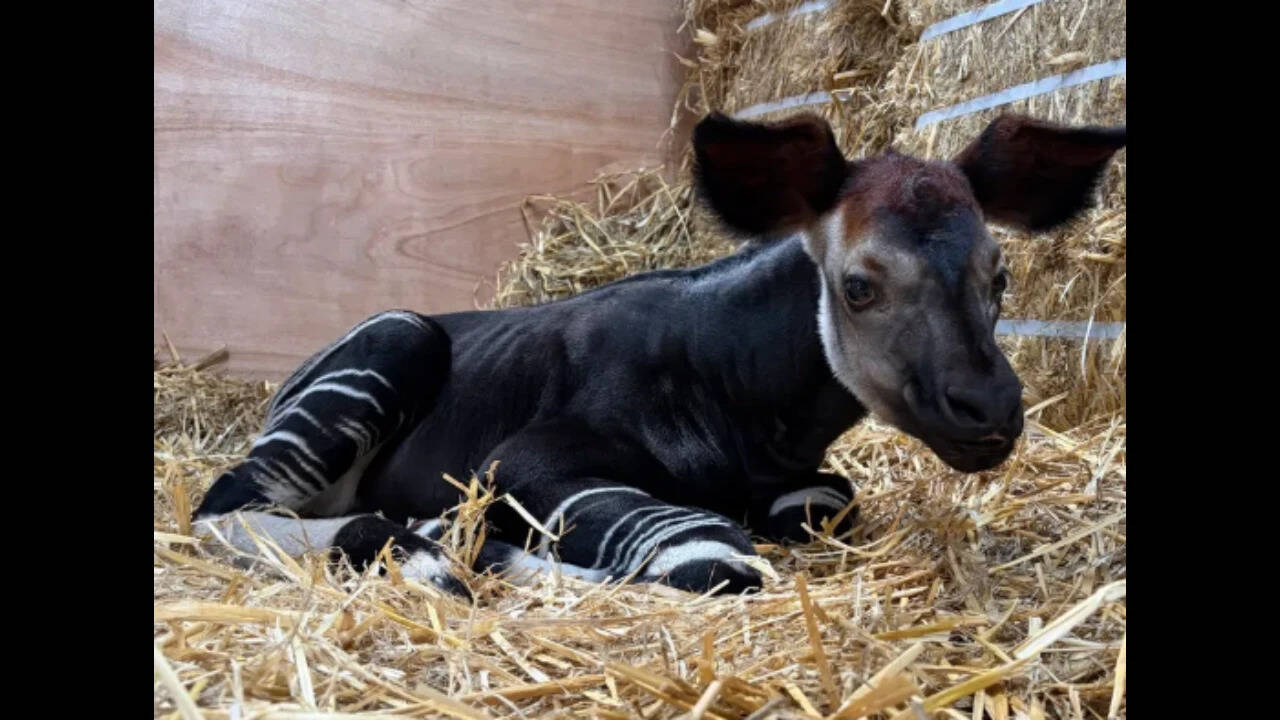
The birth of Southeast Asia's first okapi calf at the Singapore Zoo is less a standard zoological milestone and more a stress test of multi-variable captive management under strict geographical and climatic constraints. When an institution outside the species' native equatorial rainforest biome successfully reproduces Okapia johnstoni, it exposes the hidden mechanical inputs required to override evolutionary geography. Understanding this event demands shifting away from sensationalist novelty and examining the biological cost functions, environmental simulation matrices, and captive population dynamics that govern the survival of this rare forest ungulate.
The Evolutionary Mismatch of Ex-Situ Conservation
To evaluate the Singapore birth, one must first dissect the fundamental mismatch between the okapi's native ecology and the structural reality of modern zoological facilities. Endemic exclusively to the dense tropical rainforests of the Democratic Republic of the Congo, the okapi is an obligate browser adapted to a hyper-specific niche.
The animal's baseline operating parameters include:
- High relative humidity that prevents respiratory irritation and skin desiccation.
- A dense multi-tiered canopy filter that minimizes direct ultraviolet radiation exposure.
- An acoustic ecology defined by low-frequency infrasonic communication adapted to absorb dense foliage.
- A fragmented, highly specialized diet consisting of hundreds of distinct understory plant species, ferns, fungi, and fruit.
Relocating these parameters to a facility in Singapore requires an intensive engineering and husbandry apparatus. The island's equatorial climate shares a baseline thermal profile with the Congo Basin, but urban heat island effects, municipal noise pollution, and constrained spatial footprints introduce severe operational friction. Captive breeding programs cannot rely on environmental coincidence; they require artificial replication of the understory microclimate, precise nutritional substitution for missing endemic browse species, and rigorous behavioral monitoring to mitigate the chronic stress responses typical of solitary ruminants placed in semi-enclosed enclosures.
The Energetics of Ruminant Reproduction in Confinement
Reproduction in Okapia johnstoni is an extraordinarily high-stakes biological investment. With a gestation period averaging roughly 425 to 450 days—among the longest of any ungulate relative to its body size—the metabolic cost borne by the dam is immense. In a wild setting, energy allocation during this prolonged gestation is modulated by the animal's ability to selectively forage across vast territorial ranges, optimizing nutrient intake against energy expenditure.
In captivity, this dynamic inverts. The animal trades spatial freedom for guaranteed caloric input, but this introduces a secondary risk vector: nutritional imbalance and sedentary metabolic decline. The successful birth of the Singapore calf indicates that the husbandry team effectively solved the gestation energy equation through precision diet formulation. Because the exact botanical composition of Congolese forest undergrowth cannot be replicated abroad, keepers must substitute imported or locally cultivated browse that matches the precise crude protein, neutral detergent fiber, and secondary plant metabolite ratios required by a foregut fermenter.
The biological mechanics of the neonatal phase further compound this difficulty. Okapi calves exhibit a unique developmental strategy: they engage in a prolonged "parking" phase, remaining hidden in a dense nest or shelter while the mother ranges away to feed. In a zoo environment, replicating a safe, low-stimulus parking zone within a public-facing enclosure requires architectural interventions that shield the neonate from acoustic and visual stressors without compromising veterinary observation protocols. A failure in this balance triggers maternal abandonment or accidental trampling—the leading causes of neonatal mortality in captive artiodactyls.
Demographic Bottlenecks and Global Studbook Architecture
The strategic significance of a regional first birth extends far beyond local public engagement metrics. Globally, the okapi population managed under professional human care operates as a single, highly coordinated metapopulation governed by international studbooks and Species Survival Plans.
When a regional studbook—in this case, coordinated through regional association frameworks within the region—expands its geographic breeding footprint, it achieves three distinct structural advantages:
- Risk Diversification: Distributing the global captive population across multiple independent geographic nodes protects the species against localized catastrophic events, including epizootic disease outbreaks, regional political instability, or infrastructure failures at primary holdings.
- Gene Flow Optimization: Introducing new regional breeding centers broadens the global demographic pool, reducing the long-term coefficient of inbreeding and preserving genetic variance across generations.
- Operational Competency Diffusion: Successfully rearing a calf in a novel climate institutionalizes specialized husbandry techniques, creating a codified operational blueprint that can be exported to other tropical or sub-tropical facilities facing similar environmental variables.
Despite these advantages, captive management remains bounded by finite carrying capacities. Zoos are not infinite reserves; every birth must be weighed against institutional holding capacity, transfer logistics across international quarantine frameworks, and the long-term genetic assignments dictated by the global species coordinator.
The Conservation Fallacy of Ex-Situ Insurance
A critical error in public discourse surrounding zoo births is the conflation of captive propagation with ecological conservation. Maintaining a stable, reproducing population of okapis in Singapore or San Diego does nothing to alter the downward trajectory of the species in its native habitat.
The primary threats to Okapia johnstoni in the Ituri Forest are systemic and external:
- Unchecked artisanal coltan and gold mining that drives deforestation and heavy metal soil contamination.
- Bushmeat poaching utilizing indiscriminate wire snares that trap okapis alongside primary target species.
- Civil conflict and militia presence that restrict researcher access and prevent effective wildlife law enforcement within protected areas like the Maiko National Park and the Okapi Wildlife Reserve.
Captive populations function strictly as a biological insurance policy against total extinction, not as a restoration mechanism for compromised wild ecosystems. Reintroduction of captive-bred okapis into the Congo Basin is neither currently feasible nor biologically prudent given the persistence of the underlying threat vectors. Until the security and socio-economic integrity of the native range are stabilized, the species remains ecologically tethered to the artificial life support of global zoological institutions.
Institutional Allocation for Regional Breeding Success
[Environmental Inputs] ---> [Microclimate Engineering] ---> [Nutritional Substitution]
                                                                      |
[Global Studbook]      <--- [Neonate Behavioral Shielding] <---+
        |
        v
[Metapopulation Resilience]
To replicate the operational conditions that yielded Southeast Asia's first okapi calf, an institution must commit to a multi-year resource allocation strategy.
The operational matrix requires:
- Acoustic Isolation Engineering: Designing perimeter barriers that absorb low-frequency city vibrations to prevent chronic cortisol elevation in pregnant females.
- Custom Browse Protocols: Establishing dedicated botanical gardens or import channels capable of supplying tannin-rich, high-fiber foliage year-round to support foregut fermentation without inducing ruminal acidosis.
- Redundant Veterinary Surveillance: Implementing 24-hour remote telemetry and thermal imaging during the final trimester to predict parturition windows down to the hour, minimizing human intervention during the vulnerable neonatal handoff.
Institutions lacking this level of infrastructural depth will continue to experience high perinatal mortality and low reproductive yield. The Singapore milestone demonstrates that while geography is an immutable constraint, rigorous physiological and environmental engineering can successfully translate an equatorial forest specialist into a globally distributed, resilient managed framework.