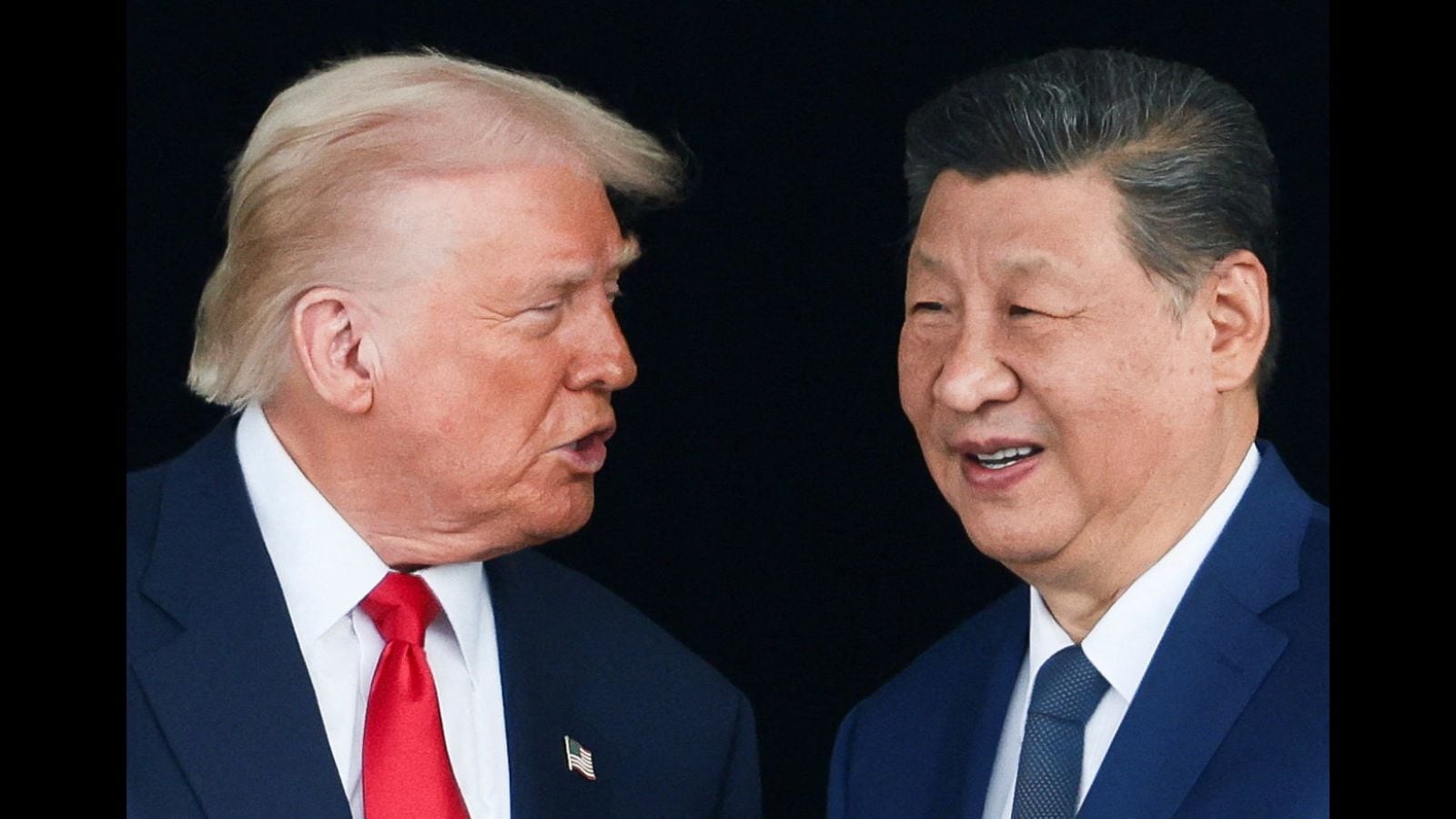
Bilateral trade summits between the United States and China do not fail or succeed inside the negotiating room; their outcomes are predetermined by domestic macroeconomic constraints and external geopolitical liabilities. Heading into the Washington summit between U.S. President Donald Trump and Chinese President Xi Jinping, the structural balance of power shifted decisively toward Beijing. Rather than forcing structural concessions through unilateral tariff pressure, Washington entered talks constrained by declining domestic approval ratings and the fiscal drag of an active conflict with Iran, while Beijing arrived insulated by a surging global export surplus.
To understand why high-profile summits routinely default to extending temporary trade truces rather than resolving foundational economic disputes, analysts must strip away diplomatic rhetoric and examine the underlying mechanics of asymmetric leverage.
The Three Pillars of Asymmetric Summit Leverage
When two major economies negotiate under conditions of strategic rivalry, bargaining power is governed by three measurable variables: external demand elasticity, domestic political insulation, and third-party geopolitical entanglement.
1. External Demand Elasticity and Trade Rerouting
Unilateral tariffs only function as a coercive tool if the targeted exporter lacks alternative markets or cannot reroute supply chains. Over the four months preceding the Washington meeting, China's trade engine accelerated toward another record global surplus despite sustained U.S. tariff campaigns.
The mechanism behind this resilience is geographic diversification and intermediate goods integration. When direct exports to the United States face tariff walls, Chinese manufacturers redirect finished goods to emerging markets, the European Union, and Southeast Asia, while exporting intermediate components to third-country assembly hubs. Because global demand absorbed China's manufacturing output—buoyed in part by global artificial intelligence infrastructure spending—Beijing experienced minimal net export contraction. An exporter whose aggregate trade surplus is expanding faces zero immediate pressure to alter its industrial policy.
2. Domestic Political Insulation vs. Electoral Sensitivity
Political systems dictate time horizons. A leader operating within an electoral cycle faces immediate penalties when trade friction or foreign conflicts compress household purchasing power. Ahead of the summit, U.S. domestic sentiment deteriorated under the dual weight of persistent consumer cost pressures and waning public support for military engagement with Iran.
In contrast, Beijing's governance structure insulates leadership from short-term electoral shocks, allowing Xi Jinping to subordinate immediate consumer stimulus to long-term industrial self-reliance. While China's domestic economy exhibited clear signs of weakness—including sluggish retail sales and an ongoing slump in fixed-asset investment—the leadership treated external trade surpluses as a buffer to buy time. When one negotiator requires an immediate, visible political victory to stabilize domestic standing and the other merely requires time to fortify domestic supply chains, the negotiator seeking immediate deliverables pays a premium.
3. Third-Party Geopolitical Entanglement
Bilateral trade negotiations never occur in a vacuum; secondary security crises routinely cannibalize economic bargaining chips. Washington's simultaneous involvement in a costly war with Iran created an acute strategic vulnerability. Because China maintains significant diplomatic and economic influence over Tehran, the White House viewed Beijing as one of the few external actors capable of pressuring Iran toward de-escalation.
This dynamic alters the payoff matrix of a trade summit:
- Washington's Objective Function: Secure economic stability at home while extracting diplomatic cooperation on Iran.
- Beijing's Objective Function: Maintain tariff stability to protect export cash flows while using Washington's need for diplomatic assistance on Iran to extract concessions on core sovereign priorities, specifically Taiwan.
Once a superpower links a regional security crisis to a bilateral trade negotiation, the counterparty gains cross-domain leverage. Beijing did not need to offer structural economic reforms when it could trade marginal diplomatic influence in the Middle East for softened U.S. rhetoric or policy adjustments in the Indo-Pacific.
The Cost Function of Unilateral Tariff Campaigns
The failure of unilateral tariffs to compel structural reform in Beijing illustrates a fundamental flaw in trade coercion theory. Policy architects often assume that imposing tariffs inflicts linear, localized pain on the target economy. In practice, tariffs operate as a tax on bilateral friction that triggers four distinct second-order effects:
- Supply Chain Arbitrage: Rather than reshoring manufacturing to the tariff-imposing nation, multinational firms shift final assembly to non-tariffed jurisdictions (such as Vietnam, Mexico, or India) that remain heavily reliant on Chinese inputs and machinery. The bilateral trade deficit narrows on paper while structural dependence on Chinese upstream manufacturing deepens.
- Input Cost Inflation: Tariffs on industrial components, rare-earth magnets, and intermediate goods raise production costs for domestic manufacturers in the imposing country, eroding their export competitiveness and compressing corporate margins.
- Retaliatory Precision: Targeted economies rarely respond with blunt, symmetrical tariffs. Instead, they weaponize choke points—such as tightening export controls on critical minerals, rare earths, or pharmaceutical precursors—to inflict maximum operational disruption on specific, politically sensitive industries in the opposing nation.
- Macroeconomic Divergence: When the tariff-imposing nation simultaneously runs large fiscal deficits or funds overseas military operations, higher import costs compound inflationary pressures, restricting the central bank's ability to ease monetary policy.
The operational reality is straightforward: unilateral pressure without multilateral coordination simply subsidizes third-party trade hubs while leaving the target's core industrial capacity intact.
Issue Linkage and the Bargaining Matrix
In high-stakes summits where neither side intends to overhaul its economic model, negotiations devolve into transactional issue linkage. Each administration brings a distinct inventory of low-cost concessions and high-value demands.
What Beijing Offers vs. What Beijing Demands
Beijing's negotiating playbook relies on offering reversible, high-visibility commercial commitments in exchange for durable geopolitical or tariff relief.
- Low-Cost Concessions: Committing to bulk purchases of U.S. agricultural commodities (such as soybeans), signing letters of intent for commercial aircraft (Boeing), or tightening regulatory enforcement on fentanyl precursor chemicals. These measures generate immediate headlines for the U.S. administration without altering China's state-subsidized manufacturing model. Furthermore, agricultural purchase commitments remain entirely reversible; if Washington fails to deliver reciprocal tariff reductions, Beijing can quietly slow customs clearances or let state-backed buyers pivot back to South American suppliers.
- Core Demands: Extending the bilateral trade truce to prevent new tariff escalations, rolling back existing duties, and pressuring Washington to moderate its military and diplomatic support for Taiwan.
What Washington Offers vs. What Washington Demands
Washington's negotiating position is constrained by the gap between its maximalist structural goals and its immediate political requirements.
- Core Demands: Reciprocal market access, reductions in Chinese industrial overcapacity, verifiable enforcement against fentanyl precursor exports, and Chinese diplomatic pressure on Tehran to wind down hostilities.
- Constrained Concessions: Because re-escalating tariffs risks triggering a supply shock and further depressing domestic approval ratings ahead of midterm elections, Washington's primary offering is restraint—agreeing to extend an existing gentleman's agreement on tariff freezes and exploring targeted tariff-reduction packages.
Why Trade Truces Outlast Structural Agreements
A recurring analytical error in financial journalism is framing the absence of a comprehensive trade treaty as a diplomatic failure. From a game-theoretic perspective, an indefinite series of short-term trade truces represents a stable Nash equilibrium when both superpowers prioritize domestic risk management over deep economic integration.
A comprehensive structural agreement requires intrusive verification mechanisms, binding dispute resolution, and fundamental changes to industrial subsidies—none of which Beijing will accept while actively building domestic technological self-reliance. Conversely, a total breakdown in talks triggers immediate market volatility, supply chain freezes, and inflationary spikes that Washington cannot absorb while managing a foreign conflict.
Extending a trade truce satisfies the minimum viable requirements of both leaders:
- It prevents an exogenous economic shock to global markets.
- It allows Xi Jinping to preserve export-driven cash flows while insulating China's economy for a post-Trump geopolitical environment.
- It allows Donald Trump to claim stability in bilateral relations while redirecting political bandwidth toward domestic economic pressures and Middle East conflict resolution.
Limitations of the Export-Led Insulation Strategy
While China's roaring trade engine provides undeniable diplomatic leverage in the short term, relying on external surpluses to offset internal weakness carries severe structural limitations. No macroeconomic strategy is immune to diminishing returns.
First, global absorption capacity is finite. As Chinese manufacturing captures an ever-larger share of global exports—pushing container export shares toward 40%—trade friction is no longer confined to Washington. The European Union, Latin American economies, and emerging Asian industrializers face mounting pressure to erect their own anti-dumping duties and protective tariffs to defend domestic manufacturing bases from underpriced Chinese imports.
Second, external surpluses mask domestic deflationary traps. When weak household consumption and collapsing real estate or fixed-asset investment force factories to dump excess capacity abroad at razor-thin margins, corporate profitability erodes. Exporting deflation stabilizes employment in the short run, but it fails to resolve the underlying imbalance between state-directed capital expenditure and weak domestic household income.
Third, choke-point retaliation invites accelerated decoupling. Utilizing export controls on rare earths or critical inputs during pre-summit posturing demonstrates immediate leverage, yet it simultaneously forces Western and Asian supply chains to subsidize alternative extraction and processing networks. Every deployment of supply-chain coercion permanently reduces the long-term elasticity of the target's dependence.
Strategic Positioning for Institutional Capital and Supply Chain Operators
Corporate leaders, supply chain strategists, and institutional investors must stop pricing U.S.-China summits as binary catalysts for either a grand geopolitical bargain or an immediate, catastrophic decoupling. The structural incentives of both Washington and Beijing lock the bilateral relationship into a regime of managed friction: periodic extensions of temporary tariff truces punctuated by targeted export controls and episodic agricultural purchase pledges.
Operational strategy must reflect this baseline reality through three concrete adjustments:
- Price Truces as Temporary Options, Not Permanent Policy: Treat any announced tariff freeze or reciprocal tariff-cut package as a 6-to-12-month operational window rather than a permanent restoration of free trade. Capital expenditure decisions cannot rely on bilateral goodwill that remains hostage to U.S. electoral cycles or third-party conflicts in the Middle East.
- Hedge Upstream Input Choke Points: Because Beijing retains asymmetric leverage over critical minerals, rare-earth magnets, and chemical precursors, procurement teams must qualify non-Chinese secondary suppliers for Tier-2 and Tier-3 components immediately—even at a 10% to 15% unit-cost premium—to insulate operations against pre-summit export restrictions.
- Reallocate Exposure Toward Non-Aligned Trade Corridors: As Chinese export volume increasingly bypasses direct U.S. entry in favor of third-country assembly and emerging-market distribution, logistics and financial infrastructure providers should overweight capacity along ASEAN, Latin American, and Middle Eastern trade lanes where bilateral capital flows continue to expand despite Washington's tariff walls.