The smell of a house fire does not wash out of your hair for weeks. It settles into the pores of your skin, clings to the roof of your mouth like wet pennies, and turns every breath into a reminder of the exact minute your life stopped being yours.
For anyone who has stood on a suburban curb in a borrowed sweatshirt at three in the morning, watching firefighters hack through a roof they spent fifteen years paying off, there is only one comforting thought left in the cold air. At least we are insured. At least the safety net we fed every single month, through lean winters and tight paychecks, is waiting beneath us.
Until the letter arrives. Not a check, and not a condolence, but a thick, certified envelope from a Special Investigations Unit informing you that the fire which stole your family photographs, your grandmother's quilt, and your roof was probably lit by your own hand.
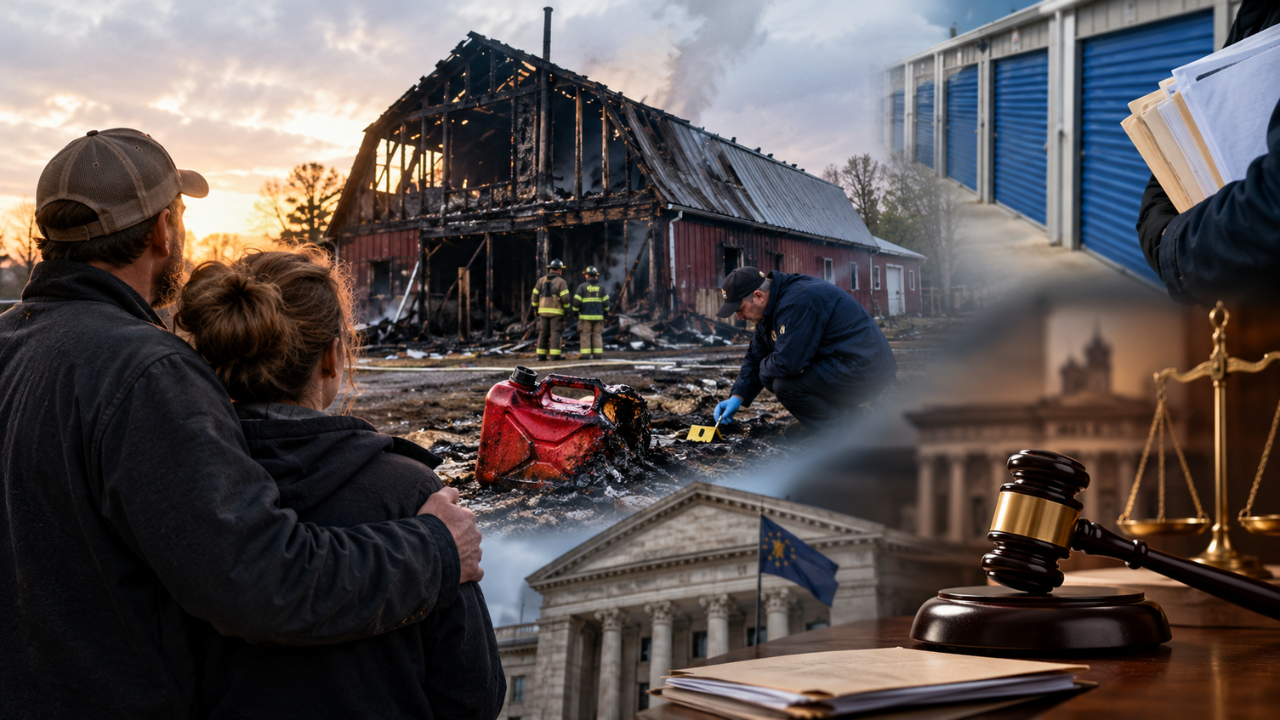
In Indiana, a married couple recently found themselves living inside that exact nightmare—and then, in a quiet appellate ruling that ought to rattle every homeowner in America, they won the right to fight back in front of a jury. Their fire insurance lawsuit, previously dismissed after their carrier denied their claim over suspected arson, was revived. On paper, it reads like a dry procedural update from a state court docket. In reality, it is a flare shot into the dark sky over a multi-billion-dollar industry's favorite escape hatch.
The Architecture of Doubt
To understand why an insurance company looks at a grieving homeowner and sees a felony suspect, you have to understand how modern property claims work when the numbers get big. A fender-bender costs a few thousand dollars; an adjuster cuts a check and moves on. A total-loss house fire costs hundreds of thousands, sometimes millions, once you tally structural rebuilding, personal property replacement, and temporary housing.
At that dollar threshold, the customer service smile disappears. In its place steps a parallel universe of forensic engineers, private investigators, and coverage attorneys whose entire job is to test a single hypothesis: did the policyholder burn this down for the money?
Consider a hypothetical scenario—let us call them Mark and Sarah, a composite drawn from dozens of real Midwest fire disputes—standing in the scorched skeleton of their living room two days after the fire department packed up its hoses. They are exhausted, terrified, and desperate to cooperate. When the insurance company's investigator asks for five years of bank statements, tax returns, cell phone records, and a four-hour recorded examination under oath, they hand everything over without calling a lawyer. Why wouldn't they? Innocent people have nothing to hide.
Except innocence, in the hands of a motivated claims department, is remarkably easy to rebrand as motive.
Did Mark carry a balance on two credit cards after a slow winter in construction? That becomes "severe financial distress." Did Sarah happen to move a box of family albums to her sister's garage the weekend before while cleaning out the basement? That becomes "removal of sentimental items prior to an intentional burn." Did an accelerant-detecting canine alert near the back porch where Mark kept a half-empty can of lawnmower gas? Suddenly, a mundane suburban garage habit transforms into physical evidence of arson.
Here is the secret that catches almost every policyholder off guard: an insurance company does not need to prove you committed arson beyond a reasonable doubt. They do not need the local prosecutor to file criminal charges. They do not even need a fire marshal to rule the blaze intentional. In a civil coverage dispute, a carrier only needs to convince a judge—or muddy the waters enough to survive summary judgment—that circumstantial indicators point toward an intentional act by the insured.
Motive. Opportunity. Incendiary origin. Three elastic words that can stretch around almost any working-class family's life if you pull hard enough.
What Happened in Indiana
The Indiana couple at the center of this revived lawsuit walked directly into that buzzsaw. After fire tore through their home, they filed the claim they had paid premiums to secure. Instead of rebuilding funds, they got an accusation. The insurer pointed to suspected arson, denied the claim outright, and left the couple stranded between a ruined house and a mortgage company that still expected its monthly payment on the first of the month.
When the couple sued for breach of contract and bad faith, the trial court initially sided with the insurer, shutting the courthouse doors before twelve citizens ever got to hear the full story. It is a move insurance defense lawyers execute with practiced precision: file a motion for summary judgment, stack circumstantial suspicions high enough to look like certainty, and convince a judge that no reasonable jury could find in the homeowner's favor.
The appellate court disagreed. By reviving the lawsuit, the judges underscored a foundational truth of American contract law that gets buried far too often beneath corporate paperwork. Suspicion is not proof. Circumstantial smoke is not a verdict. When an insurer accuses its own customer of a crime to avoid paying a valid policy, and the homeowner presents credible evidence disputing that theory, a judge cannot simply take the insurance company's word for it and send the family home empty-handed.
Think about what that reversal means in human terms. For months, perhaps years, that couple lived under a cloud that poisons everything it touches. Neighbors whisper when you walk to the mailbox. Friends hesitate before offering help, wondering privately if there is truth to the rumor. You carry the stigma of a crime you were never charged with, while simultaneously paying rent on an apartment and a mortgage on a pile of charred timber.
The Invisible Asymmetric War
If you have never dealt with a contested property claim, it is almost impossible to grasp how tilted the playing field is from the first hour after an emergency.
Think of an insurance policy not as a promise, but as an asymmetric war. On one side sits a corporation with actuarial tables, retained fire-origin experts who testify fifty times a year, in-house legal teams, and billions in reserve capital. Time is their ally. Every month they delay payment, they earn investment yield on the money they haven't paid you, while your savings bleed out on hotel rooms, rental deposits, and legal retainers.
On the other side sits you. You are traumatized. Your clothes are in a plastic trash bag. You do not know what "actual cash value" versus "replacement cost holdback" means, and you certainly do not know that a standard Homeowners 3 policy contains an "intentional acts" exclusion paired with a "concealment or fraud" clause that voids the entire contract if the insurer claims you misstated even a minor detail on a 40-page contents inventory.
Try this right now in your head: sit at your kitchen table and list every single item inside your bedroom closet, from the number of socks to the brand of your winter coat, along with the exact purchase date and original price. Now do it while suffering from acute sleep deprivation after losing everything you own. If you guess wrong on three items, an aggressive investigator can brand your entire inventory fraudulent and void your policy—even if they quietly drop the arson theory altogether.
It happens every single week across the country. According to industry fraud estimates frequently cited by the Coalition Against Insurance Fraud, property-casualty fraud costs tens of billions annually, and legitimate arson rings absolutely exist. Insurers have a real duty to protect honest policyholders from paying higher premiums to subsidize criminals. Nobody disputes that.
But somewhere along the way, a shield meant to stop fraud turned into a sword used against ordinary families whenever a claim gets inconveniently expensive. And the science used to swing that sword has a troubling history.
Ghosts of Junk Fire Science
For decades, fire investigation was treated less like chemistry and more like folklore. Investigators walked through burned structures looking for "pour patterns" on floors, "crazed glass" in windows, or "alligatoring" on charred wood—visual signs they swore proved someone had poured gasoline and struck a match. Hundreds of innocent people went to prison, and thousands more lost their insurance claims, based on those rules of thumb.
Then real scientists started burning test rooms in controlled laboratories. What they discovered humiliated an entire profession.
When a room reaches "flashover"—the terrifying moment when radiant heat ignites every combustible surface in the space simultaneously—normal household furniture creates the exact same burn patterns, melted glass, and floor charring that investigators had spent thirty years blaming on accelerants. In 1992, the National Fire Protection Association published NFPA 921, a landmark guide that forced fire investigation toward actual scientific method, demanding testable hypotheses and warning against jumping to arson conclusions from visual guesswork alone.
Yet thirty-plus years later, outdated assumptions still linger in private insurance investigations. An investigator hired by a carrier knows who signs the check. Even without overt corruption, confirmation bias is human nature: if you are paid to look for fraud, every anomalous burn mark looks like a clue, and every alternative explanation—an overloaded power strip behind a drywall seam, a faulty furnace igniter, an electrical arc in aging wiring—gets pushed to the margins of the report.
Once an insurer labels a fire "incendiary" or "undetermined with suspicious indicators," the burden shifts onto the homeowner in the most brutal way imaginable. You now have to hire your own certified fire investigator—at ten or fifteen thousand dollars out of pocket—just to prove that your house burned down by accident. If you are already broke from the fire, how do you pay for the science that proves your innocence?
Most people cannot. They take a fraction of what they are owed in a quiet, desperate settlement, or they walk away completely, broken by the process. That is precisely why cases like the Indiana couple's appeal matter far beyond state lines. Every time a court refuses to rubber-stamp a carrier's arson defense, it reminds insurers that denying a claim on suspicion carries real legal risk—including the threat of bad-faith damages that can dwarf the original policy limit.
How to Protect Yourself Before the Smoke Clears
Nobody reads their homeowners policy on a sunny Tuesday afternoon, and honestly, who could blame them? Those documents are written in dense, repetitive legalese designed to make your eyes glaze over by page four. Yet a few quiet habits, practiced before disaster ever strikes, can strip an insurer of its easiest weapons if you ever have to file a major claim.
First, treat your phone camera like an insurance policy of its own. Twice a year, walk slowly through every room of your house—opening closets, kitchen cabinets, garage shelves, and basement storage bins—while recording a continuous video. Narrate what you see. Mention brands, approximate ages, and serial numbers on electronics or tools. Upload that video to cloud storage outside your home. If a fire ever reduces your belongings to gray powder, that five-minute video turns a grueling memory test into undeniable visual proof.
Second, understand what happens the moment a major loss occurs. If fire, severe water damage, or a storm destroys your home, pause before giving recorded statements or signing blanket medical and financial authorizations. Be polite, report the loss promptly, and secure the property against further damage as your policy requires. Then, before sitting down for an examination under oath, consult an independent policyholder attorney or a licensed public adjuster—someone who works exclusively for you, never for insurance companies.
Third, document every single conversation in writing. When an adjuster makes a promise over the phone, follow up that afternoon with a brief email: "Thank you for speaking with me today. Per our conversation, I understand you are authorizing temporary housing through next month and sending an engineer on Thursday." Paper trails prevent convenient amnesia six months down the line.
Finally, never mistake an insurer's initial denial for the final word of the law. Insurance companies rely heavily on exhaustion. They count on policyholders hearing the word "denied," feeling a surge of shame or helplessness, and assuming a massive corporation must have the legal right to walk away.
The Quiet Courage of Refusing to Fold
Picture the kitchen table where that Indiana couple sat when the dismissal order first came down from the trial court. Imagine the silence in that room. You have already lost your home. You have been painted as an arsonist by the very company you trusted to protect your family. And now a judge has told you that you do not even get your day in front of a jury.
Most people would have quit right there. Nobody would have blamed them for quitting. Fighting an insurance company through an appeal takes money you do not have, patience that wears thin at two in the morning, and a stubborn refusal to let someone else write a lie as the final chapter of your life.
They appealed anyway. And when the higher court stripped away that premature dismissal and put their case back on track, something shifted—not just for two people in Indiana, but for every homeowner who pays a premium on time and expects the promise on the front page of the policy to mean something when the worst happens.
Smoke eventually clears from timber and brick, leaving behind a frame that can be scraped, primed, and rebuilt. Reputation takes longer. Trust takes longer still. Somewhere in Indiana right now, two people are gathering boxes of receipts, photographs, and expert reports, preparing to walk into a courtroom and look twelve strangers in the eye—finally able to tell the truth about the night their house burned down.