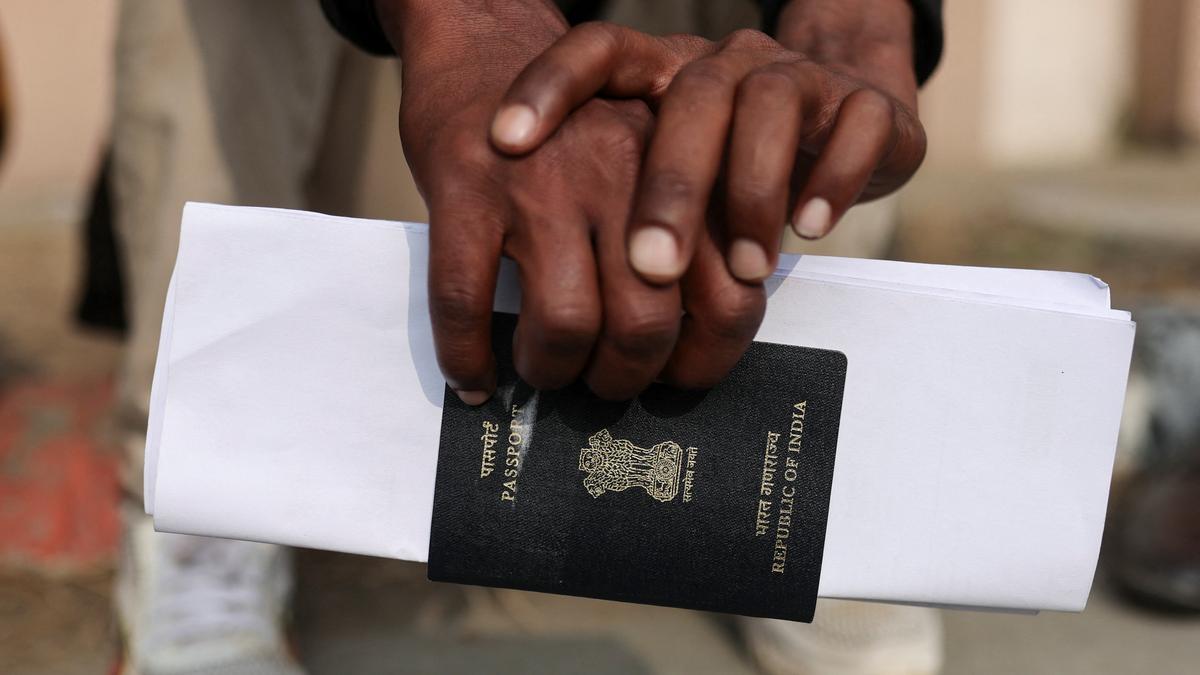
The boundaries of sovereign borders have expanded into corporate data centers. Under updated federal mandates, the U.S. Department of State and the Department of Homeland Security (DHS) have shifted from structural biographic verification to systemic behavioral analysis. For nonimmigrant visa categories—specifically student (F, M) and exchange (J) visas—applicants must not only catalog their five-year digital footprint but are also explicitly directed to alter their account privacy configurations to "public" during adjudication.
This operational shift transforms social media profiles from elective communication channels into mandatory legal disclosures. Evaluating this protocol requires an objective framework that maps the mechanisms of state data collection, the technical vulnerabilities introduced by forced public exposure, and the long-term asymmetry of data retention.
The Three Pillars of Digital Admissibility Screening
Consular screening of an applicant’s digital footprint relies on an explicit analytical matrix rather than arbitrary scanning. State agencies execute social media extraction to audit three foundational elements of admissibility:
1. The Cross-Platform Identity Attestation
Consular officers evaluate whether the applicant's real-world identity matches their digital persona. Discrepancies between submitted Form DS-160 biographic records and public account behavior create immediate operational friction. The state audits for data points such as:
- Temporal Location Alignments: Disparities between declared employment or educational residencies and geo-located metadata or status updates.
- Professional Identity Verification: Divergences between declared academic tracks or professional intents and publicly stated vocational activities.
2. Narrative Consistency and Fraud Extraction
The application narrative must maintain absolute structural coherence across all platforms. The primary mechanism here targets intent verification. For instance, a nonimmigrant student visa applicant who displays an active, explicit online pursuit of permanent U.S. employment violates the nonimmigrant intent clause dictated by Immigration and Nationality Act (INA) § 214(b).
3. Threat Matrix Screening
The automated and manual identification of markers that establish clear inadmissibility under national security provisions. This involves cross-referencing public statements, associations, and interactions with known watchlists, flagged organizations, or language indicating active hostility toward sovereign U.S. infrastructure.
The Privacy Cost Function: Network-Wide Exposure
The primary policy friction point is the transition from simple identifier disclosure (providing a username) to mandatory profile publicization. The systemic risk of this policy can be formulated as a compounded exposure problem. When an applicant shifts an account from private to public to satisfy a sovereign state's vetting requirement, they cannot selectively expose that data to government eyes only.
Total Exposure Risk = State Scrutiny + Commercial Scraping + Adversarial Targeting
The data architecture of modern social platforms means that toggling an account to "public" opens a data pipeline accessible by three distinct actors:
State Scrutiny
The state conducts targeted evaluation utilizing internal database systems such as the Consular Consolidated Database (CCD) alongside proprietary commercial data aggregators. While official screening guidelines assert that passwords, private messages, and unlisted platforms remain outside the scope of review, the public-facing timeline exposes extensive personal networks, historical geolocation histories, and relational affinities.
Open-Web Scraping and Commercial Aggregation
By forcing historically private timelines into the public domain, applicants expose their data to immediate ingestion by automated web crawlers and large language model (LLM) training scrapers. Once an account is indexed publicly, the historical data is permanently decentralized across external corporate caches, neutralizing the applicant’s ability to retroactively delete or secure that data.
Collateral Network Exposure
Social networks are inherently relational. The requirement for an individual to publicize an account automatically compromises the contextual privacy of their unchecked network. Comments, tags, associations, and shared imagery expose third-party individuals who are not subject to U.S. visa adjudication, mapping their affiliations without explicit consent.
The Structural Bottleneck of Administrative Processing
The introduction of behavioral screening scales linearly with processing delays. When automated tools or consular reviews flag a linguistic inconsistency or an ambiguous association, the application bypasses standard processing and enters a bottleneck known as Administrative Processing under INA § 221(g).
The core issue with algorithmic or manual behavioral analysis is the high rate of false positives driven by contextual blindness. Consular screening tools struggle to reliably parse:
- Sarcasm and Vernacular Nuance: Idiomatic expressions or regional satire can easily be flagged as explicit security threats or hostile intent.
- Historical Drift: A political or social statement made four years prior under a completely different geopolitical climate is evaluated against contemporary security heuristics, stripping the data point of its temporal context.
Once an application is relegated to Administrative Processing for digital vetting, the resolution timeline changes from a predictable weekly window to an indefinite timeline, often stretching across multiple months. This dynamic introduces severe execution risk for academic institutions and corporate sponsors who operate on rigid onboarding schedules.
The Long-Term Asymmetry of Data Retention
A critical operational detail overlooked by most applicants is the structural permanence of the captured data. Information surrendered during the visa application phase does not exist as a temporary session variable; it is permanently integrated into state immigration architecture.
The Department of Homeland Security records these social media handles, aliases, and associated screening results directly into an individual's Alien File (A-File). The data retention schedule for an A-File is structurally permanent, remaining active within government databases for up to 100 years from the date of file creation.
Consequently, a digital identifier provided for a temporary student visa remains linked to that individual's global identity profile across every subsequent interaction with U.S. immigration infrastructure—including future employment visas, border crossings, and potential naturalization pathways.
Strategic Action Plan for Digital Risk Management
Applicants navigating this heightened enforcement environment must approach their online footprint with analytical precision. To minimize the probability of administrative delays while preserving the integrity of their data, applicants should execute the following protocols:
Auditing and Verification
Execute an exhaustive audit of all personal digital properties spanning the mandatory five-year lookback period. Identify every handle, alias, and historical profile used across all platforms listed on Form DS-160. Absolute transparency is mandatory; omitting a known username constitutes material misrepresentation, which carries an automatic risk of permanent visa ineligibility.
Contextual Sanitization
Prior to submitting forms or altering account privacy statuses to public, evaluate existing public records for high-risk variables. Remove ambiguous or context-dependent content that could be misconstrued by automated linguistic processors or non-native consular reviewers. Avoid high-variance political or social commentary during the active adjudication window to prevent downstream profiling.
Account Access Integrity
Ensure robust operational security across all active accounts. Enable multi-factor authentication (MFA) to prevent unauthorized account modifications or malicious takeovers during the review period. Under no circumstances should an applicant provide passwords or direct authentication credentials, as official state vetting protocols explicitly restrict officers from demanding non-public access mechanisms.