The global artificial intelligence race has shifted from a pure engineering challenge to an institutional and diplomatic battleground. While the United States relies on proprietary frontier models protected by export controls, China has deployed a counter-strategy: open-weight software distribution paired with institutional networks.
This is not a philanthropic initiative; it is a calculated effort to establish a Chinese-led global technological framework. By analyzing the structural mechanics of China's "symphony of global collaboration", we can map how Beijing plans to bypass Western supply-chain choke points, establish international standards, and lock in the digital infrastructure of the Global South.
The Three Pillars of Chinas AI Power Projection
To understand the mechanics of China's technological diplomacy, we must separate the rhetorical positioning from the structural infrastructure. Beijing's strategy relies on three distinct, mutually reinforcing pillars designed to challenge U.S. hegemony in the field.
+-------------------------------------------------------------------+
|                  CHINA'S AI POWER PROJECTION                       |
+-------------------------------------------------------------------+
|  1. THE SOFTWARE PILLAR     |  2. THE INSTITUTIONAL PILLAR        |
|  - High-parameter open-weight|  - WAICO (29 Founding Nations)      |
|    models (e.g., Kimi K3)   |  - Bilateral training (5,000 slots) |
|  - Free, localized compute   |  - Standard-setting coalitions      |
+------------------------------+-------------------------------------+
|                     3. THE GEOPOLITICAL PILLAR                    |
|                     - Target: Global South (BRICS, ASEAN)         |
|                     - Alternative to U.S. "Pax Silica"            |
+-------------------------------------------------------------------+
1. The Open-Weight Software Arbitrage
The primary bottleneck for U.S. frontier AI firms is the capital expenditure required to train closed-source, proprietary models. These firms must monetize their IP through API access fees, locking users into American cloud infrastructure.
China's alternative is the rapid deployment of high-parameter open-weight models, such as Moonshot AI’s Kimi K3. By providing high-quality weights openly, China lowers the barrier to entry for foreign developers, particularly in resource-constrained environments.
The strategy creates a distinct structural path:
- Decoupling from Western APIs: Enterprises and governments in developing nations can run models locally on consumer-grade or mid-tier hardware, bypassing the need for accounts with OpenAI, Anthropic, or Google.
- Feedback Loops: Open-source distributions generate massive, globally diverse datasets as developers adapt the models to local languages and use cases. This data can flow back to Chinese developers, improving future model iterations.
- Dependency Locking: Once a nation's academic, government, and commercial sectors build their software stacks on Chinese model architectures, switching to a Western closed-source alternative becomes cost-prohibitive.
2. Institutional Framework Creation: WAICO
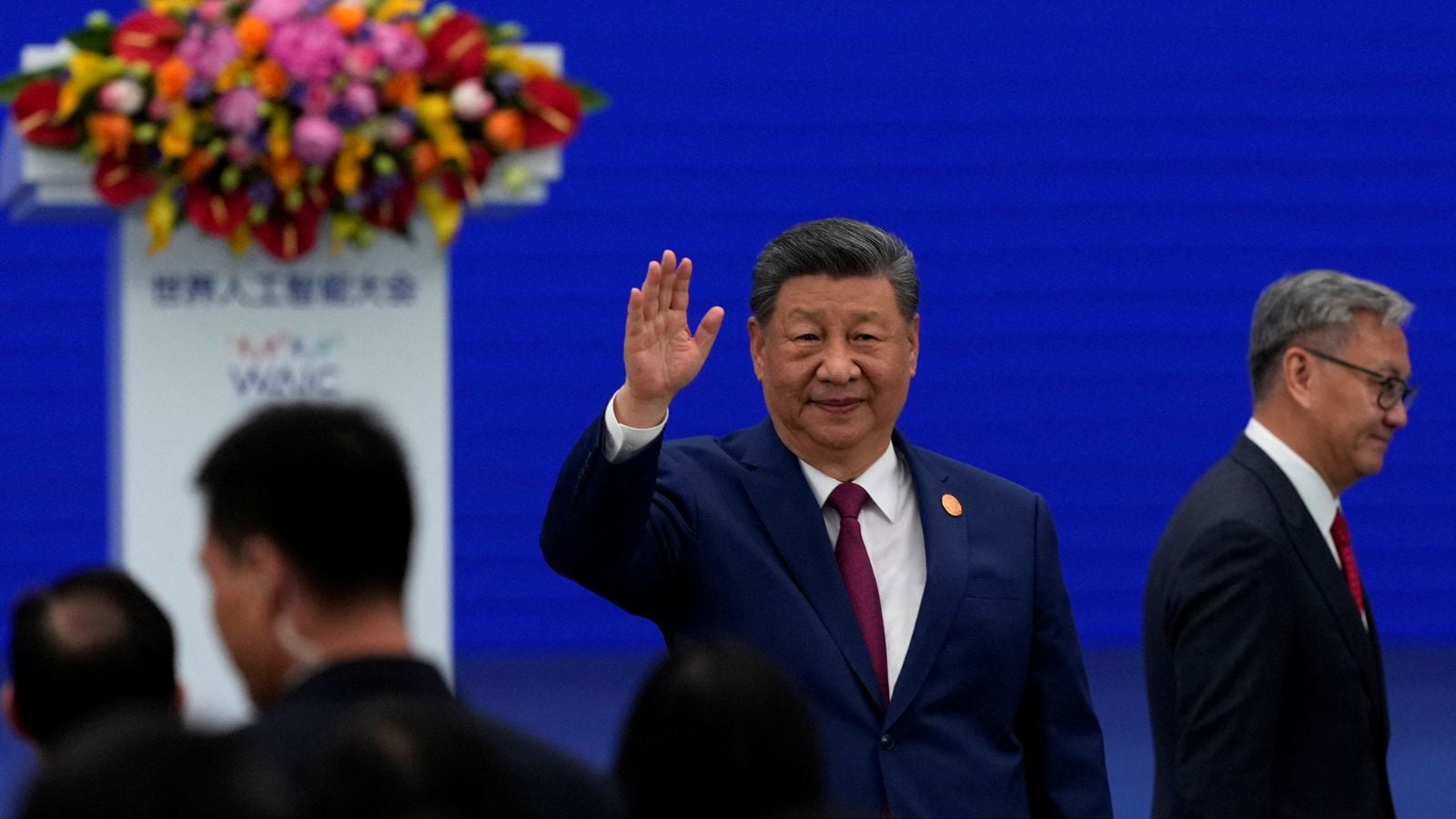
Rather than trying to join Western-dominated safety and governance forums, Beijing is building its own parallel institutions. The establishment of the World Artificial Intelligence Cooperation Organisation (WAICO) in Shanghai, with 29 founding member states (including Russia, Pakistan, and Indonesia), is a clear institutional play.
WAICO is designed to act as an alternative to the United Nations-led frameworks or Western-only alliances. It gives China a formal platform to write the rules of compliance, security, and safety. By hosting WAICO in Shanghai, China positions itself as the administrative and intellectual capital of AI governance for the developing world.
3. Diplomatic Capacity Building
The transfer of intellectual capital is a highly effective method for securing long-term geopolitical alignment. Beijing's commitment to provide 5,000 AI training opportunities to developing countries over the next five years, alongside specialized meteorological and early-warning AI tools, serves two functions:
- It trains a generation of foreign computer scientists, engineers, and policymakers to work within Chinese software ecosystems.
- It builds goodwill and diplomatic leverage within major voting blocs, including ASEAN, the African Union, and BRICS.
The Strategic Cost Function of Open-Source Diplomacy
The tension in China’s strategy lies in the trade-off between domestic security and global influence. This dynamic can be modeled as an optimization problem where Beijing must balance its geopolitical reach against the risk of losing domestic informational control.
$$J(\theta) = \alpha \cdot \text{Global Adoption}(\theta) - \beta \cdot \text{Information Security Risk}(\theta)$$
Where:
- $\theta$ represents the degree of openness and decentralization of Chinese AI models.
- $\text{Global Adoption}$ increases as models become more open, lightweight, and unrestricted.
- $\text{Information Security Risk}$ rises when models are distributed without guardrails, potentially allowing users to bypass content moderation, generate politically sensitive material, or use the models for unauthorized purposes.
The Domestic Security Bottleneck
This mathematical tension explains Beijing's dual-track behavior. While President Xi Jinping promotes "openness, collaboration, and sharing" on the global stage, domestic regulators are simultaneously weighing restrictions on overseas access to China's leading AI models.
If a Chinese open-weight model is distributed globally without strict alignment, it could be used in ways that violate Beijing's domestic censorship laws or security guidelines. Conversely, if the models are too heavily censored or locked down, they lose their competitive advantage against Western open-source models like Meta's LLaMA series.
Comparing the Competing Blocks: Pax Silica vs. WAICO
The global AI landscape has split into two distinct, competing alliances. Each block uses different mechanisms to project power, manage supply chains, and govern technology.
| Strategic Metric | U.S.-led "Pax Silica" | China-led "WAICO" |
|---|---|---|
| Primary Architecture | Closed-weight, API-first, cloud-dependent. | Open-weight, local deployment, edge-capable. |
| Governance Philosophy | Safety through restriction and compute-threshold monitoring. | Safety through human control and state sovereignty. |
| Hardware Dependency | Advanced TSMC silicon, ASML lithography. | Domestic legacy nodes, Huawei computing systems (e.g., Atlas). |
| Geographic Focus | G7, EU, Indo-Pacific allies (Japan, UK, Australia). | Global South, BRICS, ASEAN, African Union. |
| Monetization Model | SaaS subscriptions, enterprise cloud lock-in. | Infrastructure-for-resources, systemic integration. |
Strategic Bottlenecks in Chinas Global Plan
While the open-source strategy is structured to challenge U.S. dominance, it faces three critical bottlenecks that could limit its long-term viability.
1. The Compute Deficit
Advanced AI models require massive compute clusters for both training and iterative fine-tuning. U.S. export controls have limited China’s access to Nvidia’s latest chips. While Chinese firms have made progress using domestic hardware, like Huawei’s Atlas 950 SuperPoD, the efficiency gap remains a factor.
Training massive frontier models on less efficient, domestic hardware increases the capital expenditure and power requirements for Chinese labs, potentially slowing their development cycles.
2. The Alignment and Censorship Paradox
To maintain political control, Chinese AI models must strictly adhere to state-approved narratives. This requirement creates a technical challenge.
Hard-coding ideological constraints into a neural network's weights often degrades its general reasoning capabilities, a phenomenon known as the "alignment tax." If Chinese models must pay a high alignment tax to pass domestic security audits, they may lag behind Western models in complex, multi-step logical reasoning tasks.
3. The Trust Deficit in Sovereign Security
While Global South nations welcome low-cost technology, they remain cautious about sovereign surveillance.
Integrating Chinese AI models into government databases and critical infrastructure introduces national security considerations. If Western intelligence agencies successfully highlight backdoors or data-harvesting mechanisms within Chinese-distributed models, adoption rates among cautious neutral states could slow significantly.
The Strategic Playbook for Global Technology Firms
For multinational technology firms and policymakers navigating this divided ecosystem, neutrality is becoming increasingly difficult to maintain. Organizations must adapt to a bifurcated market by implementing specific operational strategies:
- Implement Hybrid Model Architectures: To mitigate geopolitical risks, enterprises should design their AI software stacks to be model-agnostic. Relying on middleware that can easily swap between Western closed-source APIs and Chinese open-weight models prevents lock-in to either ecosystem.
- Establish Regional Data Sovereignty: To navigate the competing regulatory demands of the U.S. and China, organizations must deploy localized data environments. Compute and data storage should remain within local jurisdictions, using open-weight models run on local hardware to prevent unauthorized data transfers.
- Prepare for Hardware Fragmentations: Firms operating in the Global South should optimize their software to run on heterogeneous compute environments. This means ensuring that AI workloads can run on both Nvidia-dominated Western clouds and Chinese-engineered local hardware clusters.