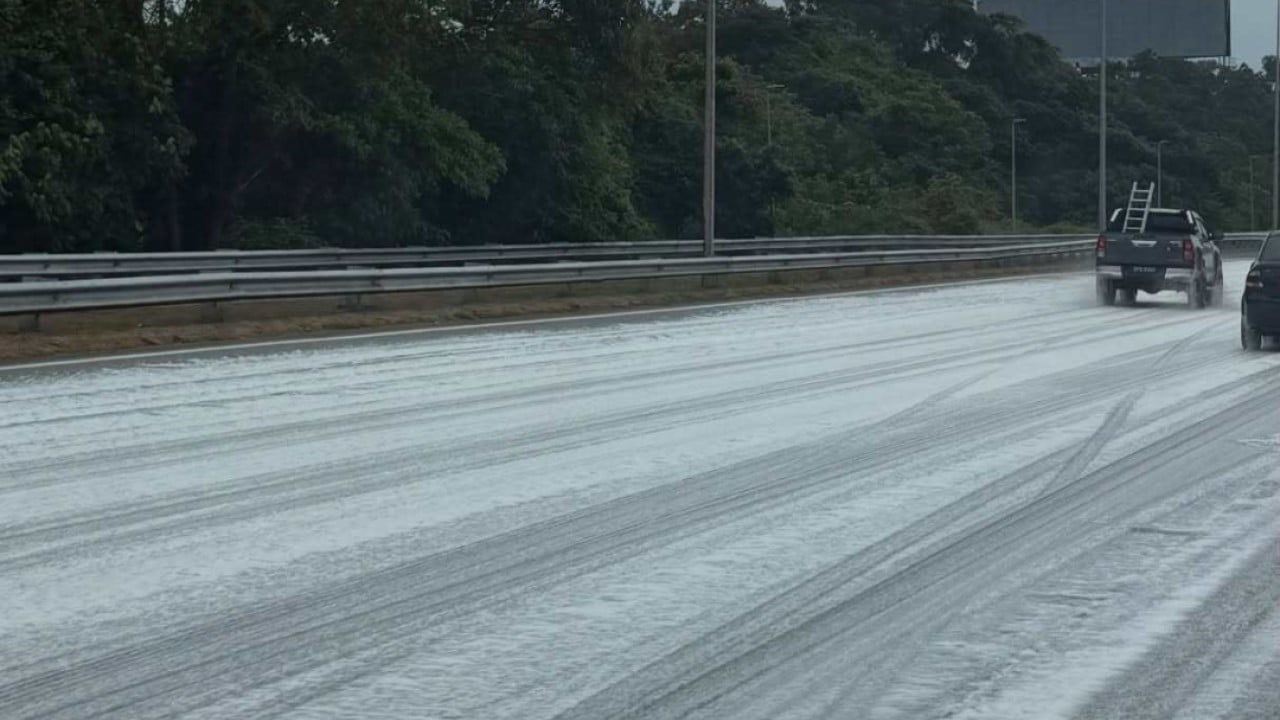
When a localized weather anomaly or environmental mishap goes viral, public perception rarely aligns with physical reality. Recently, social media networks amplified claims of snow falling on a Malaysian highway, capturing widespread attention before fact-checkers intervened to reveal a mundane, synthetic origin: industrial foam from a spillage or cleaning operation.
This dynamic illustrates a predictable failure mode in modern information processing. Observers confuse surface-level sensory data with underlying physical mechanisms, and algorithms reward the resulting cognitive dissonance. Analyzing this phenomenon requires deconstructing how sensational visual stimuli override baseline probabilistic reasoning, why municipal infrastructure vulnerabilities invite such incidents, and how digital ecosystems accelerate cognitive capture.
The Cognitive Mechanics of Visual Misattribution
Human sensory processing relies heavily on pattern matching under conditions of high uncertainty. When presented with a novel visual input—such as white, particulate matter accumulating on an asphalt surface in a tropical climate—the brain searches internal heuristics for a match.
For audiences in equatorial regions, snow represents an exotic, highly salient weather event. The rarity of the phenomenon heavily skews prior probabilities. Because actual snowfall in Malaysia is physically impossible under standard meteorological conditions, a rational observer should assign a near-zero probability to the hypothesis of natural precipitation.
Instead, viral content short-circuits this Bayesian updating process through emotional resonance and cognitive priming.
- Salience Bias: Exceptional visual stimuli override mundane explanations. White foam looks remarkably like fresh powder when filmed through a compressed mobile phone camera at night.
- Authority Vacuum: Early video uploads characteristically lack contextual metadata, GPS tags, or environmental measurements (such as ambient temperature and humidity).
- Confirmation Incentives: Viewers prioritize the entertainment value of an impossible anomaly over the tedious reality of an environmental hazard.
This creates an analytical blind spot. The audience does not evaluate the claim based on the laws of thermodynamics or regional climatology; they evaluate it based on emotional novelty.
The Infrastructure Vulnerability Matrix
The physical origin of the Malaysian highway incident points to operational failures rather than meteorological events. Foam accumulation on roadways typically stems from specific, identifiable industrial or maintenance protocols gone wrong.
Understanding these physical vectors transforms an inexplicable viral anomaly into a standard mechanical failure mode:
- Surfactant Transport Failures: Transport vehicles carrying concentrated detergents, firefighting foam, or industrial cleaning agents frequently experience containment breaches during transit. When these compounds mix with road moisture and high-velocity vehicle turbulence, they generate voluminous, persistent suds.
- Drainage System Saturation: Tropical downpours require high-capacity urban drainage. When blocked culverts interact with accidental chemical releases, the resulting mixture cannot dissipate efficiently, forcing foam onto the driving surface.
- Friction Dynamics: Unlike water, which reduces traction predictably via hydroplaning, industrial foam introduces a viscoelastic boundary layer between tires and asphalt. This creates a severe safety hazard that resembles black ice in its unpredictability, forcing emergency braking maneuvers that compound traffic chaos.
Municipal authorities frequently misdiagnose these events during the initial response window. Because the visual presentation mimics winter weather, first responders often focus on traffic management rather than chemical containment, inadvertently allowing the substance to disperse further and fuel secondary online speculation.
Algorithmic Amplification Loops
Digital distribution platforms are structurally optimized to reward high-arousal content. An improbable event—real or fabricated—generates a steep trajectory of engagement metrics that traditional news cycles cannot match.
The distribution architecture relies on an escalation feedback loop:
- Initial Frictionless Sharing: Users upload unverified clips to short-form video platforms without geographical or physical context.
- Algorithmic Acceleration: High initial comment velocity—driven by debates over whether the substance is real snow—signals high user engagement to recommendation engines.
- Reach Maximization: The platform distributes the content to wider demographics who possess even less contextual awareness of regional weather patterns.
- Correction Lag: Verified debunks generated by meteorological agencies travel slower and retain lower emotional valence than the initial sensation, ensuring the correction reaches only a fraction of the original audience.
This structural asymmetry means that factual accuracy operates at a severe distribution disadvantage. The economic incentives of digital platforms reward the propagation of ambiguity.
Strategic Operational Response
Mitigating the systemic risks posed by viral misinformation and industrial spills requires a coordinated institutional framework. Agencies can no longer treat public misinterpretation as an isolated communications challenge; it must be managed as an operational hazard with direct impacts on public safety and economic productivity.
First, municipal response teams must institute rapid-response protocols that prioritize empirical data over narrative management. Deploying immediate environmental testing kits to verify surface chemical compositions prevents the window of speculation from opening.
Second, transportation ministries must enforce stricter containment regulations on vehicles hauling high-foaming agents through high-density urban corridors. The cost of a containment failure extends beyond environmental remediation; it includes the economic friction generated by millions of distracted digital consumers misallocating attention to fabricated meteorological anomalies.
The ultimate safeguard against digital contagion is not post-hoc fact-checking, but an institutional commitment to operational transparency that renders anomalies immediately explicable before they reach a global audience.