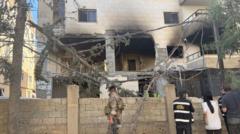
The Israeli airstrike on the Choueifat district south of Beirut breaks a three-week operational pause in the Lebanese capital, fundamentally altering the strategic equilibrium established by the April 17 Washington-brokered ceasefire. While casual observers view the kinetic action as an isolated "targeted strike," rigorous military analysis reveals it as a calibrated execution of theater-wide escalatory pressure.
The operation targets the command architecture of regional proxy forces immediately prior to high-level diplomatic renegotiations in Washington. By analyzing the structural mechanics of this strike, the breakdown of ceasefire boundary constraints, and the asymmetric friction of unmanned aerial vehicle (UAV) warfare, we can map the precise calculations governing this theater.
The Tri-Lateral Framework of Kinetic Calibration
The decision to execute a precision strike within the capital perimeter, bypassing previous geographic restrictions, relies on three distinct operational variables. Israel's command structure balances tactical utility against diplomatic friction through a predictable calculus.
1. High-Value Target Asset Value vs. Diplomatic Friction
The primary variable dictating capital strikes is the strategic weight of the target. Israeli security sources indicate the operation targeted Ali al-Husseini, commander of the missile unit within the Imam Hussein Division—an Islamic Revolutionary Guard Corps (IRGC) Quds Force brigade integrated alongside Hezbollah.
Striking an asset of this caliber within a capital zone requires that the target's neutralizational value exceed the diplomatic capital expended by violating host-nation or intermediary red lines. This balance is formalized as:
$$V_{target} > C_{diplomatic} + R_{retaliation}$$
Where $V_{target}$ is the operational degradation of enemy capability, $C_{diplomatic}$ is the political cost imposed by allies, and $R_{retaliation}$ is the projected kinetic response.
2. Geopolitical Window Optimization
The timing of the strike occurs exactly one week before the fourth round of ambassador-level talks in Washington and one day prior to bilateral military assemblies at the Pentagon. Executing high-impact kinetic operations immediately preceding diplomatic forums serves as a leverage-maximization mechanism. It signals a willingness to expand the geographic scope of engagement if terms are not met, using localized violence to force structural concessions at the negotiating table.
3. Intelligence Freshness and Perishable Windows
Capital environments present dense human and signal landscapes. The operational window to strike a high-tier commander in a residential area like al-Ajniha al-Khamsa is highly perishable. When real-time signals intelligence (SIGINT) or human intelligence (HUMINT) confirms an asset's location to a specific apartment floor, the decision matrix shifts automatically toward execution, overriding broader theater-level pauses.
The Breakdown of Geometric Restraints
The April 17 ceasefire relied on geometric and geographic boundaries to maintain stability. The erosion of these physical thresholds explains why kinetic activity has expanded into a broader theater campaign.
[Southern Border] ---> [Litani River Line] ---> [Sidon/Tyre Corridor] ---> [Beirut Perimeter]
       ^                        ^                         ^                         ^
  Ground Incursion       Forward Operating         Deep Interdiction         High-Value Targeting
     (Expanded)            Bases Crossed                Strikes                  (Choueifat)
The Litani River historically served as the primary line of demarcation for de-escalation. Recent maneuvers demonstrate that Israel has crossed this threshold, establishing forward operating positions north of the river. This physical advancement breaks the spatial buffer, compressing reaction times for both defensive and offensive operations.
With ground forces pushing beyond the Litani, the rear echelons of the defense network—specifically in Tyre, Sidon, and the Bekaa Valley—have shifted from logistical safe zones to active combat areas. The Israeli Air Force struck more than 135 targets across these zones within a 24-hour window. This theater-wide expansion means that targeting an IRGC or Hezbollah asset in Beirut is no longer a major escalatory leap, but rather the logical extension of an ongoing, unrestricted deep-interdiction campaign.
The United States administration provided tacit approval for targeted operations against senior commanders across Lebanon, while issuing explicit private warnings against sustained infrastructural bombardment of Beirut proper. This policy creates a distinct operational distinction:
- Infrastructural Bombardment (Prohibited): Broad, destructive campaigns targeting civilian or dual-use logistics hubs, which would collapse ongoing diplomatic channels with regional backers.
- Precision Decapitation (Permitted): Highly localized, low-collateral kinetic actions targeting specific command-and-control personnel, viewed by international partners as legitimate counter-terrorism actions rather than open territorial warfare.
The Choueifat strike fits precisely within these boundaries. By utilizing low-yield, precision-guided munitions against a single apartment on the second floor of a residential building, Israel achieved its targeting objective while remaining just below the threshold that would trigger a complete collapse of international diplomatic support.
The Asymmetric Friction of Attrition
The intensification of the air campaign reflects a direct response to structural vulnerabilities exposed on the ground. Tactical shifts are driven by distinct asymmetric factors.
Hezbollah's adoption of first-person view (FPV) and fiber-optic guided exploding drones has introduced severe friction to Israeli forward lines. These platforms bypass traditional electronic warfare (EW) countermeasures. Because fiber-optic links are immune to radio frequency jamming, they maintain high-resolution video feeds and precise command telemetry until the moment of impact.
This technological adjustment has inflicted steady casualties on Israeli ground personnel, including a recent fatal strike on a soldier in northern Israel. Unable to mitigate this threat entirely through defensive jamming networks, Israel has pivoted toward aggressive offensive attrition. This approach targets the production, logistics, and command personnel responsible for these unmanned systems at their source.
The operational reality of this strategy introduces structural limits that prevent a decisive military resolution:
- The Displaced Population Bottleneck: The displacement of over one-fifth of the Lebanese population creates massive internal demographic pressures. As displaced families move northward into cities like Sidon and Beirut, military assets and civilian populations mix. This overlap inevitably increases civilian casualties during precision strikes, accelerating international diplomatic blowback.
- The Intelligence Satiation Limit: Executing over 135 precision strikes within 24 hours requires a massive amount of actionable target data. Maintaining this operational pace quickly depletes the military's pre-analyzed target database. This asset depletion forces reliance on real-time, lower-confidence data, which elevates the risk of mission failure or unintended collateral damage.
- The Sunk-Cost Dynamic of Proxy Warfare: Because the Imam Hussein Division and associated units are funded externally via transnational supply lines, localized structural damage does not break their financial or material model. The destruction of physical real estate or the neutralization of individual commanders does not fundamentally alter the adversary's long-term capacity to wage war, ensuring a continuous cycle of replacement and engagement.
Strategic Playbook and Theater Forecast
Based on the mechanics of the Choueifat strike and the expansion of operations past the Litani River, the theater is moving toward a defined tactical resolution rather than a sustained regional war.
Expect Israel to maintain an elevated kinetic posture over the next 72 hours, concentrating heavy airstrikes on logistical nodes in Tyre and the Bekaa Valley. This surge is designed to deplete frontline munitions caches and disrupt tactical communications immediately before the Washington talks begin.
By maximizing structural damage in the short term, Israel aims to enter negotiations from a position of clear strength, offering a reduction in strike frequency in exchange for a enforced, verifiable demilitarized zone north of the Litani River. Consequently, the Beirut strike should not be interpreted as the opening salvo of an uncontrolled war, but as a calculated exercise in coercive diplomacy executed through precision violence.