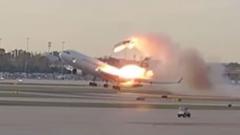
The mechanical detachment of a wing-mounted engine during takeoff represents the ultimate breach of transport category aircraft airworthiness. When United Parcel Service (UPS) Flight 2976, a McDonnell Douglas MD-11F, suffered a catastrophic structural failure on November 4, 2025, at Louisville Muhammad Ali International Airport (SDF), the event was immediately reductionised by mainstream media as a sudden, isolated tragedy. However, newly released National Transportation Safety Board (NTSB) surveillance footage and more than 2,000 pages of investigative documents expose a predictable chain of systemic maintenance omission, unreported metallurgical decay, and regulatory blindness. The physics of the disaster reveal that the ultimate crash was merely the final macro-level manifestation of a microscopic fatigue failure profile that had gone unaddressed for years.
Understanding the failure mechanism requires a rigorous examination of the aircraft's primary structural load paths, the historical maintenance data-logging gaps, and the severe aerodynamic control limitations imposed when a heavy widebody cargo transport loses symmetric thrust and hydraulic integrity simultaneously at rotation.
The Tri-Focal Load Path and Pylon Metallurgy
An aircraft engine pylon does not merely hang from a wing; it serves as the critical mechanical interface designed to transmit massive thrust, lift, and drag vectors into the primary wing box while isolating the fuselage from engine-induced harmonic vibrations. On the MD-11F, this interface relies on a precise geometry of steel and titanium fittings, centered on forward and aft mount lugs.
The NTSB metallurgical analysis isolates the root cause of the separation to a definitive fatigue failure profile within the left engine pylon's aft mount lug. This specific component is subjected to severe cyclic stress concentrations during every phase of flight, particularly during the transition from static thrust to maximum takeoff thrust. The engineering failure sequence progressed through three distinct phases.
- Microscopic Initiation: Fatigue cracks originated at the bore surface of the aft mount lug. Metallurgical inspection discovered that these fissures propagated over hundreds of flight cycles, driven by the stress spectrum of standard operations.
- Macro-Fracture Propagation: As the cracks grew, the effective cross-sectional area of the structural lug decreased, mathematically increasing the localized stress concentration according to the standard stress intensity formula:
$$K = \sigma \sqrt{\pi a} Y$$
Here, $\sigma$ represents the nominal applied stress, $a$ is the crack length, and $Y$ is a geometric boundary modification factor. As the crack length ($a$) surged, the localized stress intensity breached the fracture toughness threshold of the material.
- Unzipping Failure: During the takeoff roll, as the three General Electric CF6-80C2 engines reached maximum thrust configuration, the nominal load exceeded the residual strength of the compromised aft lug. The lug fractured cleanly, transferring the entire structural load instantaneously to the forward mounts. Under asymmetric, un-designed force vectors, the remaining pylon structure tore free from the wing box in a rapid, unzipping mechanical failure sequence.
The released surveillance footage illustrates the exact moment this structural threshold was breached. The engine did not simply stop producing thrust; it pivoted upward and outward, violently ripping away from the leading edge of the left wing, severing fuel lines and electrical looms, and generating a massive, immediate post-separation fireball.
The Communication Breakdown and Regulatory Blind Spots
The engineering failure did not happen in a vacuum. It was mirrored by a parallel failure in structural data governance and oversight. The NTSB investigative docket reveals a dangerous divergence between field-level maintenance observations and federal regulatory databases.
Two months prior to the fatal accident, the specific airframe involved, registration N259UP, was grounded for six weeks to address a cracked fuel tank. During this extensive maintenance intervention, technicians uncovered advanced corrosion along two critical structural beams within the fuselage, alongside structural anomalies within the engine mount assemblies. Under a optimized safety culture, these findings should have triggered an immediate, comprehensive non-destructive testing (NDT) inspection of all contiguous pylon fittings and a formal report to the Federal Aviation Administration (FAA).
Instead, the systemic breakdown occurred across three distinct operational layers.
Unreported Maintenance Flaws
The flaws discovered during cyclical maintenance checks were logged internally within the carrier's proprietary maintenance tracking systems but were never escalated into the FAA’s Service Difficulty Reporting (SDR) database. This lack of systemic reporting effectively masked a dangerous trend line from federal oversight.
Ignored Manufacturer Notifications
An NTSB investigator disclosed that as early as 2011, Boeing had issued an explicit service notice to operators flagging historical structural failures and potential pylon vulnerability on the aging MD-11 platform. The airline elected not to execute enhanced, voluntary ultrasonic or eddy-current inspections on the aft mount lugs, citing the fact that the manufacturer's notification was advisory rather than a mandatory Airworthiness Directive (AD).
Institutional Friction
The final systemic vulnerability was exacerbated by macro-environmental factors. The incident transpired during a federal government shutdown, a variable that severely curtailed the field-presence of FAA inspectors and restricted proactive regulatory audits. This created an operational bottleneck, leaving the carrier to self-police its fleet health during a period of peak logistical demand.
Aerodynamic Control Decay Under Asymmetric Conditions
When the left engine and its supporting pylon detached seconds after rotation, the flight crew was presented with a compound aerodynamic crisis that breached the edge of the aircraft's certifiable control envelope. Flight data recorder information indicates that the aircraft climbed to an absolute peak altitude of approximately 30 feet before control was lost.
The rapid decay of the aircraft's flight path was dictated by three immutable aerodynamic and mechanical constraints.
- Violent Thrust Asymmetry: The instantaneous loss of the number one engine at max takeoff power created an extreme, uncommanded yawing moment toward the dead engine. Because the engine tore away physically, it did not windmill cleanly; it altered the local wing chord geometry, destroying lift production on the outboard sections of the left wing.
- Total Hydraulic Depletion: The violent physical separation of the pylon tore through the leading-edge slats and severed the redundant hydraulic lines routed through the wing's front spar. In the MD-11, mechanical damage of this magnitude can exhaust system pressure rapidly, leading to a catastrophic drop in actuator authority for the ailerons and spoilers.
- Cascading Impact Vector: Deprived of sufficient hydraulic pressure and suffering from severe lift asymmetry, the aircraft entered an un-recoverable left roll. The left main landing gear struck the roof of a nearby supply chain warehouse, carving a 300-foot gash through the structure. This secondary impact induced further drag and structural destruction, causing the aircraft to roll past 90 degrees before impacting an auto scrap yard and a semi-truck parking area.
The total debris field expanded across 3,000 feet, driven by the massive kinetic energy of a fully fueled, maximum-takeoff-weight cargo transport. The crash claimed the lives of all three crew members on board and 12 individuals on the ground, making it the deadliest operational event in the history of the logistics provider.
Systematic Mandate for Fleet Management
The operational legacy of Flight 2976 lies in its immediate, industry-wide structural repercussions. Following the preliminary identification of metal fatigue in the aft mount lug, the carrier executed an immediate retirement of its remaining tri-jet widebody fleet in January 2026. This move highlights an industry-wide recognition that aging transport-category aircraft require exponential increases in maintenance capital to manage structural fatigue pathways safely.
For fleet operators managing legacy metal, the strategic play is no longer to rely on passive compliance with minimum regulatory standards. The data bottleneck between maintenance discovery and regulatory transparency must be closed through automated, real-time telemetry systems that upload localized NDT crack-propagation data directly to safety management systems. If an operator is managing airframes with high cyclic times, the cost function of continuous structural monitoring eventually outpaces the residual economic utility of the asset. The ultimate lesson of the Louisville disaster is that structural metallurgy remains indifferent to corporate logistics schedules; when microscopic cracks cross the critical fracture threshold, macro-level structural failure becomes an mathematical certainty. Operators must proactively ground aging fleets before physics makes the decision for them.