The infinite hum of fluorescent lights has a specific frequency. If you sit in an MIT engineering lab long enough, that hum stops being background noise and becomes a clock, ticking away the hours between midnight and dawn.
Most people see the triumphs of modern engineering from a distance. They see the polished drone effortlessly navigating a disaster zone, the autonomous vehicle smoothly merging into traffic, or the sleek medical device saving a life on an operating table. They read the press releases. They applaud the final product.
But they don't see the grease. They don't see the code that crashed four hundred times before it finally ran. They don't see the quiet desperation of a student staring at a pile of machined aluminum parts that refuse to fit together by a fraction of a millimeter.
This is where Avani Ahuja lives.
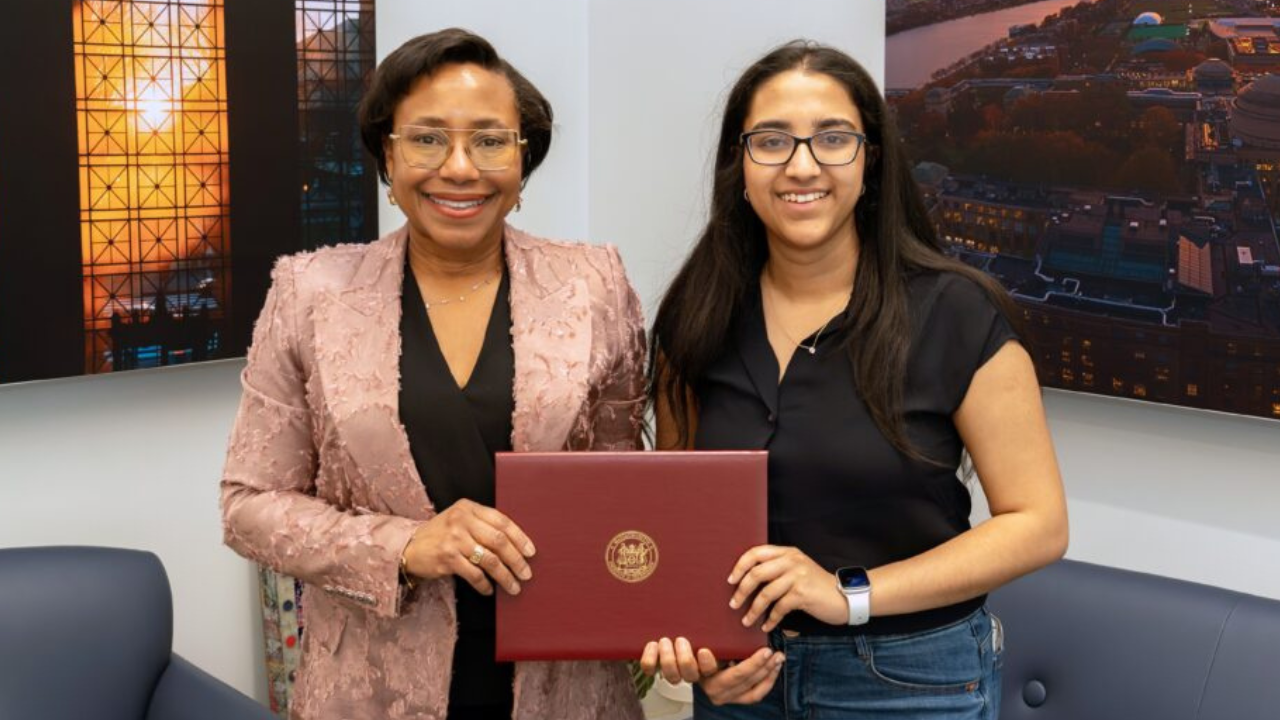
To the outside world, the narrative is neat, tidy, and wrapped in accolades. The headlines announce that Ahuja, an Indian-origin student at the Massachusetts Institute of Technology, has won the prestigious Henry Ford II Scholar Award. The honor is bestowed upon a senior who has demonstrated exceptional engineering excellence and leadership. It is a golden token of academic nobility, a signifier that the recipient is among the brightest minds of a generation.
Yet, reducing a human being to a list of achievements does a disservice to the actual grit it takes to earn them. The Henry Ford II Scholar Award isn't handed out for high test scores or impeccable attendance. It is forged in the grueling, unglamorous crucible of elite engineering. To truly understand why this matters, we have to look past the trophy and into the lab.
The Fiction of the Lone Genius
We have been conditioned by Hollywood to believe in a specific myth. We like the story of the lone eccentric who scribbles a complex mathematical formula on a chalkboard in the middle of the night, instantly solving a crisis.
It is a beautiful lie.
Modern engineering is a brutal sport of collective endurance. Consider a hypothetical scenario to ground this reality: imagine designing a robotic arm meant to assist in delicate surgeries. The mechanical engineer builds the physical structure. The electrical engineer designs the circuitry that feeds it power. The computer scientist writes the algorithms that translate a surgeon’s hand movements into mechanical motion.
If one of them fails to communicate, the machine does not just stall. It breaks. It might even harm someone.
This is where the distinction between a brilliant student and a true leader becomes stark. The academic world is filled with people who can solve equations in isolation. But the Henry Ford II Scholar Award looks for something rarer: the ability to bridge the gap between abstract mathematics and human collaboration.
Ahuja’s journey at MIT highlights a fundamental truth about the current trajectory of technology. We are no longer in an era where single breakthroughs define industries. Instead, we are in an era of integration. We are forcing separate disciplines—robotics, artificial intelligence, materials science—to speak the same language.
When you look at the track record of those who win this specific award, a pattern emerges. These are individuals who possess a rare dual sight. With one eye, they can peer into the microscopic mechanics of a system. With the other, they can look across a room of exhausted peers and figure out how to guide them through a technical dead end.
The Heavy Weight of the Invisible Ceiling
Step inside the Infinite Corridor at MIT during finals week. The air smells of stale coffee, ozone from the electronics shops, and the distinct, palpable anxiety of overachievers realizing they might have met their match.
For international students and those of diaspora communities, there is an added layer of invisible pressure. It is an unwritten expectation to not just succeed, but to justify the immense sacrifices made across generations to put them in that corridor in the first place. You carry the hopes of a family, perhaps an entire community, on your shoulders while trying to debug a real-time operating system.
It is easy to feel like an imposter when walking past the portraits of historical giants lining the university walls. The machinery of elite education can feel cold, mechanical, and indifferent to the human spirit.
That is why leadership in these spaces matters so deeply. It transforms the culture. When a student like Ahuja takes the helm of a complex engineering project, leadership isn't about giving orders from a podium. It is about empathy. It is about recognizing when a teammate is burning out, when a design flaw is a result of miscommunication rather than incompetence, and when to pivot a strategy before weeks of work are wasted.
Let's demystify what engineering excellence actually looks like on a Tuesday at 3:00 AM.
It looks like failure. Over and over again.
Imagine trying to optimize the thermal efficiency of a new battery housing. You run a simulation. The software predicts the housing will melt. You alter the lattice structure of the composite material. You run it again. The software predicts it will crack under structural stress. You change the alloy. The simulation crashes entirely.
This loop can repeat for days. It requires a specific kind of psychological resilience to wake up every morning, look at a mountain of data that tells you that you are wrong, and decide to climb it anyway. The Henry Ford II Scholar Award recognizes that specific, stubborn resilience.
Why the World Outside the Lab Should Care
It is easy for the average person to look at academic awards and dismiss them as insular. We think, Good for her, but how does that affect my life?
The answer is woven into the very fabric of your day.
Every time you cross a bridge, board an airplane, use a smartphone, or rely on a medical monitor, you are trusting your life to the decisions made by engineers years prior. You are trusting that the person who designed the system didn't cut corners when they were tired. You are trusting that the team leader listened when a junior engineer pointed out a flaw in the logic.
The stakes are remarkably high. As we push further into automation and autonomous systems, the ethical and practical responsibilities placed on engineers are growing exponentially. We are no longer just building tools; we are building systems that make decisions.
If the leaders of these projects are trained only in mathematics and not in humanity, the consequences can be catastrophic. Biased algorithms, fragile infrastructure, and technologies that prioritize efficiency over human safety are the direct results of detached engineering.
When an institution honors a student for both excellence and leadership, it is signaling what the future must look like. It is an acknowledgment that the technical elite must also be deeply grounded in the human element.
The Real Price of Excellence
We often celebrate the climax of the story—the handshake, the certificate, the applause, the flashing cameras. But the real story is found in the quiet moments that preceded the stage.
It is found in the sacrifices that never make it into the newsletter. The missed family gatherings because a prototype was delayed. The friendships put on hold. The physical toll of surviving on vending machine snacks and three hours of sleep because a deadline refused to move.
There is a vulnerability in pursuing something to this level of perfection. You have to care so much that the failures hurt. If you don't care, you can't build anything great. But if you do care, you open yourself up to the profound frustration of hitting walls that seem entirely unmovable.
Ahuja’s recognition is a milestone, certainly. But more than that, it is a reminder of what is possible when intellect is paired with the willingness to do the heavy lifting in the dark. It proves that the future of technology isn't just about cleaner code or faster processors. It is about the people who refuse to leave the lab until the problem is solved, not just for the sake of the machine, but for the sake of the world waiting outside the doors.
The ceremony ends. The banners are packed away. The press release moves down the news cycle, replaced by the next headline, the next breaking story, the next viral moment.
But back in the lab, the fluorescent lights keep humming. A new problem sits on the workbench, casting a long shadow under the stark white glare. There are no cameras here. There are no awards committees watching. There is only a blank screen, a pile of components, and the quiet, deliberate sound of a keyboard coming to life in the dark.