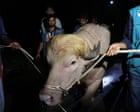
The economic value of livestock during the Eid al-Adha festival in Bangladesh is typically governed by a predictable commodity pricing model. Animals are priced based on carcass weight, body condition score, and structural soundness. This framework was disrupted when a 700-kilogram albino water buffalo, exhibiting a rare genetic mutation that produced a distinct blond hair tuft, a cream-colored body, and a pinkish nose, entered the Dhaka market.
Nicknamed "Donald Trump" by its initial breeder, Zia Uddin Mridha, due to its physical resemblance to the United States President, the animal transitioned from a agricultural commodity into a high-value memetic asset. The subsequent intervention by the Bangladesh Ministry of Home Affairs to halt its ritual slaughter and transfer it to the National Zoo in Dhaka provides a clear case study in how viral social media mechanics can completely override established religious, economic, and logistical frameworks.
The Biometric and Genetic Framework of High-Value Livestock
To understand how an animal breaks out of standard commodity pricing, one must first look at the baseline structural metrics of the Bangladeshi livestock market. During the Eid al-Adha trading season, the market handles approximately 12 million head of livestock. The standard valuation formula relies on clear physical metrics:
$$V = f(W, C, R)$$
Where:
- $V$ represents the market value.
- $W$ represents the total live weight (yielding roughly 55-60% dressed carcass weight).
- $C$ represents the body condition score (fat-to-muscle ratio).
- $R$ represents breed rarity or visual prestige.
Under standard conditions, dark-skinned water buffaloes dominate the market. The subject animal possessed a profound genetic anomaly: oculocutaneous albinism. This condition suppresses melanin production, resulting in a cream-colored coat and a blond tuft of hair.
This genetic rarity immediately spiked the variable $R$ in the valuation equation. Rarity, however, introduces a steep operational cost function. The biological maintenance of an albino buffalo requires a massive surge in labor and resource allocation due to its heightened vulnerability to solar radiation and cellular stress.
The Maintenance Cost Function of Albino Livestock
The operational data from the agro-farm in Keraniganj highlights a significant spike in daily upkeep costs:
- Thermoregulation Demands: The animal required four distinct baths daily to prevent heat stress, driven by the lower UV tolerance of albino skin.
- Nutritional Inputs: The feeding frequency was elevated to four structured meals per day to maintain metabolic stability and support its 700-kilogram mass.
- Labor Allocation: The high maintenance needs required a dedicated handler, shifting the production cost from a low-intervention model to a high-overhead asset strategy.
The Memetic Mechanics of Valuation
The transformation of this animal from a premium agricultural asset to a priceless cultural phenomenon occurred through rapid social media amplification. This process follows a precise multi-stage pipeline that changes how value is generated.
[Genetic Mutation: Albino/Blond]
       │
       ▼
[Anthropomorphic Labeling: "Donald Trump"]
       │
       ▼
[Social Media Hyper-Amplification]
       │
       ▼
[Foot Traffic Bottlenecks & Security Risk]
       │
       ▼
[State Intervention & Nationalization]
First, the asset underwent anthropomorphic labeling. The assignment of a high-profile political moniker anchored the animal's physical anomaly to a globally recognized visual brand. This labeling created an immediate hook for digital content creators.
Second, digital network effects took over. Algorithms on platforms like Facebook and TikTok prioritized video content of the animal due to high initial watch-time metrics and comment-section engagement. This created a positive feedback loop, driving exponential views.
Third, digital engagement transformed into physical foot traffic. The farm in Keraniganj faced a massive influx of visitors, turning a secure agricultural facility into an unmanaged, high-density public gathering space. This surge in visitors created a major operational bottleneck, disrupting local transit networks and overwhelming the farm's security infrastructure.
The Economics of State Intervention
When the buffalo was sold to a private buyer, Moniruz Zaman, for ritual slaughter, its market value hit an institutional ceiling. The transaction followed the traditional rules of private property transfer under religious frameworks. The state's decision to step in just hours before the scheduled sacrifice reveals a complex calculation of public safety and asset preservation.
The state's intervention was driven by a clear cost-benefit analysis:
State Decision Matrix:
──────────────────────────────────────────────────────────────────────────
Allow Sacrifice        ──► Low Short-Term Cost  ──► High Security Risk
                                                    (Crowd Control Failure)
──────────────────────────────────────────────────────────────────────────
Nationalize Asset      ──► High Financial Cost  ──► Risk Mitigation &
                           (Refund & Upkeep)        Long-Term Revenue
The Ministry of Home Affairs, led by Minister Salahuddin Ahmed, faced a clear security challenge. Allowing a highly public sacrifice of a viral phenomenon created a high probability of unmanageable crowds, civil friction, and potential public safety hazards at the slaughter site.
The state also recognized the long-term value of preserving a rare biological specimen. The Livestock Department noted that the animal was young and possessed several more years of reproductive and display viability. By stepping in, the state successfully mitigated immediate security risks while shifting a high-performing digital asset into the public portfolio.
Post-Acquisition Logistics and Institutional Risks
The relocation of a 700-kilogram viral asset to the Bangladesh National Zoo in Dhaka introduces complex operational challenges. Transitioning a high-maintenance animal from an agro-farm to a public exhibit requires strict risk management protocols.
Biosecurity and Quarantine Protocol
The primary operational risk during asset transfer is the introduction of pathogens to the zoo's existing livestock population. The National Zoo curator, Atiqur Rahman, established a strict two-week isolation protocol. This quarantine serves as a vital diagnostic window to monitor the animal for signs of stress-induced immunosuppression or underlying infections before it is introduced to the public.
Capital Allocation and Infrastructure Retrofitting
The zoo had to quickly adjust its budget and resources to accommodate the new animal. They built a dedicated, climate-controlled enclosure tailored to the buffalo's specific biological needs, including sun protection and specialized drainage for frequent baths. They also hired a full-time, dedicated caregiver, locking in ongoing operational costs to ensure the animal's safety and upkeep.
The Lifecycle of Attention and Revenue Extraction
The long-term value of this nationalization strategy depends entirely on the zoo's ability to turn short-term viral fame into sustained foot traffic and ticket revenue.
The zoo faces a distinct attention decay curve. The initial surge in visitors will inevitably drop off as the social media cycle shifts to new topics. To offset the high daily maintenance costs, the zoo must use structured crowd control, design informative exhibits around the animal's unique biology, and create branded educational merchandise to maximize returns before the viral interest fades.
Strategic Playbook for Viral Asset Management
The nationalization of this animal sets a clear precedent for how state institutions and agricultural enterprises should handle sudden, high-value viral trends in traditional commodity markets.
When an animal or asset experiences a massive surge in social media fame, traditional pricing models no longer apply. Agricultural operations must immediately pivot from standard volume-based sales to high-margin tourism and digital content monetization. This approach allows businesses to capture maximum value from the public interest while the trend is at its peak.
Concurrently, state agencies must establish clear protocols to handle the security and logistical challenges that come with viral trends. Rather than relying on last-minute interventions, regional authorities need structured frameworks to manage crowds at private properties, streamline asset-transfer and compensation processes, and safely transition unique animals into public institutions. This proactive strategy ensures public safety, protects rare biological specimens, and converts short-term internet fame into long-term civic and educational value.